By
By 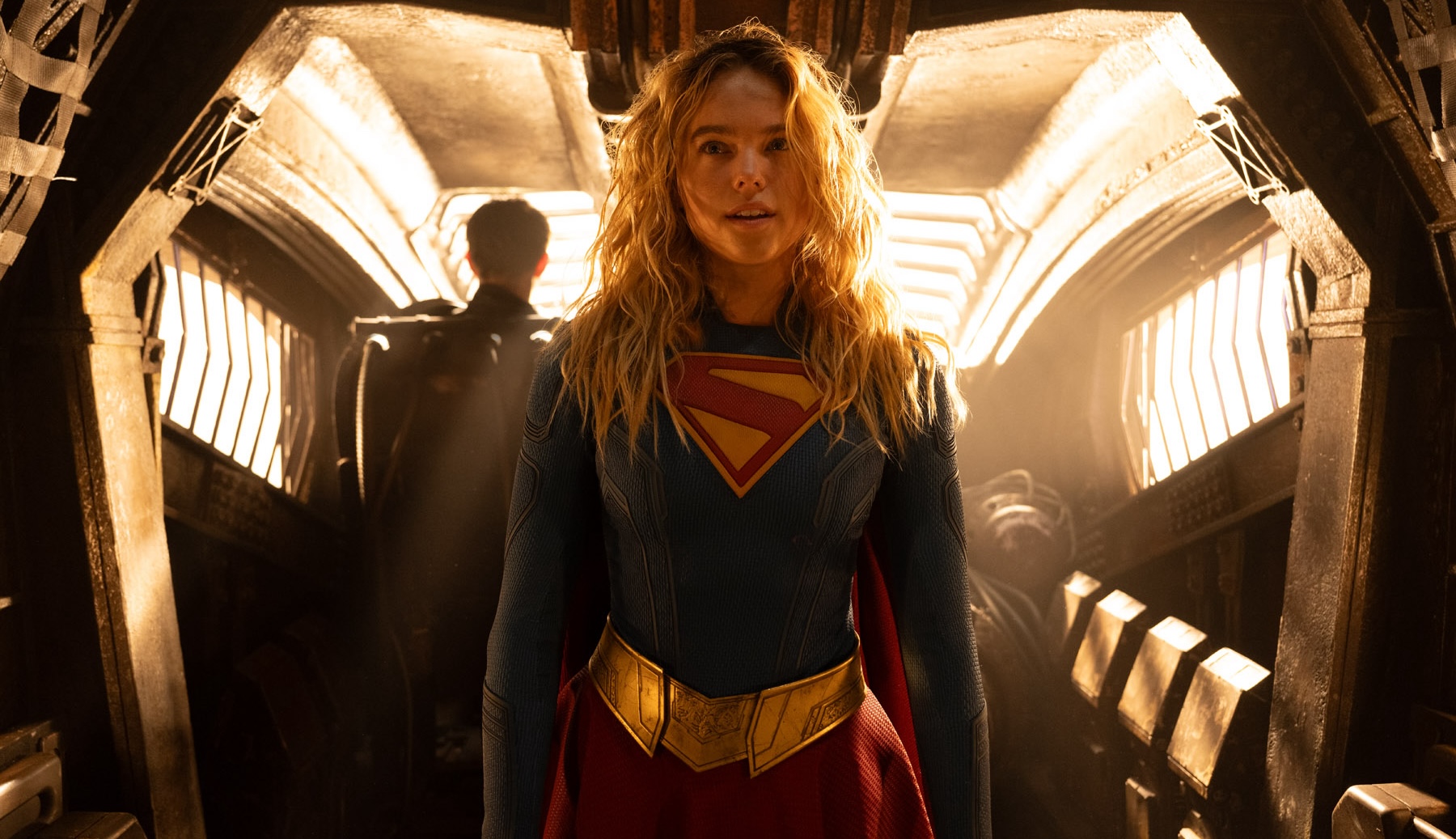
It’s a warm spring day outside of London when I step onto a backlot at Leavesden Studios. Yet as judged by the rubble and ruin falling down around me and a group of fellow journalists who traverse the debris before our eyes, it might as well be another planet. One that’s on it’s last legs.
Across the way, over a previously grand but now grimy thoroughfare, the bitterest of goodbyes is taking place. Walking beneath a row of colonnades that would not look out of place in ancient Rome or the Pharaohs’ Thebes, a young girl and her father in cream-colored knitwear lead a procession of what appear to be Kryptonian nuns. A humble casket stands atop the cruel affair. They are here to bid farewell to a woman who was of the House of El. Her daughter Kara Zor-El, played on the day as a teenager by 24-year-old Milly Alcock, and the deceased’s husband (Oppenheimer’s David Krumholtz) look despondent. These are the last days of the last city of Krypton, and the atmosphere is rife with tragedy.
A moment later, though, the spell breaks and director Craig Gillespie calls cut. The dying Argo City is again a (stunning) backlot built atop a field in England, and the actors reset for another take. In this gasp between shots, reality rushes back in, and production designer Neil Lamont quickly supervises another pass on a set that we were told a week ago looked pristine for a different flashback of Kara’s homeworld, back before the ruin of Krypton descended. For those shots, the waters of Argo City were a clean, inviting blue, as opposed to the shade of green I see today. It looks like Kryptonite Presumably the pond also was not polluted by fallen tree limbs that will perhaps have special significance for readers of Tom King and Bilquis Evely’s Supergirl: Woman of Tomorrow, one of the greatest superhero graphic novels ever written and a major source of inspiration on the new film.
It’s day 70 of an 80-day shoot, and the second to last before Gillespie, Alcock, and a parade of other film artisans travel to Scotland and Iceland for the final round of production. When we briefly meet with Gillespie and Alcock during our visit to the set, the pair compare the atmosphere to the hours before graduation.
“It’s like the last week in school, and we gotta tell the kids they’re still working,” Gillespie muses.
Perhaps not to get senior jitters, Alcock even declines to watch a rough cut of sizzle reel dailies prepared for the press. “I don’t wanna watch,” she nervously laughs, acutely aware that she’s in the last stretch of her first film, Hollywood or otherwise, and it’s time to bring the thing home.
Yet for those of us who stayed to see the footage, we got something compelling, haunting, and frankly unlike much of the marketing Supergirl has revealed to the public in the 13 months since our stopover in Leavesden. Scored to a moody, female-fronted cover of Radiohead’s “Creep,” the loneliness and isolation of Kara Zor-El, Last Daughter of Krypton—who unlike her more famous boy scout cousin can remember Krypton—is put in full context.
Some of the same trailer footage you’ve seen of Kara waking from a hangover to don sunglasses is present, but when juxtaposed with shots of her leaning over a shotglass, or looking glassy-eyed while staring down bad men, it takes on a different cadence. Here is a young woman still stalked by the memory of what she left behind when, also in a scene we saw, Superman (David Corenswet) discovers her in a downed crystal spaceship straight out of Richard Donner’s 1978 Superman. She’s alone in the universe except for the puppy in her arms when she finally lands on Earth. All of which evokes a melancholy closer in temperament to King and Evley’s graphic novel.
“I hope what you’ve seen so far, and what you’re going to see, just shows you the breadth of what we’re doing at DC,” executive producer Chantal Nong Vo says near the beginning of our tour. “They’re very different films, obviously, different characters, and very different filmmaking styles.”
On the day, the promise of this approach departing from producer James Gunn’s previous superhero movies—from last year’s Superman to Guardians of the Galaxy, although both are clear influences on Supergirl—was clearly visible. As clear as a little girl standing in the ruins of her home, forced to say goodbye.
Road Trip in Space!
This is not to say Supergirl appeared on the set, or is expected to be, a funereal experience. The film is indeed from director Gillespie, whose filmography often threads the needle between skewed irreverence and blunt sentimentality. Previous efforts like I, Tonya, Lars and the Real Girl, and Cruella are gamely name-dropped during the visit. And then there is the popcorn-pooping alien that many a colleague ate shit from.
No, really.
In a bit that might be considered far out for even the iconic Mos Eisley cantina sequence in Star Wars—an obvious reference point for both Guardians of the Galaxy and now Supergirl—one of the intergalactic rest stops that Kara finds herself at in the film features a chunky space slug in a terrarium that excretes technicolor popcorn of a shade reminiscent of Kids WB products back in the ‘90s. And I can attest, it’s quite edible.
It’s one of the more bizarre alien creatures to expect in Supergirl, all of which will apparently be achieved using practical effects, but it’s par for the course in a film that seems to heavily lean on the Woman of Tomorrow comic book story.
Like in that tale, writer Ana Nogueira’s Supergirl screenplay is a departure from the traditional depiction of Kara in most comics or the CW TV show. Set almost entirely in space, it is the story of a traumatized and bitter Kara, who escapes Earth as often as possible to go drinking in star systems that have red suns (it weakens her powers which allows her to get drunk). Hence on her 24th birthday, she finds herself incognito in a rustic world filled with brigands and bad men at the local watering hole.
“She’s off the job when you meet her,” Nong Vo says while explaining why in the film version, Kara will not put on her famous costume until the third act. “Obviously she’s been fighting crime, if you will, on Earth. But is she doing it as her whole full self? That’s a different story. We would argue that she isn’t. So in this journey she’s already been a hero, but not in the way where she’s her full self and her whole self.”
She might even be a shadow of it when she’s discovered by Ruthye Marye Knoll (Eve Ridley, who was 12 when production began). Ruthye’s a young girl who, like Kara, has lost everything, albeit she has an easier target to blame: Krem of the Yellow Hills (Matthias Schoenaerts) murdered her parents after attacking her farm. Taking more than a few pages out of True Grit, Ridley’s Ruthye is as much a protagonist as Kara. It’s Ruthye who recruits Kara to help her avenge her parents on Krem, as well as discover a vital antidote following… an unfortunate crime committed against Kara’s only remaining childhood friend, the dog Krypto.
So it is that Kara and Ruthye wind up traveling the red-sun cosmos in search of Krem via dilapidated public space transportation, and meeting sights as unsavory as the neon-corn pooping space slug, or intergalactic bars that serve eyeballs as delicacies—also quite tasty, as confirmed by the fact 12-year-old Ridley reportedly tested a couple dozen of the glorified desserts.
“Think of the worst possible Greyhound you’ve ever been in, but in galactic terms,” unit publicist Sophie Scott tells us of Kara and Ruthye’s transit, which looks like a perfect distillation of every indignity you’ve ever endured on an airplane. It is the steed, of sorts, that takes our pair to a 7/11-inspired way station bedecked in neon lights and a tone that will likely up the levity in between flashbacks of Argo City and Kara’s time on Earth. (Apparently the only sets built for her new home in the film are the Fortress of Solitude and Kara’s Metropolis apartment.)
One can ascertain from the sets made available to the press which scenes will lean into the humor and which will definitely not. Ruthye’s home planet, for instance, will be represented almost entirely by wood and an old world sensibility.
“It’s got a real Western vibe to it,” says Scott. “[Production designer Neil Lamont] had just come back from Japan. So there’s some Japanese influence in that design, but it also feels like the frontier. Very simple. Lee Sandales, who [decorated] it, described it as very much his planet of wood. So everything in those sets feels very homemade and handmade.”
The only element that might feel like a luxury is Ruthye’s sword, which she brings on her journey with the intent of running it through Krem of the Yellow Hills. Supervising hands prop supervisor Charlie Horwood tells us it’s modeled after Middle Eastern metal work, representing perhaps the one thing of great, ancient value from Ruthye’s humble farming background.
“There’s a lot of the way the Afghanis used to make their weapons with really detailed golden filigree,” says Horwood, “so we used that as a lot of inspiration. But the shape of Ruthye’s sword was from the comic book.”
Conversely, Krem and his brigands take on a more Nordic and Viking aesthetic aboard their brigand battleship, which like the last remnants of Argo City occupies a substantial amount of backlot space in what can best be described as a cross between a Star Destroyer and Dennis Hopper’s barge in Waterworld. “The brigands were very much heavily influenced by Vikings and Celtic, stuff like that,” Horwood says.
The most impressive indoor set we viewed, however, was the utter chaos of another dying world that does not appear in Supergirl: Woman of Tomorrow but will be vital to the Supergirl movie (and with a name comic book fans should still appreciate): Evely, the capital city of Bilquis.
“It’s a dying planet, and the people are barely surviving,” Scott explains. “So criminals from across the galaxy have seen it as a really good place to set up and hide, and Krem’s brigands have swooped in, as the Space Vikings they are, to pillage that planet and use it as a base because it’s dying.”
The scale of the set is genuinely impressive too: an entire town square and accompanying back alleys that look like they’ve endured a World War II era bombing. More than once Saving Private Ryan crossed my mind while stepping through the rubble of a village that’s been trashed by space tanks apparently belonging to Krem—including one that is tipped over. The production built six of these suckers, three of which are functionally drivable. Presumably it’s not the one we discovered Kara leaving in tatters.
Well, Kara or someone else…
Lobo Rides Out
The other big addition to the Supergirl movie not from the Woman of Tomorrow graphic novel involves the DC character that Jason Momoa wanted to play since before he was cast as Aquaman: the wise-cracking space biker they call Lobo. He too will be on Evely in Bilquis, and when he gets there, expect him to look good.
Appearing in the film with a flowing, long leather trenchcoat, which is worn over a vest with a flaming skull on the back and real silver biker chains draped around his neck, Lobo has been something of a dream role for Momoa.
“We had a chain around his neck, which was a pretty big chain,” recalls costume designer Michael Mooney, “and Jason said, ‘I’ve got bigger chains on my wallet!’ So we went a lot bigger with that, and then we added the grenade on it.” Similarly, the leather coat is modeled after a real 1918 vintage number, but Momoa suggested adding silver spiky “fingernails” to Lobo’s accoutrements. He wanted the character to have claws.
It’s a flashy addition to the story, but one that made sense to the DC team after Momoa started lobbying to play the character before the curtain was even officially lowered on the DCEU and the Hawaiian actor’s Aquaman.
“Obviously it’s public now that Jason raised his hand very early when James [Gunn] and Peter [Safran] started the job to say he loved the character,” says Nong Vo. “When we were developing the story, it became a go from A to B to C to D [thing]. We felt with a story like this, you generally want somebody to twist it up and change the game unexpectedly.”
Scott would seem to agree, suggesting Lobo is not necessarily the most trustworthy character in the film.
“He is pursuing a bounty who is amongst Krem’s brigands and who’s worth a lot of money to him,” the unit publicist explains. “So in pursuit of that bounty, sometimes he and Kara and Ruthye align in their mission, but then it’s also whatever works for him. I wouldn’t trust him, necessarily, in a fight.”
While he is not technically a major element of the film, the executive producer promises he is in a “high impact 15 percent” of the movie.
The Woman of Tomorrow
There is much to take in during a visit to a film production, yet during my own time with Supergirl, the through-line of everything I witnessed was how much of this is channeled via Kara Zor-El’s sense of grief and guilt, even down to the pop affectations.
When the first Supergirl trailer dropped last Christmas, plenty was made in the press about how similar its use of a classic rock song—in this case Blondie’s “Call Me”—echoed producer Gunn’s Guardians of the Galaxy. And there certainly are elements of that, including Kara rocking out to what prop supervisor Horwood calls a “space iPod” (although it is designed as something unique in the film, with its orange fuzzy ear-covers and a sci-fi ability to rock out on the other side of the galaxy). Still, even that graphic T-shirt Kara rocks in all the trailers and its incorporation of Blondie has a careful logic to it.
“We went through hundreds of different bands, and then Craig settled on Blondie,” costume designer Michael Mooney says of the shirt. “We occasionally put up some mainstream bands and he just went, ‘No, no, it’s not that.’” Instead it’s a telling throwback, with Kara herself seeming to be modeled after Debbie Harry in the film due to both her punk personality and her apparent allergy to the kind of square goodness we associate with most Superman characters. It speaks to a hero who actually seems to be dealing with things that echo the immigrant and refugee experience of today.
If you’ve read the source material, you know this version has an edge, and a foul mouth, which we’ll see onscreen. In fact, Nong Vo teases that, at least in April 2025, there was still debate over how many f-bombs they can give Kara in a family-oriented superhero movie.
“Obviously this is a PG-13 movie, so it’s limited when it comes to ratings,” the executive producer laughs, “but we have been like, ‘Is this her fuck? Is this her fuck?’ So we have different options, and I think there’s one that’s special in Craig’s heart, but we are having a lot of fun with it.”
Through it all is a take on two young women finding a self-actualization that hopefully could be a bit outre from the traditional superhero movie formula. Kara will not wear her costume until what appears to be the climax of the film aboard Krem’s brigand warship, but when the time comes, it will be the traditional one comic book fans know. One of its chief architects even confirms he and co-designer Anna B. Sheppard sought to make it more like the comic book version.
“[Anna] really wanted to have the skirt have more movement in it,” Mooney says. “So we went very close to the comic. We took some elements from the last suit [in Superman] and then carried that through, but the bell and the skirt, and the cloak, it’s just got so much more movement in it. It just makes the fights more dramatic.”
It also made for one of the least padded or exaggerated superhero costumes in the modern genre. As Mooney tells it, there was only a little padding added in the shoulders, which is a far cry from the supped up musculature he’s seen in so many modern superhero movies (including ones he’s worked on in the past, including several Marvel and DC films). They want to emphasize Alcock’s petiteness and seeming vulnerability, especially when contrasted with Space Vikings and thugs. Even the glyph on Supergirl’s chest was reduced, as the designers found it restricted movement the bigger the emblem became.
Kara is just a young person quite alone out there, and only beginning to find community and kinship when another orphan enters her life.
No one working on the film wants to call Supergirl an origin story or coming-of-age film, but if it lands the promise of that day along the crumbling colonnades of Krypton, it will become something quite special.
Supergirl opens in theaters on June 26.
The post Supergirl Movie Walks Among the Ghosts of Krypton: A Set Report appeared first on Den of Geek.