By
By 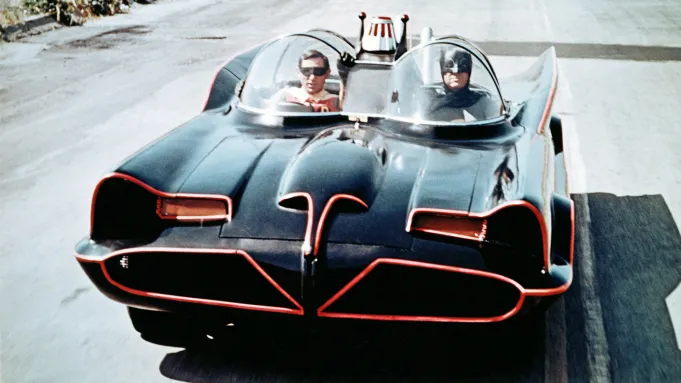
There are moments in television history where executives stumble onto greatness, probably accidentally. There was a time in the early 1980s when this happened. It probably started with a single question:
“What if a vehicle… was REALLY awesome? Not just fast. Not just cool. Not just expensive. No… a vehicle that could talk, or go underwater, or become invisible, launch missiles, outrun fighter jets, and jump over buildings, or all of the above!”
Phew! Cocaine was really strong back in the 1980s. Whatever happened, every kid suddenly wanted a talking car, or an attack helicopter with jets on it, or a motorcycle that could jump a house.
And so, the Age Of The Super Vehicle was upon us, and Hollywood History is back because we were there!
Dawn Of The Age Of The Super Vehicle
For a glorious few years, according to American television, every single problem in society could be solved by giving a handsome man a futuristic machine and pointing him at criminals.
And, honestly? They were absolutely right. If you were a young boy growing up in the 1980s, this was the greatest era television has ever produced. Forget prestige drama. Forget “grounded realism.” Forget antiheroes wrestling with their moral ambiguity.
A black Trans Am with a red scanner light was punching criminals into rivers. An attack helicopter was blowing up drug dealers. A motorcycle was leaping over warehouses.
Life wasn’t just good. Life was just about as fucking perfect as it was ever going to get. For a start, television would never be this gloriously ridiculous again.
This super vehicle era didn’t emerge from nowhere. Television had flirted with special vehicles for decades. The 1960s gave us the Batmobile from the original Batman series. There was Wonder Woman’s plane. The 1970s also brought futuristic concepts like the Viper from Battlestar Galactica, while shows such as CHiPs helped elevate vehicles into stars.
Meanwhile, cinema was doing some heavy lifting, too. Smokey and the Bandit made the Pontiac Trans Am cool. Star Wars made every kid obsessed with futuristic machinery, just as Roger Moore’s run as Bond convinced entire generations that gadgets were more important than plot.
Then television executives looked at all this and reached a simple conclusion:
“What if the vehicle was the co-star?”
And suddenly the floodgates opened.
One Man Can Make A Difference
Let’s be honest. There was one king. Everybody else was competing for second place.
Knight Rider debuted on NBC in 1982 and instantly became one of the defining shows of the decade. Created by producer Glen A. Larson – the same mad genius behind Battlestar Galactica, Buck Rogers, and Magnum P.I. – the concept was absurdly simple.
Michael Knight. A talking car. Crime… Go! Basically, rework The Lone Ranger with a car as his faithful steed. David Hasselhoff became a global superstar as Michael Knight, but the real star was KITT. The kids didn’t tune in for Hasslehoff’s magnificent and buoffant hair. We tuned in for the Knight Industries Two Thousand.
This heavily modified Pontiac Trans Am with artificial intelligence, KITT, wasn’t simply transportation. He was a character. Sarcastic. Smug. Smarter than everyone. Basically, C-3PO, if he’d been redesigned by Pontiac and made about 12% less camp. Kids didn’t just want a Trans Am. They wanted THAT Trans Am. The scanner light alone became one of the most recognisable visual effects in television history.
Then there was the supporting cast. Edward Mulhare’s Devon Miles brought British gravitas, alongside Patricia McPherson’s Bonnie Barstow as the engineer every nerd had a crush on. Which is why fans were furious when Bonnie disappeared after Season One.
NBC and producers replaced her with Rebecca Holden’s April Curtis. Nothing against Holden, but this was the television equivalent of replacing Han Solo with some other guy and hoping nobody noticed. The audience noticed. Ratings research noticed. The producers noticed. Bonnie returned and justice was restored.
It wasn’t all perfect, though. There was Super Pursuit Mode. This was the moment Knight Rider jumped the shark. Somebody apparently looked at the coolest car on television and decided it needed more plastic add-ons and to resemble a rejected Hot Wheels prototype.
Even as a kid, I knew it was stupid and ugly and lame and possibly gay.
Knight Rider survived four seasons and 90 episodes, which is an extraordinary run for the genre. More importantly, it entered syndication. This is crucial because syndication is where these shows truly became legends. Knight Rider became bigger in reruns than many shows ever became during their original broadcast.
One Man With A Cello
If Knight Rider was the king, Airwolf was the cool older cousin your parents didn’t entirely trust. Premiering on CBS in 1984, Airwolf was created by Donald P. Bellisario, who had served in the military and possessed a knack for blending action with character drama.
The premise was as insane as it was perfect to boys of a certain age.
A top-secret supersonic attack helicopter, piloted by brooding loner Stringfellow Hawke, supported by the always excellent Ernest Borgnine, kept away from the CIA but allowed to be used on certain missions. It was astoundingly dark and had quite a complex, ambiguous nature for the time. Somehow, this all worked.
Jan-Michael Vincent brought genuine charisma to Hawke. The helicopter itself looked incredible, even today the titular Airwolf remains one of the most beautiful fictional vehicles ever designed.
What many younger fans don’t realise is just how dark the first season was. Airwolf originally resembled a Cold War thriller. There were assassinations, political conspiracies, moral ambiguity, and actual tension.
The show’s first year often felt like an action movie for adults. So, of course, CBS executives got nervous and looked across at Knight Rider with its younger viewers. Toy companies wanted children. Advertisers wanted families. Dark Cold War intrigue doesn’t sell nearly as many lunchboxes, and so Airwolf became lighter.
The espionage elements diminished, and more straightforward action stories appeared. More explosions. Less moral complexity. And a female lead was introduced. We were about eight years old at the time, and girls were icky and probably had cooties.
It remained entertaining, but some of the original edge vanished. By season four, things became tragic. Costs were rising, ratings were falling, and Jan-Michael Vincent’s personal problems were becoming increasingly serious. CBS cancelled the show.
A Canadian-produced final season attempted to continue without most of the original cast, starring television’s perennial substitute teacher, Barry Van Dyke, but even today, fans generally try to pretend this season never happened. Frankly, that’s probably for the best.
Just Another Frustrated Observer
Blue Thunder began life as a 1983 movie starring Roy Scheider, but Hollywood immediately saw television potential. ABC launched Blue Thunder in 1984. The problem?
Airwolf launched almost simultaneously. This was unfortunate. Very unfortunate. Because Blue Thunder wasn’t bad, it just wasn’t Airwolf.
It starred James Farentino, and a very young Dana Carvey as his JAFO, the wonderfully named Clinton Wonderlove. The helicopter looked fantastic. The action was solid. It even had Hightower from Police Academy and Dick Butkus from the NFL. But audiences had already picked their helicopter.
Blue Thunder lasted only eleven episodes. Today, it exists largely as a fascinating historical footnote. The television equivalent of arriving at a fancy dress party wearing exactly the same costume as somebody much cooler.
The One That Was Gone Too Soon
Street Hawk may be one of the most beloved one-season wonders in television history.
ABC launched it in 1985 and the concept was simple. A secret government motorcycle capable of speeds approaching 300 miles per hour. But of course. Because why wouldn’t it?
Rex Smith played Jesse Mach. A proper hero name. The motorcycle itself looked like something a twelve-year-old would sketch in the margin of a maths textbook, which is precisely why everyone loved it.
Street Hawk could turbo boost, leap obstacles, perform impossible manoeuvres, and do it all while looking absolutely incredible, while Tangerine Dream’s pounding synthesizers were the cherry on top of a sundae of pure 80s perfection.
The only problem was, much like Airwolf and Blue Thunder, we were already in love with Knight Rider, and the market was becoming crowded.
Ratings weren’t terrible. They just weren’t good enough, and ABC cancelled the series after thirteen episodes. Fans have spent forty years complaining about this decision, and they are still right.
The Best Of The Rest
Not every super vehicle show became a hit, or even in cancellation, maintained a place in pop culture folklore. Television kept trying.
There was Automan. A bizarre hybrid of Tron and Knight Rider featuring a holographic crimefighter and a Lamborghini computer car. It lasted one season.
Manimal occasionally flirted with vehicle-based gadgetry despite mostly focusing on turning into animals. That lasted a season. The Highwayman featured Flash Gordon himself, Sam J Jones, featuring a futuristic truck capable with a helicopter inside it.
Meanwhile, cartoons joined the battle, with M.A.S.K. essentially combining G.I. Joe and Transformers. Vehicles transformed, children demanded toys, parents surrendered, capitalism worked.
At this time, the television shows were only half the story. The rest of the battle happened in toy stores. KITT toys were everywhere. Airwolf helicopters filled shelves. Street Hawk motorcycles appeared. There were model kits, remote-controlled versions, lunchboxes, pencil cases, bed sheets.
If a surface existed, a licensing executive wanted a super-vehicle printed on it. This was the golden age of merchandising before the internet and before smartphones. Children interacted with franchises physically. You watched them on TV, then you owned them and played with them. Or you wore them.
You recreated episodes on living room carpets and occasionally smashed them into furniture while making explosion noises. Usually, while your mother shouted from another room.
Naturally, the comic industry joined in. Knight Rider comics appeared, then annuals and novelisations. Airwolf received similar treatment. The franchises expanded through every medium available. Today, we talk about “transmedia storytelling” as if it were invented by Marvel, but the 1980s were already doing it.
Just with more helicopters.
Network Darlings
The appeal for networks was obvious. Vehicles sold internationally, where dialogue-heavy sitcoms often struggled overseas. A helicopter firing missiles at a drug cartel translated perfectly and the action was universal. Knight Rider became a global phenomenon. Even today, David Hasselhoff could announce another thousand-year Reich and all of Germany would line up behind him without question.
The visual concepts sold themselves, and networks also loved the repeatability. Every week – New villain. New stunt. New explosion. Reset. Do it again next week. Simple, reliable, profitable. So why did they die?
Nothing lasts forever. Not even turbo-boosting motorcycles. That whole profitability angle couldn’t be sustained. By the late 1980s, production costs were becoming difficult to justify just as audiences were fragmenting and action-adventure television was changing.
The rise of syndication-first shows altered economics, and star salaries increased just as special effects expectations increased and, frankly, there are only so many times a helicopter can save the day before viewers start asking awkward questions. So the genre slowly faded.
But it never truly disappeared. Its DNA survives in everything from Viper to Fast & Furious and countless modern action franchises. What made these shows special wasn’t realism. It wasn’t prestige. It wasn’t sophisticated storytelling. It was imagination. Pure imagination and the belief that technology could be exciting before the internet came along and ruined everything.
The Age Of The Super Vehicle arrived during a unique moment when television wasn’t afraid to be unapologetically cool, and made a generation of boys nearly believe that there really was a talking car, a super helicopter, or a rocket-powered motorcycle fighting crime out there somewhere.
Looking back now, it’s impossible not to smile.
The post Hollywood History: Age Of The Super Vehicles appeared first on Last Movie Outpost.