By
By 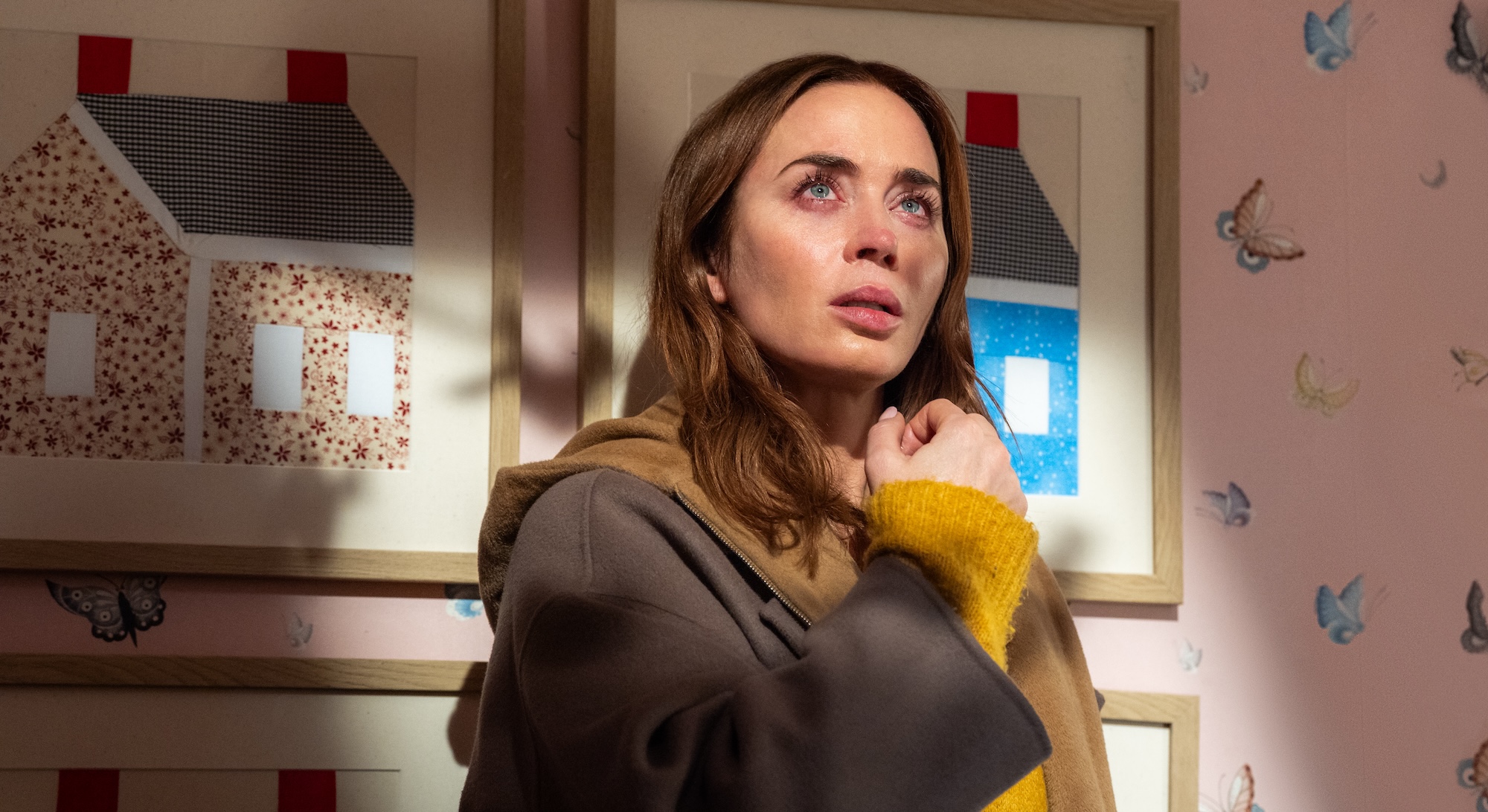
I always felt bad for Larry, Josef Sommer’s character in Close Encounters of the Third Kind (1977). In Steven Spielberg’s magnum opus about UFOs and the governments who cover them up, Larry is a true believer that, like Richard Dreyfuss’ Roy and Melinda Dillon’s Jillian, traveled all the way to Devils Tower in Wyoming, sneaking past federal authority checkpoints and lies… only to miss the aliens at the last minute because of some knockout gas.
That of course was part and parcel for Spielberg’s vision of an obsessive, almost maniacal need to know. Only the most dedicated, driven and, ahem, visionary folks like Roy get to learn the truth and board a starship with little gray men. Everyone else should be so lucky to see the epic John Williams concert and UFO light show at the top of the mountain. Otherwise we wind up like Larry: left behind in the dark, wondering what really happened on that evening of night skies.
The Spielberg who made Close Encounters is a different man. He’s indicated as much over the years by saying he regrets his amazing ending of Roy abandoning his life and family to go on a space odyssey. Becoming a parent in real life will have that effect. But he’s also become more fixated on the stakes of our world and society as a collective. The man who once made grandiose adventures about the lone individual facing nature in Jaws, or a little boy fixing his fractured childhood by befriending another extraterrestrial in E.T., has spent most of the last 20 years making dramas about who Americans are as a people, a culture, and (perhaps quaintly these days) a force for moral good. You watch how he frames Abraham Lincoln or Kay Graham, and you know he believes in the dream in his bones.
It’s so strong that his civic-minded egalitarianism has even drifted into the fifth(!) alien film in his career, Disclosure Day. In many respects, Disclosure Day positions itself to be a king returning to his throne. The paterfamilias of the modern blockbuster is reclaiming a style of moviemaking he perfected decades ago, yet has barely acknowledged at all in the last 15 years, save for 2018’s Ready Player One. But after two achingly personal passion projects like West Side Story (2022) and The Fablemans (2023)—alas two masterpieces that were sadly commercial flops—Spielberg is returning to his roots in a movie with car chases, government big bads, and of course aliens.
Yet the film is at its best when the director stops showing off the craft and a boundless energy that eludes men a third his age and instead pivots to the more magnanimous view of humanity, and for that matter aliens, which has evolved in the filmmaker’s later years. If Disclosure Day is a coda on the man in the beard’s fixation with unexplained lights in the sky, it is also a reclamation for the Larrys of the world; a wide-eyed, awe-inspired gaze into a future where no one gets left behind and the truth is shared with all. Human and extraterrestrial alike.
To get to that kind of graceful epiphany, however, Disclosure Day spends a lot of time running through some standard blockbuster storytelling, or at least what was the standard 20 years ago when Spielberg and other filmmakers were still making zippy escapism for adults. Two such grown-ups are Margaret Fairchild (Emily Blunt) and Dr. Daniel Kellner (Josh O’Connor). To the outside world, and even to the characters, these are two folks who should have little in common. Margaret is a professionally stifled weatherwoman at a local TV station in Kansas City who wants more out of her life; Daniel works for WARDEX, a government-adjacent agency that for the last 50 or so years has coordinated UAP research and cover-ups for the Department of Defense.
Yet Margaret and Daniel’s paths are inextricably linked after Dan goes the full Edward Snowden route and steals reams of classified documentation, files, and even video evidence that prove aliens are real, they’ve been visiting us for longer than there’s been a U.S. government, and we know where some of the literal bodies are buried because our leaders put them there. He even gets his hand on something that’s only cryptically referred to as… The Device.
Curiously, the moment Daniel and his mentor, an aloof but immediately endearing Colman Domingo, get the information out of government control is the moment that Margaret starts getting visions of repressed childhood memories and discovers she somehow can speak all languages and knows everything that can and will happen to Daniel—especially as WARDEX boogeyman Noah Scanlan (Colin Firth) begins closing in with his men in black. Noah isn’t without sympathy, but it has stark limits when he resorts to threatening (or worse) Daniel’s girlfriend Jane (Eve Hewson).
Longtime Spielberg collaborator and screenwriter David Koepp recently confirmed to me that the final scene of Disclosure Day is the first sequence Spielberg wrote. It is also one of the things that was left largely untouched after Koepp and Spielberg began reworking the director’s treatment. This shows in the final film. Without giving away what the finale of Disclosure Day exactly is, rest assured it features some massive secrets which allow Spielberg to return to the cinematic vernacular of 1970s cinema, both his own with his penchant for characters staring up in bewildered, wondrous close-up, as well as some of his contemporaries like Sidney Lumet and Alan J. Pakula.
It’s pure Spielbergian magic. The movie that gets to those final moments is a lot more checkered, although not without its charms and entertainment.
Blunt and O’Connor make for compelling leads who find themselves as the everyman and woman in extraordinary situations. Blunt, particularly, walks a fine line that skirts close to saying something sacrilegious or heretical as her mysterious and definitely alien-touched journalist carries an air of the prophet about her. There is something radical being teased by this characterization, but it’s perhaps intentionally left unexamined. Mostly the religious implications of what discovering aliens walking among us would mean for Old World texts and tenets are softly, even patronizingly slow-walked in a subplot involving Hewson’s Jane, a former novitiate nun who is forced to consider some profound implications about God’s Garden of Eden apparently being a lot bigger than the good book suggested.
But the biggest hurdles Disclosure Day faces is repeatedly raising some explosive ideas and then demurring from unpacking them. One glorious exception in the film involves a crackling intellectual confrontation between Firth’s cynical justifications for control and concealment, and Domingo’s full-throated advocacy for radical transparency and dissemination. Domingo is indeed the performance of the film, offering an avuncular and twinkly personification of truth-telling. His debate with Firth is about extraterrestrials, but one senses it is as much of a plea for humanity needing grown-up conversations about empathizing with their fellow man… and facing the unknown with a sense of charity and openness.
I honestly wish Domingo’s Hugo was the protagonist, and his motivations more front and center, as one senses that they’re Spielberg’s own convictions as well. But Hugo is ultimately peripheral to the central dynamics of Spielbergian everymen and women finding themselves in preposterous thrill ride sequences. At one point there’s even a rental car left dangling from the sides of a train.
Nonetheless, there is still some of that old school fairy dust from the storyteller who knows how to turn rolling boulders and bobbing buoys into cinematic legend. One sequence in particular involves Firth’s antagonist using “the Device” to manipulate a human character into acting against their self-interests is a tour de force scene of dread and violation. Bright and shiny science fiction suddenly takes on an air of dark magic, or possession horror, and it is yet one more reminder that it’s a shame Spielberg himself never tried his hand fully in the chiller genre.
What makes Disclosure Day ultimately worthwhile, however, exists beyond the thrills. This is a movie with a warm, even grandfatherly sense of equanimity to it; of a storyteller bringing perspective and newfound affection to one of his favorite subject matters. The film does not seek to glorify UAP accounts like Close Encounters, or turn it into something sweet (E.T.) or horrifying (War of the Worlds). It is a movie that wants viewers to be radically open to all ideas and perspectives, even those that might seem scary.
It wants us all on that starship alongside Dreyfuss, and its effectiveness is self-evident when the ending holds out its hand and leaves you eager to climb aboard.
Disclosure Day opens on Friday, June 12.
The post Disclosure Day Review: Steven Spielberg’s Coda to a Lifetime of Alien Movies appeared first on Den of Geek.