By
By 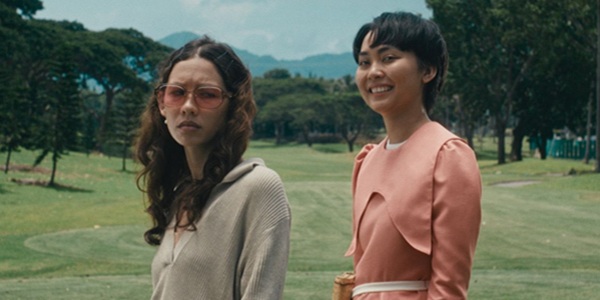
The feature debut from writer-director Rafael Manuel and an expansion of his 2020 short film of the same name, Filipiñana is a dispatch from ground zero of the class war: the luxurious country clubs of the Philippines and beyond. The film, which won the Special Jury Award for Creative Vision at this year’s Sundance Film Festival, peers beneath the pristine facades of these hierarchical spaces and provides a glimpse of the ugliness required to maintain their existence.
Beauty and Beasts
Filipiñana begins aboard a tourist bus in the bustling, colorful heart of Manila before quickly moving to an exclusive country club outside the city, where the atmosphere is so quiet and calm that it almost feels oppressive; if you breathe too loudly, you may upset one of the wealthy elites who come there to golf and relax.
source: Kino Lorber
Isabel (Jorrybell Agoto), a seventeen-year-old girl from the northwest region of Ilocos, has recently started working at the club as a “tee girl,” one of a fleet of blue-smocked young women whose job is to sit next to the golfers as they practice their swings and replace the balls, one after the other. On the other end of the club’s class spectrum is Clara (Carmen Castellanos), an expatriate visiting her wealthy uncle, Renato (Carlitos Siguion-Reyna). Renato keeps urging Clara to move back to the Philippines and work for his golf equipment company. However, the more Clara observes this patriarchal world—one in which she could only have a place of privilege at the expense of other young women like herself—the more reluctant she is to return and become part of it.
The country club’s president, Dr. Palanca (Teroy Guzman), hails from Ilocos like Isabel, and she finds herself strangely drawn to him. So, when he leaves a golf club behind, Isabel takes it upon herself to return it to him. Her quest takes her throughout the club, to spaces normally closed off to her as staff: dining spaces where tables heave with uneaten food, dance classes, sparkling blue-green swimming pools. But the longer she wanders the club, the more dark secrets she uncovers—secrets only the rich can afford to keep.
Invisible Crimes, Nonexistent Consequences
While the country club at the center of Filipiñana initially appears to be an oasis, an undercurrent of menace bubbles beneath the surface of the perfectly manicured green lawns. A little girl in a red dress is briefly seen before going missing. Ominous rumors about the men who make up the vast majority of the club’s members are whispered by the mostly female staff. Rules are enforced with dictatorial precision; if a tee girl wanders onto the course, a man in a cart quickly drives up to scold her for daring to enter off-limits spaces. When Isabel sneaks a taste of an untouched dessert in an empty dining room, a seemingly sleeping waitress lifts her head from the table and warns her that people have been fired for less.
source: Kino Lorber
Everything in the club runs like clockwork, emphasized by a montage in which staff members are seen mechanically going about their daily tasks in time with the music being played by the club’s in-house band. Their place in the club’s rigid hierarchy is symbolized by the color they wear: blue for the tee girls and pink for the caddies, in contrast with the members’ crisp, clean white. At one point, Ina (Isabel Sicat), the caddie assigned to Clara for her visit, is shocked to learn that in the United States, amateur golfers often carry their own bags. She and Clara chat comfortably throughout their day on the course together; their difference in status becomes stark when Clara’s uncle scolds Ina for spending too long at a water fountain, as though she’s taking more than her fair share of hydration. Meanwhile, sprinklers regularly drench the greens of the golf course, with no complaints heard.
Filipiñana is beautifully crafted thanks to a trifecta of women: cinematographer Xenia Patricia, production designer Tatjana Fanny Honegger, and costume designer Carla Villanueva. The film is shot in a series of long takes, many of which contain very little movement; its languid pace echoes the way its characters move in the oppressive heat. The staff members are often portrayed as small and insignificant in the frame, relegated as they are to the edges of the club members’ consciousnesses. Simple, sensual pleasures—the sweet flesh of a fallen mango, the smoke of a shared cigarette, the warmth of the sun during an afternoon nap—are lingered upon as all-too-brief escapes from a mundane reality. When a moment of violence cuts through the peaceful atmosphere, it is all the more shocking because the reactions are so understated, as though it were merely a vase accidentally being broken, with the pieces swept under the rug to be forgotten.
source: Kino Lorber
As Isabel, Agoto is quietly magnetic. As she wanders through the club, memories that she had thought were submerged begin to rise to the surface and haunt her. “My memory is like a bush or a patch of grass that has been trimmed really precisely, and all that has fallen was blown away by the wind,” she muses. Required to maintain a professional facade in front of the club members, she allows herself small acts of rebellion when their eyes are averted; she might be treated like a robot, but she never forgets that she is still human, and neither do we.
Conclusion
Filipiñana is a film with a flawless aesthetic that nonetheless never allows us to forget how much exploitation is necessary for a world like the one it depicts to thrive.
Filipiñana opens in New York on August 28, 2026, and in Los Angeles on September 4, 2026.
Does content like this matter to you?
Become a Member and support film journalism. Unlock access to all of Film Inquiry`s great articles. Join a community of like-minded readers who are passionate about cinema – get access to our private members Network, give back to independent filmmakers, and more.