By
By 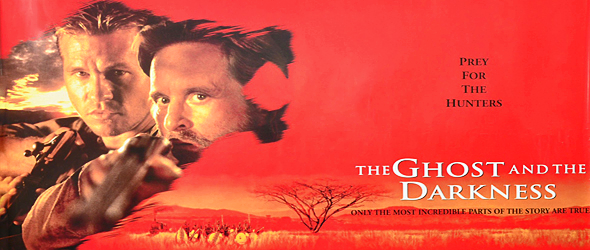
There are certain films that slip through the cracks of cinematic history. They’re not quite cult classics, not quite forgotten, but definitely not talked about as much as they deserve. The Ghost and the Darkness from 1996 is one of those films. It’s wildly underrated. Not “mildly underappreciated.” Not “people remember it sometimes when lions come up in conversation.” No. This thing should be mentioned in the same breath as the great adventure films of the late 20th century.
Instead, it mostly sits there in the streaming menus, waiting patiently like a lion in tall grass. Which is appropriate, because lions are the whole problem.
Sometimes, you just need those lions, some railways, and peak ’90s manliness.
The Ghost and the Darkness
The Ghost and the Darkness is directed by 1990s Mr. Reliable – Stephen Hopkins. It stars Val Kilmer and Michael Douglas, telling the story of the infamous Tsavo man-eaters. Two lions that allegedly killed dozens (possibly over a hundred) of railway workers in Kenya in 1898 during the construction of the Uganda Railway.
It’s based on a true story… or at least the kind of true story where the facts are mostly real but the details get filtered through whisky, colonial diaries, and the cinematic need for dramatic lion lunges.
But here’s the key ingredient that should immediately make you sit up straighter in your chair: the screenplay. This was written by William Goldman. Yes. That William Goldman. The man behind Butch Cassidy and the Sundance Kid, All the President’s Men, and The Princess Bride. A genuine titan of screenwriting.
If you ever wondered what happens when one of the greatest screenwriters of all time decides to write a movie about two homicidal lions eating railway workers in colonial Africa… well, this is it, and it’s glorious.
The historical basis for the film comes from the experiences of John Henry Patterson, a British engineer tasked with building a railway bridge across the Tsavo River in what is now Kenya. This is because during the late 19th century the British had this charming habit of arriving somewhere, building infrastructure, setting up administrative systems, and laying down railways. The only downside to this is that they now own your country, completely.
Whatever you think of colonialism, if you happened to be colonised by the British rather than some of the other imperial powers of the era, you were at least reasonably likely to end up with railways, legal systems, civil administration, and the hallmarks of civilisation. The Belgians, by contrast, tended to arrive with rubber quotas and a worrying enthusiasm for dismemberment.
In The Ghost and the Darkness, British engineers are building a railway through Tsavo as part of the Uganda Railway project. This is an enormous logistical undertaking meant to connect the interior of East Africa to the coast. Industry! Progress! Empire!
Unfortunately, two lions have decided the workforce looks delicious.
Eventually nicknamed “The Ghost” and “The Darkness”, they begin picking off workers at night. At first it’s one or two. Then it becomes a pattern. Then it becomes a horror movie.
Tents get ripped open. Workers vanish into the darkness. Entire camps panic. Fires burn through the night as terrified labourers huddle together hoping not to be eaten. And unlike most lion stories, these beasts aren’t behaving normally. They’re not just opportunistic predators. They’re systematic. They’re bold. And worst of all, they’ve apparently decided that human beings are now their favourite take-away.
This is where Val Kilmer comes in.
Post-Batman, Pre-Reputation
Kilmer plays Patterson, the engineer who arrives in Tsavo determined to build the bridge, prove himself, and return home to his wife and newborn child.
This was an interesting moment in Kilmer’s career. He had just come off playing Batman in Batman Forever the year before.
Which meant two things – he was a huge star, and Hollywood had started whispering that he might be difficult. The “Val Kilmer is awkward” legend was just beginning to form around this time. Directors would later describe him as intense, perfectionist, moody, or “a bit much.”
But here’s the thing: in The Ghost and the Darkness he’s great. Not flashy. Not scenery-chewing. Just solid, stoic, quietly determined. Exactly what you want from a Victorian engineer slowly realising he’s locked in a death match with two lions that apparently hate railways.
Kilmer plays Patterson as a man who believes in order, rationality, and the steady advance of civilisation.
The lions, meanwhile, believe in eating his workforce.
Enter Michael Douglas, professional lion puncher. Douglas as Charles Remington, a legendary hunter sent in to deal with the problem. He’s loud, confident, swaggering, and radiates the energy of a man who has absolutely shot something enormous before breakfast.
If Kilmer is quiet professionalism, Douglas is charismatic chaos. He shows up like a Victorian rock star. Hat. Rifle. Stories about hunting everything that moves. And suddenly, the movie becomes a buddy film about two men trying to outwit a pair of lions that seem smarter than the average screenwriter.
One of the reasons this movie works so well is that it plays the premise completely straight. It is a surprisingly serious adventure film. There’s no winking. Nobody incredulously says, “isn’t this silly?”. There is no CGI lion nonsense. Instead, the film treats the situation as genuinely terrifying, and it kind of is.
The Tsavo man-eaters were real. Their stuffed remains still exist today in the Field Museum in Chicago.
The attacks caused real panic during the construction of the railway. The film leans into that atmosphere. Camps lit by firelight. Workers whispering in fear. The vast African wilderness presses in from every direction. You get the sense that humanity has come here with its railways and engineering plans… but nature might still be in charge.
Just as it was when they tried to make this movie. The production itself was almost as dramatic as the story. The movie was shot largely in Africa, including locations in South Africa and Namibia. The filmmakers wanted authenticity. Real landscapes, real environments, and real lions whenever possible. Which is always a reassuring phrase in film production:
“Don’t worry, we’ll just use real lions.”
What could go wrong? The film used a mixture of trained lions, animatronics, and stunt work to create the attacks. Compared to modern CGI animal effects, it holds up surprisingly well precisely because much of what you’re seeing actually existed in front of the camera.
The cinematography by Vilmos Zsigmond gives the movie a golden, dusty look that perfectly captures the late-19th-century frontier atmosphere. This is adventure filmmaking in the old tradition—huge landscapes, practical effects, real sweat. Also: dust. So much dust.
What elevates the movie above “competent lion thriller” territory is the script. Because William Goldman understood something essential: the lions aren’t just monsters. They’re symbols.
The railway represents civilisation, industry, order, and progress. The lions represent something ancient and untamed, pushing back.
Goldman fills the script with small character moments. Conversations about fear, about reputation, about the strange psychology of hunting something that hunts you back. There’s also a lovely running theme about pride and masculinity. Patterson wants to prove himself. Remington wants to maintain his legend. Meanwhile, the lions are quietly dismantling everyone’s confidence.
Goldman reportedly wrote the script quickly after reading about the Tsavo incident, and you can tell he was having fun with it. Not jokey fun. But that “what a great story this is” kind of fun.
And the lions are magnificent. These aren’t cartoon villains. They’re eerie, almost supernatural presences. Often glimpsed only briefly, eyes in the dark, a shape in the grass, a sudden explosion of fur and teeth.
The movie does something very smart: it doesn’t show them too much. This is Jaws territory for keeping the “monster” off-screen, and it pays off in spades.
So when they do appear, it matters. Also, they look big. Uncomfortably big, which is historically accurate as Tsavo lions are large, mostly maneless males with a particularly intimidating look.
When one of them charges a campfire full of screaming railway workers, you absolutely believe that this is not a situation anyone wanted to be in.
One of the more interesting things about the film, especially watching it today, is how it portrays the colonial setting. It is fashionable in current year to wail and gnash teeth at any mention of colonialism. Here, the British characters are presented largely as agents of progress: building infrastructure, bringing engineering expertise, trying to impose order on a hostile environment.
And from the perspective of the story, that’s basically accurate. The Uganda Railway was a massive industrial project that eventually became the backbone of East African development. Railways tend to do that.
As I said earlier in this review, compared to some other colonial powers of the era, it was a gift to be colonised by the British. A gift that involved totally losing your country and the possibility of the odd brutally put-down rebellion, but still, better than the Spanish, the Portuguese, or the Belgians. At least you got cricket and a railway.
Assuming the lions didn’t eat you.
Criminally Underrated
So why didn’t The Ghost and the Darkness become a huge classic? A few reasons.
First, it arrived in the mid-90s when Hollywood was obsessed with big flashy blockbusters and CGI spectacle. A gritty historical adventure about lions eating railway workers wasn’t exactly the easiest marketing pitch.
Second, the film sits awkwardly between genres. It’s not quite a horror movie. Not quite an adventure epic. Not quite a prestige historical drama. It’s sort of all three. Studios hate that, as they don’t know what to do with it. Audiences, however, often love it, and sure enough, over time, the movie has developed a reputation among fans as one of those “how did this not get more love?” films.
Because when you watch it now, it absolutely holds up.
The Ghost and the Darkness is a throwback to a style of filmmaking that doesn’t happen much anymore: serious, adult adventure movies with real locations, practical effects, and actors actually sweating in the sun instead of standing in front of green screens.
It’s got a great true story, a script by one of the best writers in Hollywood history, two charismatic leads, actual lions, and a railway. It physically couldn’t tick any more of my man boxes!
Plus there is a real, constant underlying tension that at any moment someone might get dragged into the tall grass and eaten. Which really keeps the pacing tight.
If you missed it in the 90s, do yourself a favour and watch it now. Because sometimes the best films are the ones that slipped through the cracks while everyone was busy arguing about which Batman movie was good. Sometimes civilisation, democracy, industry, and railways collide head-on with two very hungry lions.
The lions, it turns out, were not particularly impressed with the railway.
The post Retro Review: THE GHOST AND THE DARKNESS (1996) appeared first on Last Movie Outpost.