By
By 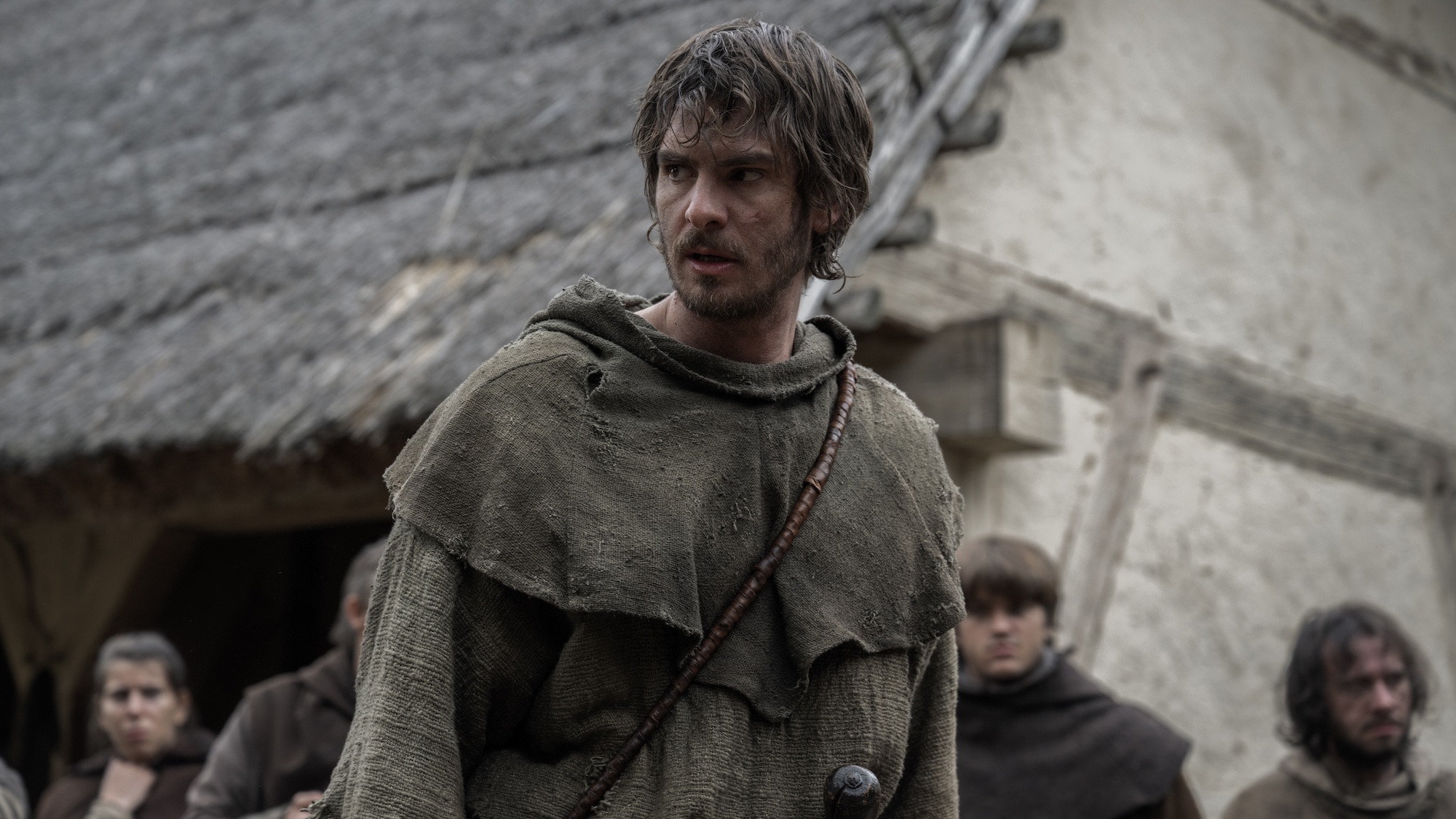
Paul Greengrass knew he always wanted to make a quasi-Robin Hood movie well before his deeply naturalistic historical epic, The Uprising, had the famous rogue’s name added to the poster. The film is still very much in the vein of the realpolitik thrillers Greengrass made his bones on early in his career with the Irish Troubles-set Bloody Sunday (2002) and the 9/11-based United 93 (2006), plus more recently in Captain Phillips (2013)—although this time with a far more exotic sheen in 1381 England on the eve of the fabled Peasants’ Revolt. Even so, he didn’t mind when Focus Features revealed in the marketing that the movie about peasants marching on London is also a chance to “Witness the Rise of Robin Hood.”
“When I wrote the original screenplay, I called it The Hood, so that tells you where I was,” Greengrass tells us during a Zoom conversation. “I called it The Hood because after the Peasants’ Revolt, people told stories of outlaws, most particularly outlaws of the hood, and so my hero’s journey was always gonna go from being a simple farmer to ending up being an outlaw. I never called him ‘The Hood,’ but he puts the hood on and he puts the mask on, and he confronts the king, and at that point, you’re in a cinematic world. You’re in a sort of mythic world.”
So he never had a problem with the film’s marketing revealing that facet of the movie: “You have to suggest what your movie is about, [and] it’s totally part of it.” However, the movie is so much more. It is, in fact, a passion project that began for Greengrass back in the days of the pandemic when he discovered a book by Barbara Tuchman about another world that came out of an even worse time of pestilence and paranoia. In England, it’s estimated anywhere between a third and half the population died from bubonic plague in the mid-14th century. For the survivors, the wheels of the world had come off… including for the peasants who revolted by marching on London after their taxes were raised yet again to fight a distant war in France.
Below we discuss with Greengrass the historical reality of 1381 England, what echoes and lessons he sees in it for our world today… and why he thinks it is the reason we have the Robin Hood we know and love in the 21st century.
I imagine like a lot of children of the British school system that you were at least somewhat familiar with the Peasants’ Revolt.
Very much so. I don’t think children today are taught about the Peasants’ Revolt in England, but when I was a boy you were.
You’re saying it’s taught even less now? Because I was curious if in the UK it was taught as a success for the rights of individual freedom.
I think that’s what it was for sure. I think that we were taught it was one of the important moments, but I don’t recall my kids being taught about it if I must be honest, but I wouldn’t read too much into that… but history was sort of taught [in my time] mostly about how the power of the king, or the kings and queens and aristocrats, and how that power ultimately over centuries was transformed into people having individual and democratic rights.
That was the structure that you were taught, and in that story the Peasants’ Revolt was a very important moment, of course, because it’s the first moment in European history when the ordinary man and woman come center stage to say my rights matter and they articulated a very clear set of economic and political rights… but obviously the rebellion was crushed, and yet the dream of the rebellion lived on and it succeeded. And it succeeded in a number of important ways.
It changed the way people felt about themselves. They understood that they mattered, and you can see that because after the rebellion, that’s when the legend, these outlaw legends really began in England, particularly Robin Hood, but not only Robin Hood, although he was the most popular of those outlaws. Because people told outlaw stories, I’m not talking about courtly poets, I’m talking about the people down in the taverns and village squares, they told stories about outlaws because it was a way of keeping the dream alive. We tell these stories about this outlaw who stands up against the powerful at a time when we feel powerless.
That’s interesting because on this side of the pond we obviously know about Robin Hood, and we hear a lot about Richard the Lionheart, and we’re taught in our schools about Magna Carta, but we are not taught about the Peasants’ Revolt. I believe you’re one of the few films that have been made about the subject. So I wonder if you think that’s at all because it is seen as such a demarcation point, especially on the left and among socialist groups?
Let me take those point by point, because this is a really interesting set of questions. First of all, the Robin Hood that you’re talking about is Robin of Locksley, the dispossessed aristocrat at the time of King John. That Robin Hood is a Victorian version of the Robin Hood legend. The original authentic Robin Hood ballads were the story of a simple man, a yeoman who was an outlaw, much like the character who ends up in The Uprising.
So there was no person called Robin Hood. The phrase Robin Hood, or Rob Hood or Rob of the Hood, existed before the Peasants’ Revolt, and it just basically meant a criminal. It’s some moniker given to a criminal or an outlaw. It was after the Peasants’ Revolt in the years and decades after that the legend and ballads of Robin Hood began to emerge and other outlaw ballads, that’s when people really told stories about this character who stood up against the king. But he was an outlaw and a much, much different figure to the Robin Locksley that you’re talking about. That’s hundreds and hundreds of years later.
So that’s point one, but as to your second point: on the left, people have always pointed to the Peasants’ Revolt for sure, but I think that’s a pretty obscure sort of part of the discourse, if I could put it that way. The Peasants’ Revolt, when I was a kid, was different to Magna Carta, because Magna Carta was the king meeting the nobles. It was an aristocratic fight. The Peasants’ Revolt was different.
They didn’t care about the peasants in the Magna Carta.
No, they were irrelevant! What was fascinating to me about writing this film was that it was a spontaneous uprising. It came out of nowhere. Of course you can look at the world as it was then, ravaged by plague, a failing government, corrupt oligarchs jealously guarding their power, a weak young king who was deeply mentally ill too, and an enraged population believing that the elites were corrupt and not listening to them, and rigging the system against them. That was the world of 1381, and it sounds quite like our world today, really, doesn’t it? That’s as it seemed to me when I started writing the film.
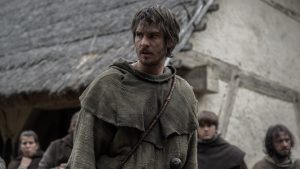
While obviously there wasn’t a real man called Ploughman, he’s my fictional hero, but that village looks pretty much like Brentwood would have looked like, and the tax collection would have been the tax collection, and for sure it began with a violent altercation when the tax collector came to town and started roughly assaulting the young women in the village. It’s attested that that’s how it began. What was unusual was it spread incredibly rapidly all across southern England within a matter of days and coalesced into this coordinated march by ordinary men and women in their tens of thousands on London at a time when there were no armies there. The armies were in Scotland and France, and the crown was effectively defenseless.
You had then this week of high drama as they got to London, negotiated with the king, were betrayed and the rebellion was crushed, but they got inside the place and trashed the place. It began peacefully with very clear and specific aims and was actually initially highly disciplined, but then like all revolutions do, it descended into violence and chaos.
That violence, as well as the ideals and aspirations, it all begins with people challenging their institutions. After the plague, peasants began challenging their governments, their churches, in the 1300s, but I feel like right now, we’re living in a moment of retrenchment where people are pulling away or burrowing down. Do you see this movie as a reminder to the opportunity we as a society might have at this moment?
When you make a movie you start by trying to decide what sort of movie you want to make. Do you wanna make a sci-fi movie, do you want to make a romantic comedy? I wanted to make a sort of historical epic, that’s kind of what was in my mind. I very much admired Spartacus, [Stanley] Kubrick’s movie, very much, and I very much admired Ridley’s movie Gladiator. I love those kinds of movies. So when I was looking to do a story about an English [event], I thought, ‘Oh, I could do like a Gladiator, Spartacus type movie, but it’d be my version of one of those movies, because I’m not going to have the same sensibility as either Ridley or Kubrick.
So I’ll create a fictional character and I’ll try to tell a hero’s journey through these dramatic events, which were so important in the evolution of the story of individual rights in our societies, I mean, historians hold a mirror up to the Peasants’ Revolt [to today]. There’s a brilliant book by a historian called Barbara Tuchman, A Distant Mirror, and it’s about the 14th century, the chaos of the 14th century, but it’s really all about how that instability of which the Peasants’ Revolt was the most important part of it, led the way to the evolution of individual rights and on through the individual rights, the fight against the crown, the American Revolution, the Constitution, it’s an unfolding story of the Enlightenment and the evolution of democracy, and it was a foundational moment.
But all of that’s irrelevant because you’ve got to craft an entertainment, you’ve got to craft a movie. Although I was very struck by how contemporary it all felt, to go to your question—this starkly divided world between the oligarchs protecting their wealth and this sense generally of rage out there that people feel a bit locked out by a system rigged against them—that all felt very contemporary, but in the end, it doesn’t give you your film. It’s part of what you’re dealing with, but you’ve got to craft your hero’s journey, your entertainment, characters that you want to follow, and tell it with economy and give it scale and drama and all the rest of it.
So it’s in your mind, it’s part of what makes the film interesting, but it’s not your purpose; its purpose is to give people a great experience. Like I loved when I saw Spartacus in the cinema or when I saw Gladiator.
The Uprising is in theaters on Friday, Sept. 11.
The post Paul Greengrass Reveals The Uprising Began With the Title ‘The Hood’ appeared first on Den of Geek.