By
By 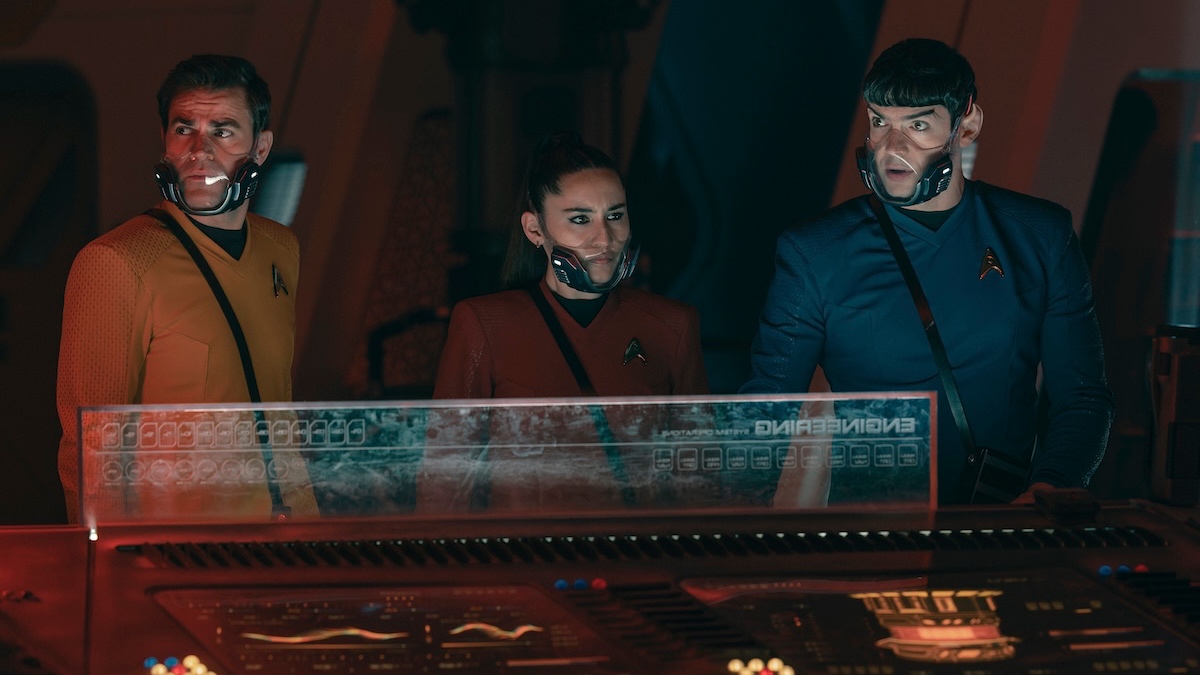
This article contains spoilers for Star Trek: Strange New Worlds season 4 episode 2
The latest Star Trek: Strange New Worlds episode “The Griffin Incident” builds from a classic Star Trek premise. A group of Starfleeet officers returning from a conference—in this case, Kirk, Spock, and La’an coming from the Future Leaders of the Federation Conference—encounter a strange phenomenon, namely the missing Starship the USS Griffin. As the trio begin making their way through the abandoned ship, they realize the mystery may go beyond their abilities to solve, with Spock musing, “Perhaps the answers can only be uncovered by Division 12.”
The line will likely go unnoticed by most viewers, who will find plenty to love in the episode’s horror vibes and the lore building around Kirk’s relationship with Carol Marcus and their son David. But for those who recall Erica Ortegas mentioning the unit in the season three episode “Terrarium,” Division 12 becomes all the more compelling, especially in light of the franchise’s mishandling of Starfleet’s favorite secret unit, Section 31.
For a series devoted to exploring the USS Enterprise in the years leading up to Kirk’s command, Strange New Worlds hasn’t been afraid to expand or add to the franchise’s lore. We already saw how the show used the effects of the Temporal Cold War on Star Trek: Enterprise to alter the timeline of Khan Noonien Singh and introduce a new long-living race called the Lanthemites, in the form of engineer Pelia. But Division 12 feels distinct from even these additions, precisely because of how gradually the series is revealing it.
The first mention of Division 12 occurred in “Terrarium” and, as in “The Griffin Incident,” it only comes up as an off-hand observation. When Ortegas goes through a wormhole, she notes that she’s in a region famed for its strange phenomena, “The kind of thing Division 12 usually looks into.” In that episode, Ortegas ends up encountering a Gorn, a species she and her shipmates know well, and a Metron, one of the godlike beings who pit Kirk and a Gorn against one another in the Original Series episode “Arena.”
In “The Griffin Incident,” we get at least a little more about Division 12, thanks to some follow-up dialogue. When Spock brings up the unit, La’an describes them as “Starfleet analysts that run around investigating unexplained phenomena.” La’an’s phrasing makes Division 12 sound similar to another recently-introduced part of Starfleet, Division 14. As shown in the Lower Decks episode “Much Ado About Boimler,” Division 14 focuses on scientific and medical mysteries, particularly those affecting personnel.
Certainly, whatever happened on the Griffin affected the crew. However, where Division 14 deals with strange issues that come to them, the descriptions from La’an and Ortegas suggest that Division 12 goes looking for the unexplainable, sort of like The X-Files in the world of Star Trek.
Obviously, “X-Files in Star Trek” is an elevator pitch that would make any genre nerd excited. But it’s particularly compelling given modern Star Trek‘s obsession with a different secret Starfleet division, Section 31. First introduced in the later seasons of Deep Space Nine, Section 31 is a clandestine black ops division put into place by Article 14, Section 31 of the original Starfleet Charter.
In Deep Space Nine, Section 31 was used by writers as something that tempts our heroes, but something that they ultimately overcome. Section 31 first appeared in a storyline that saw operative Luther Sloan attempt to recruit Dr. Bashir, blackmailing him by threatening to expose him as an augment, a condition that would bar him from serving in Starfleet. Sloan wanted the doctor to help him wage war against the Dominion, and Bashir’s resistance echoed the various ways Captain Sisko and others fought against their darker impulses while dealing with an overwhelming enemy. The fact that Section 31 secretly used Odo to commit genocide against the Changelings running the Dominion undercut Starfleet’s final victory, showing how war corrupts the Federation’s optimism.
While Enterprise more or less used Section 31 in the same way, later Trek has been more eager to embrace and even valorize the unit. Although Section 31 is the true big bad of the 2013 movie Star Trek Into Darkness, that thematically messy film makes all of Starfleet feel vaguely fascist, positioning Kirk and crew as outliers instead of exemplars. Discovery seems to follow suit, making a Section 31 operative its prime villain in season two and sending Empress Georgiou of the Mirror Universe’s Terran Empire to join them. But the show is too in love with edgy cool to truly critique her actions, and so Georgiou’s inclusion ends up making Section 31 feel cool, too.
Or, rather, attempt to feel cool. It’s hard to imagine anyone who saw the Section 31 movie actually enjoyed it. But it’s also hard not to see how hard the movie wanted the audience to cheer for a black ops group that gunned down its enemies, doing the “real” work so all the dorky explorers can travel the galaxy.
Given that Star Trek is all about dorky explorers who travel the galaxy, Section 31 never deserved the amount of attention it received. But if Division 12 is indeed a unit devoted to finding the strange and unexplainable, then Trek producers may have finally found the secret organization they’re looking for. Intentionally seeking out phenomena that makes no sense fits right in the Star Trek ethos, especially if its agents approach the phenomena with reason and empathy, acting out of a desire to understand instead of responding to fear.
The Event Horizon homage in “The Griffin Incident” shows how hard it is to be empathetic instead of fearful, even for the Future Leaders of the Federation. But “The Griffin Incident” also demonstrates that boldly going into scary environments can make for excellent Star Trek, in a way that Section 31 stories rarely accomplish.
Star Trek: Strange New Worlds streams new episodes every Thursday on Paramount+.
The post Star Trek: Strange New Worlds Can Fix Modern Trek’s Biggest Problem appeared first on Den of Geek.