By
By 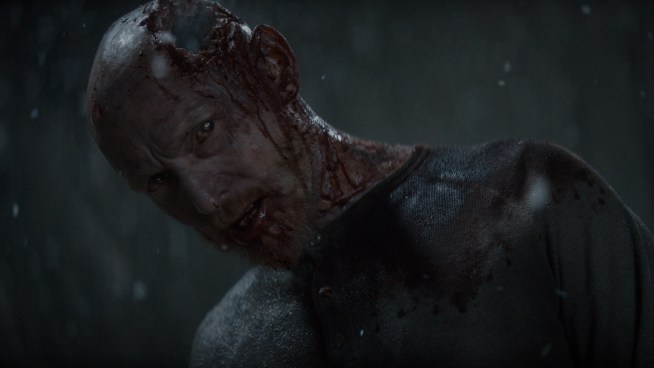
Modern Evil Dead movies are a far cry from the tongue-in-cheek splattercore silliness of Sam Raimi’s original trilogy, but they’ve very much cemented their own legacy within the genre by pushing the boundaries of good taste and competing for the title of horror’s meanest franchise. With Evil Dead Burn, the sixth film in the series, director Sébastien Vaniček (Infested) leans fully into the franchise’s take-no-prisoners, nothing-is-sacred mentality, sprinkles the screen with viscera, showers it with blood, and delivers another nasty, simple, brutally effective piece of genre filmmaking that proudly carries on the Evil Dead’s demented baton.
One thing that has defined this modern slate of Evil Dead movies – beyond how unspeakably mean they are to basically every single character unfortunate enough to wander into frame – is that each latches onto a different thematic wound. Fede Álvarez’s 2013 reboot transformed Deadites into a metaphor for addiction and the collateral damage it inflicts upon families and friends. Evil Dead Rise explored the nuclear family dynamic, torturing a mom, aunt, and her three kids to speak to ideas of maternal instincts and guardianship. This latest installment, Evil Dead Burn, centers around the idea of domestic abuse. The bruises and broken bones. The grabbing of arms. The “accidents” that leave scars. The public dressing downs. And ultimately how silence begets complicity that allows abuse to fester, take root, and become integral to the home itself.
Alice (Souheila Yacoub) is the abused party here and, from our very first encounter with her and her husband William (George Pullar), we get a taste of the casual cruelty that defines her daily life. William’s abuse manifests in little ways long before Deadites ever enter the equation: snide remarks about Alice’s sexuality, the casual degrading of her French heritage, grabbing her violently, and bristling at the small displays of affection between Alice and his meek (but also taken) younger brother Joseph (Hunter Doohan). We’re worried about Alice before the first Deadite arrives. Supernatural evil comes later but domestic malevolence has already taken root.
If there’s one thing we learn about the Deadites, it’s that it’s easier to infect a household that’s already rotten. They almost give themselves over to its evil willingly. And once the Deadites do arrive, veteran Evil Dead viewers already know the rules. If the camera lingers on an object for even a moment, there’s a very high likelihood it’s eventually going to violently enter somebody’s body. Every seemingly ordinary household item becomes a future pigsticker. Every body part is essentially expendable. No line is left uncrossed. No digit or hole left ungored. Few modern horror series delight in creative human suffering quite like Evil Dead, and Burn somehow manages to keep up the already ridiculous standard of imaginative cruelty previously established.
In addition to their brutal adherence to a high watermark of violence, modern Evil Dead films have thrived on their simplicity and adherence to a winning formula, resisting the temptation to overcomplicate the mythology, and Burn continues that tradition. Written by Vaniček and his Infested collaborator Florent Bernard, the screenplay once again proves that straightforward horror can nevertheless support rich thematic ideas without drowning in superfluous lore. There is one notable addition this time around: a mystical dagger capable of carving the evil out of a possessed deadite and returning it to just a normal, not-even-haunted corpse.
[READ MORE: Our review of ‘Evil Dead Rise‘ directed by Lee Cronin and starring Lily Sullivan]
Joseph, who has devoted himself to studying his grandfather’s research into the occult and the mysterious Circle of Wise Men who forged the weapon, accidentally brings it back into the light. As an early recording ominously warns, once the Deadites know the dagger has resurfaced, they’ll stop at nothing to reclaim it. But all of that mythology is really just a delivery system for the horrors to unfold. The emphasis remains where it should: on this twisted family and the deadites there to chew their already torn-apart pieces even further asunder.
And while other franchises may try to find some semblance of lessons learned for their broken characters, Burn doesn’t let anyone off the hook quite so easily. Edgar (Erroll Shand), the family’s patriarch, carries himself with an almost demonic severity long before the undead burn their way into his psyche, while Susan (Tandi Wright) embodies another recognizable type of abuse: the cold and enabling spouse. Wright gives Susan a caustic bitterness that suggests a woman whose humanity has slowly calcified beneath decades of obedience and scorn.
When William dies and the fractured family gathers for his funeral, the rot becomes impossible to ignore. Alice, rather than finding sympathy after years of abuse, is treated like an unwelcome intruder. Everyone knows exactly what William was. Everyone knows how he treated her. Yet it’s easier for them to convince themselves Alice somehow deserved it than confront the uglier truth that they all stood by and let it happen. As a French outsider who married into this well-to-do but deeply insular family, she was never truly accepted. She was tolerated. Provided for. Never embraced.
Which makes the arrival of the Deadites especially inspired here – almost welcome. The undead, as they so often do in this franchise, know all the secret buttons of the living. Their shame. Their desires. They weaponize the family’s buried resentments and hypocrisies, taunting Alice with the grotesque suggestion that maybe she stayed put because she liked the abuse. Perhaps she needed it. The vicious twist of victim-blaming rhetoric and supernatural horror. Horrifying in how abuse doesn’t merely survive because of one violent man but because entire families construct stories that allow them to keep living with themselves and their horrors.
[READ MORE: Our review of ‘Evil Dead‘ directed by Fede Alvarez and starring Jane Levy]
Kid brother Joseph, the family’s perennial punching bag, and his girlfriend Thya (Luciane Buchanan), the lone outsider besides Alice, bring a different shade to the proceedings. Doohan channels a kind of earnest awkwardness that almost makes him sympathetic. He’s the one quietly offering Alice moments of kindness. The one who clearly recognizes the abuse. Yet Burn wisely refuses to let him off the hook. Kindness without intervention is still passivity. Joseph isn’t cruel in the way his big bro and pops are. He’s simply too much of a coward to actually stop them. The subtext of this movie about undead gore-hound demons quietly argues that violence survives not merely because monsters exist, but because decent people convince themselves doing the bare minimum is sufficient.
The cast understands exactly what kind of blood-soaked phantasmagoric nightmare they’re in. Yacoub makes for a committed, physically punished final girl, even if the role’s demands are mostly her screaming in pain rather than tons of emotional range. And while Buchanan is given relatively little to do before the chaos begins, she gamely throws herself into becoming one of the film’s more inventive human punching bags once the Deadites arrive. Then there’s Maude Davey, whose delightfully senile grandmother repeatedly steals scenes with perfectly timed bits of dark comedy. In a movie this relentlessly nasty, the script’s small moments of levity are totally essential.
The effects meanwhile are every bit as grotesque as fans of the franchise have come to expect. While there’s already an impossibly high standard for brutality, blood, and bodily mutilation in the Evil Dead world, Burn somehow lives up to it, delivering some of the series’ grossest moments alongside kill sequences that are intricately staged and impressively directed. It might even be the meanest of the bunch. But beneath all the arterial spray lies one of its richest thematic explorations. It’s a movie about monsters, certainly. But more importantly, it’s a movie about the monsters people become when casual domestic violence is allowed to fester inside a house, passed from one generation to the next unchecked. In this case, the scariest thing in this Evil Dead movie isn’t the Deadite. It’s the family that invited it inside.
CONCLUSION: ‘Evil Dead Burn’ is a sadistic addition that proudly continues the franchise’s tradition of treating its characters with extreme cruelty while gifting its sicko fans with some of the year’s gnarliest gore. Beneath all that blood, however, lies a surprisingly thoughtful story about an abuse survivor fighting to escape a family determined to wear her down long before the Deadites arrive.
A-
For more reviews, interviews, and featured articles, be sure to:
Follow Silver Screen Riot on Letterboxd
Follow Silver Screen Riot on Facebook
Follow Silver Screen Riot on Twitter
Follow Silver Screen Riot on BlueSky
Follow Silver Screen Riot on Substack
The post Horror’s Meanest Franchise Strikes Again with ‘EVIL DEAD BURN’ appeared first on Silver Screen Riot.