By
By 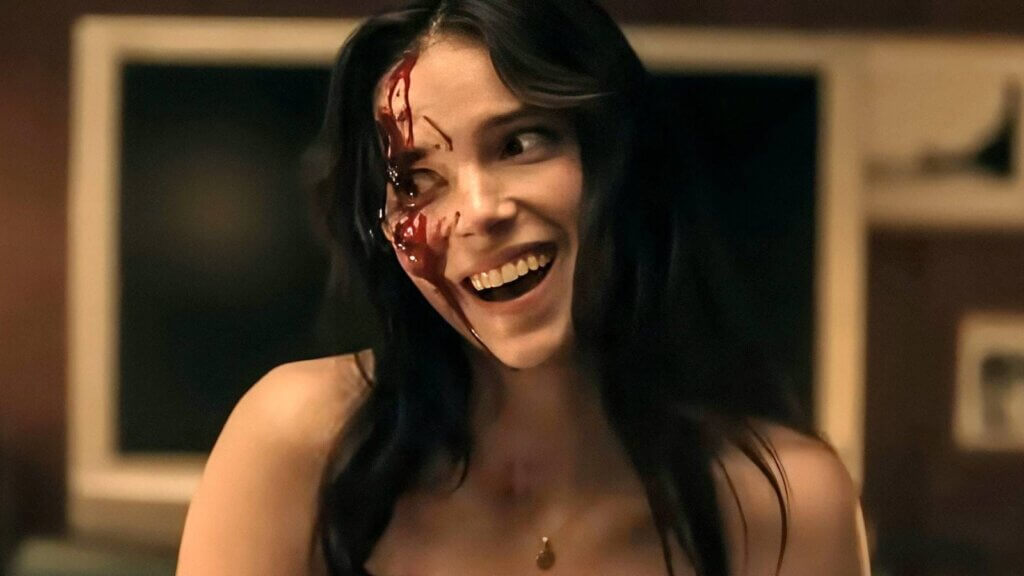
I have a soft spot for horror films that clearly don’t have money to waste. When a filmmaker cannot rely on big budgets or a recognizable franchise, every choice has to matter a little more. Curry Barker’s Obsession (2026) was reportedly made for just $750,000, but it rarely feels constrained by that budget. It is confident, nasty, frequently funny, and far more visually controlled than plenty of studio horror films that cost twenty times as much.
Michael Johnston plays Bear, a young man who’s secretly in love with his childhood friend and co-worker, Nikki (Inde Navarrette). Rather than risk the embarrassment of telling her how he feels, Bear uses a strange novelty called the One Wish Willow to make her fall in love with him. It works, although anyone who has ever encountered a cursed object in a horror film can probably guess that “works” comes with some big caveats. Nikki’s affection quickly becomes terrifying.
That premise could have produced a fairly ordinary story about an obsessive woman and the frightened man trying to escape her. Fortunately, Obsession is smarter than that. Bear may spend much of the film looking like the victim, but he created the situation by trying to bypass Nikki’s freedom.
There is something painfully believable about the cowardice behind that decision. Bear wants intimacy without vulnerability. He wants the reward of being loved without risking rejection, embarrassment, or an honest conversation. Like Craig in Friendship (2024), he turns a recognizable desire for connection into something frightening because he cannot accept that another person’s feelings exist independently of his own. The difference is that Bear gains the supernatural power to force reality into the shape he wants.
I have seen people online try to connect Nikki’s behavior to Borderline Personality Disorder. I understand where that interpretation comes from, particularly in the intensity of her attachment and her terror of abandonment. Still, I think diagnosing Nikki distracts from what the film is actually doing. Her behavior is not presented as the emergence of some hidden psychological condition. It has been imposed on her. Reading the horror primarily through BPD risks turning a violation committed against Nikki into a pathology that belongs to her. It’s also disrespectful to those who actually struggle with BPD, as it conflates horrific behavior with the condition.
Obsession (2026)
The more disturbing implication is that Nikki’s true self has not simply changed. It has been displaced. Her body and personality are reorganized around Bear’s desire, while the person she was is effectively pushed into a hellish limbo. She remains present enough for the loss to matter, but not free enough to reclaim herself.
This is where Obsession becomes more than a clever variation on “The Monkey’s Paw.” The wish does not merely deliver an exaggerated version of what Bear requested. It exposes the violence already contained within the request. Love obtained by eliminating the other person’s autonomy is not imperfect love or unhealthy love. It is possession.
That concern places the film surprisingly close to Heretic (2024), another horror story about a man who convinces himself that control is a form of intellectual or personal fulfillment. Both films understand that coercion can disguise itself as an invitation. Bear is less theatrical and self-assured than Mr. Reed, but his insecurity doesn’t make him innocent. If anything, his passivity makes his behavior more frustrating. He causes something catastrophic because he is afraid to be honest, then repeatedly proves too cowardly to deal with the consequences.
Inde Navarrette is the main reason all of this works. Nikki could easily have become a collection of “crazy girlfriend” tropes, especially once the film begins pushing her behavior into grotesque territory. Navarrette gives the character a physical unpredictability that is much harder to dismiss. She can switch from affectionate to uncanny without a conventional scare cue, and Barker frequently lets her body do more than the dialogue.
Obsession (2026)
The film’s creepiest moments are simple in nature. Nikki hides behind a flower plant in a way that’s almost childish, but extremely scary. When she crashes through a car window, Navarrette and the practical effects transform a sudden burst of violence into one of the film’s most memorable images. These scenes work because Nikki does not behave like a monster following familiar horror rules. She behaves like a person whose body is being operated by a desire too large and too artificial to fit inside it.
Barker’s direction deserves much of the remaining credit. His background in comedy is visible in the timing, but the humor rarely dissolves the tension. As Barker explained in an interview with Focus Features, comedy and horror both depend on observing why people behave the way they do and then pushing those behaviors into unexpected territory. Obsession does exactly that. Bear’s social awkwardness is initially funny because it’s familiar. It becomes horrifying when the film gives that awkwardness the power to control someone else.
The limited budget occasionally works in the film’s favor. Barker keeps the focus on faces, bodies, and tactile practical effects. The violence feels unpleasantly close rather than polished into digital spectacle. As with Swallow (2020), the body becomes the place where an abusive relationship makes its control visible. Nikki’s transformation is frightening not just because of what she might do to Bear, but because we gradually understand what has already been done to her.
Obsession (2026)
That is also why I expect the film to resonate strongly with people who have experienced abusive relationships, though not necessarily in a comfortable or cathartic way. Some viewers may recognize the experience of having their identity reorganized around another person’s needs. Others may find that recognition too close to home. Obsession exaggerates coercive control through magic, but the emotional structure is painfully ordinary: one person treats another’s independence as an obstacle, then acts surprised when the relationship becomes a nightmare.
My only real reservation is that Obsession is slightly less frightening than its premise and imagery suggest it could be. It is consistently tense and contains several genuinely creepy scenes, but it does not sustain outright fear throughout its runtime. The black comedy, relationship drama, and escalating grotesquerie sometimes take precedence over scares. That is not a major failure, and I would not want Barker to sacrifice the film’s personality for constant jump scares. Still, it is the small gap separating an excellent horror film from one of the rare films I would consider nearly perfect.
I almost never give a film five stars, so four should not sound like faint praise. Obsession is one of the strongest low-budget horror films in recent memory, anchored by a fearless performance from Inde Navarrette and a director who understands exactly how much discomfort he can extract from a simple premise. Most importantly, it refuses to let Bear hide behind the consequences of his wish. Nikki’s behavior may provide the spectacle, but his violation of her autonomy is the real horror.
Obsession (2026) Film Rating: ★★★★ out of 5
If you’d like to watch Obsession (2026), the film is currently available to stream, rent, or purchase via Amazon.
The post Obsession (2026), Horrific Love Without Consent appeared first on Philosophy in Film.