By
By 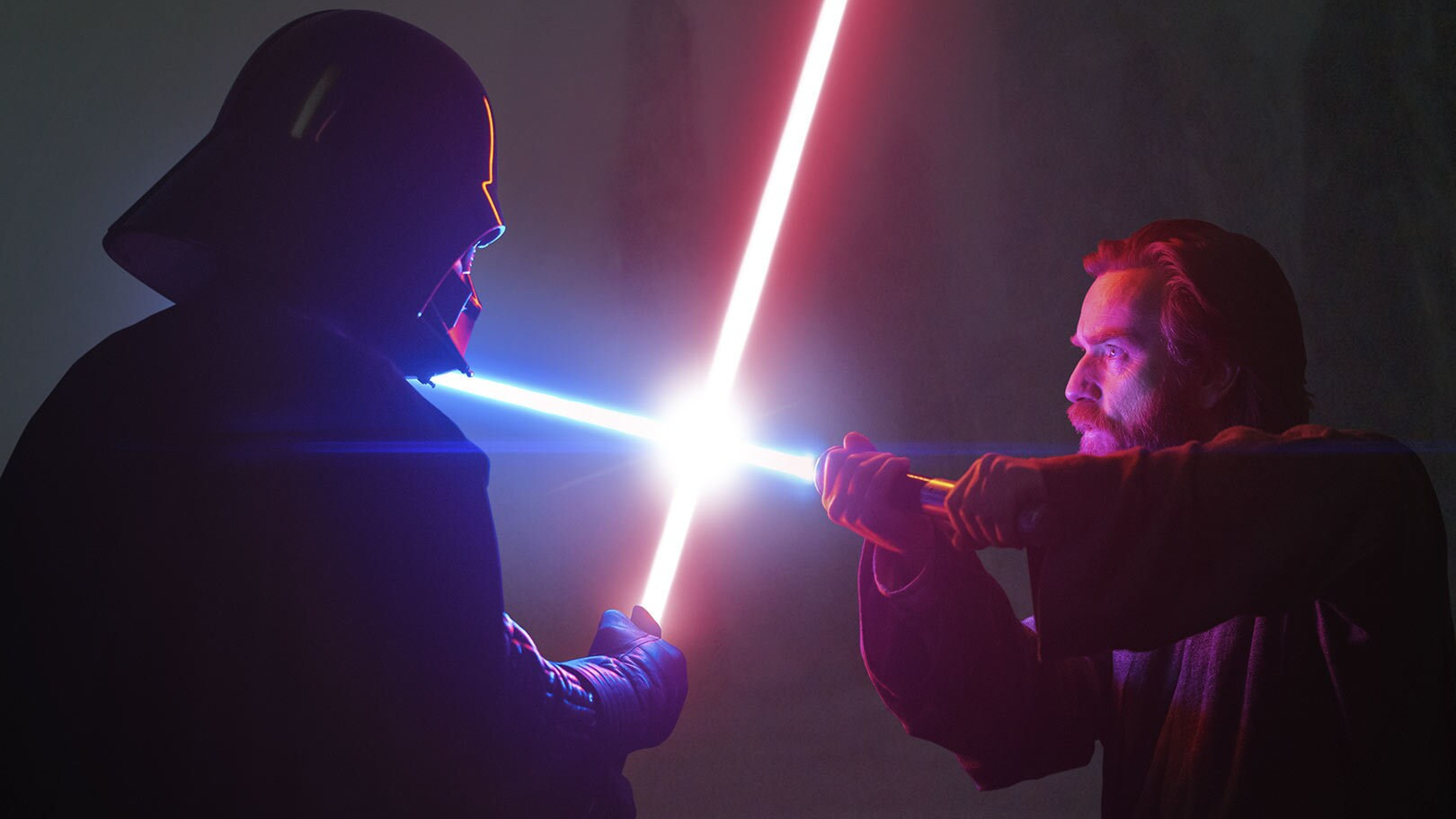
Who da man? If you’re a Star Wars fan of a certain age, there’s only one answer to that question. It comes from a television ad for the DVD release of Attack of the Clones, which began with the lines, “Who da man? Yoda man!” The commercial is built around a scene from the movie, the first to feature a CGI Yoda. No longer bound by the arm of Frank Oz, Yoda hobbles into a cave to face Count Dooku and, in a hyperactive variation of the Drunken Master trope that birthed him, leaps into the air to attack with his lightsaber.
What follows is an aggressive, spectacular, and frankly dizzying sword fight, unique for Yoda, but not, at this point, for Star Wars. Since the release of The Phantom Menace, lightsaber duels have become all about speed and flash, as if the combatants primarily wanted to overwhelm their opponents with slashes rather than land a strategic strike. The evolution makes the contests in the original trilogy look slow and outdated, but something is lost when spectacle becomes the main goal of a fight scene.
Stories and Sabers
Consider perhaps the best lightsaber duel of the original trilogy, the climactic clash of Luke Skywalker against Darth Vader in The Empire Strikes Back. The scene looks incredible, with cinematographer Peter Suschitzky using smoke and colored lights to add texture to the industrial setting. The fighters face off in silhouette, the blue and red of their blades providing simple representations of good and evil.
Luke gets in a few fancy moves during the fight. He employs the occasional spin and flip, and even uses the Force to leap out of a pit. But he just as often stumbles, as when he gets the saber knocked from his hands, and even visibly struggles when climbing up some hoses to escape Vader. When Luke knocks his enemy down, the editing takes its time to show his process of moving in to complete the job. Luke pauses to attach his weapon to his belt, he waits for the hydraulic gate to open. When Vader uses the Force to hurl objects against Luke, he simply stands stoically to the side, letting the flying debris do the work.
The Empire battle leads to one of the most famous twists in cinema history, the reveal that Darth Vader is Luke Skywalker’s father. But even before that legendary piece of dialogue, the scene is telling a story through its fighting. When the two meet, Luke draws his saber first and points it at Vader, indicating that he wants to fight the man who killed his mentor, not to just attack him. Vader doesn’t immediately strike either, and instead touches his blade to Luke’s, initiating the battle. By doing so, Vader shows respect to Luke that he didn’t have in the previous movie, when Young Skywalker was just a farm boy picked up by Obi-Wan.
All of the attacks in the fight continue the narrative, with each slash and strike adding a new wrinkle. Lukes initial salvo demonstrates how much he’s learned from Obi-Wan; Vader’s one-armed deflections show how little he actually knows. Vader’s stance during the Force indicates his confidence in his overwhelming power; Luke’s frantic attack toward the climax reveals his loss of control.
These story beats are only legible because we viewers aren’t distracted by the mania of the fight. The battle has room to establish the characters, without detracting from their skill as duelists.
First Fight
The same principle is at work in the franchise’s first lightsaber fight, between Obi-Wan and Darth Vader in the original Star Wars. In the memory of most fans, the contest is slow and plodding, a consequence of pitting 63-year-old Alec Guinness against costume-laden David Prowse. Some have even taken to recreating the scene to bring it into line with the more frenetic modern battles.
In fact, Obi-Wan does get in a couple of spins, and Vader does do a little charge while slashing, albeit much less than when Ewan McGregor and Hayden Christensen face off. But to dismiss the pace of the fight as nothing but old people making a shoddier movie is to miss the drama of the scene.
Like the battle in Empire Strikes Back, the fight in Star Wars comes laden with tension between the two characters. In this case, Vader wants to show his former master what he has learned, to prove that he no longer needs the old man’s teachings. Obi-Wan seeks to show that his pupil has learned nothing at all, which he demonstrates even before sacrificing himself.
Vader thinks that power comes entirely from physical strength, and while he’s mature enough to avoid the onslaught that the excitable Luke unleashes in the next movie, he still wants to win the duel. To that end, Vader maintains his form and keeps to the rules, hoping to defeat his opponent fair and square. Conversely, Obi-Wan knows that he will only become more powerful if Vader strikes him down, and therefore doesn’t need to fight to win. His strikes are sparse and strategic, his stances tend to be defensive, giving him space to teach his protégé one last time.
The Star Wars duel cannot be fast, because it’s not about winning or physical domination. It’s about developing the characters.
Losing the High Ground
It wouldn’t be fair to say that lightsaber battles after the original trilogy have disregarded storytelling. Yes, the Yoda fight in Attack of the Clones is egregious, but others have their beats and memorable moments. The sliding doors in The Phantom Menace give space to show young Obi-Wan’s anger at Darth Maul after Qui-Gon Jinn’s death. “I have the high ground” may be a clanger, but that fight shows just how far Anakin has fallen, and the desperate measures Obi-Wan is willing to take.
The sequel trilogy has notable moments too, especially in The Force Awakens. Finn losing the lightsaber and Rey gaining it may be a lamentable story beat, but it is a story beat. And Kylo Ren’s pounding of his chest to increase blood flow adds a compelling character detail.
But these beats and quirks are minor digressions. Instead, the fundamental point of each modern lightsaber scene is simple and the same: look how cool this guy is. What once began as scenes intended to show that size matters not, have turned into celebrations of power, spectacles designed to answer once and for all, “Who’s the man?”
The post Star Wars’ Slow Lightsaber Duels Were Elegant Battles For a More Civilized Age appeared first on Den of Geek.