By
By 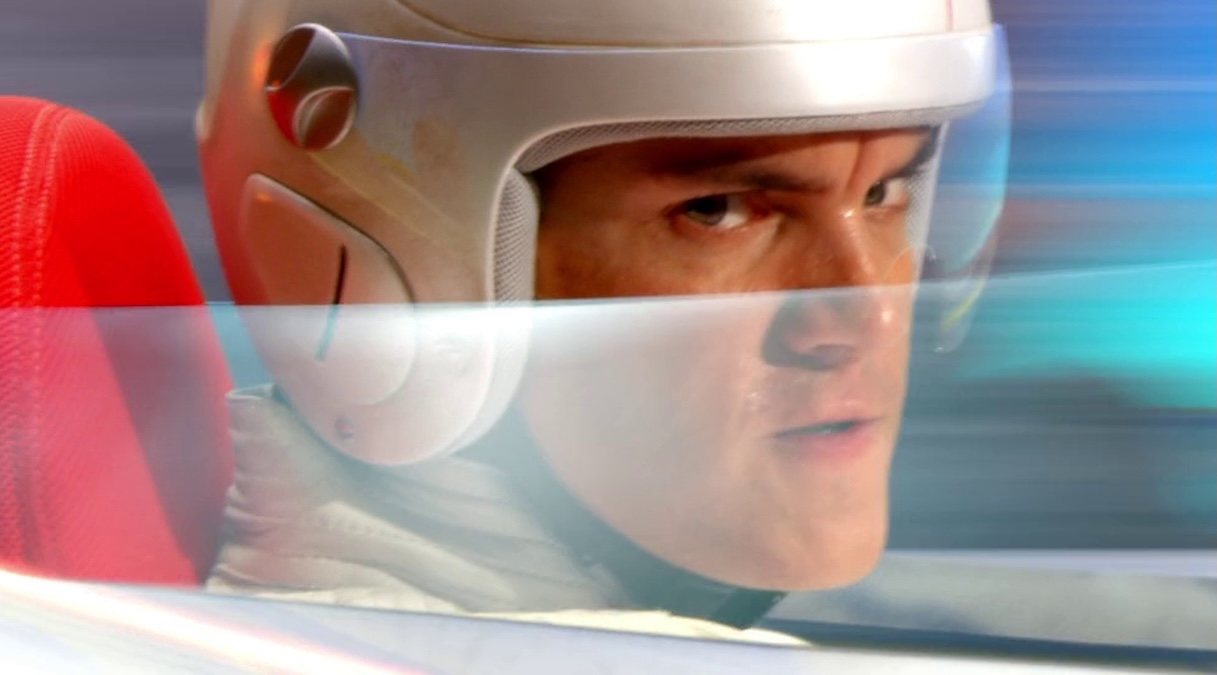
When Speed Racer hit theaters in 2008, its pleasures blew right by audiences. “Speed Racer goes nowhere, and you’d be amazed how long the trip can take,” lamented the New York Times; “It’s
forward-thinking, visionary, and much of the time unwatchable,” charged theA.V. Club. Moviegoers agreed, and Speed Racer barely crossed the finish line, making $93.9 million on a budget of $120 million.
Nearly 20 years later, it’s clear that Speed Racer wasn’t falling behind. It had already lapped us. In recent years, fans have come around to what directors Lana and Lilly Wachowski were doing with their unabashedly earnest, visually uncompromising celebration of passion over profits, with even A.V. Club critic Scott Tobias calling it “cutting-edge work” and admitting “not everyone is ready for the future, even if they suspect they’re seeing it”
If there’s one person who always saw where Speed Racer was going, it’s actor Emile Hirsch. Which makes sense, because he’s the guy behind the wheel. “When we saw the finished product, it was incredible,” Hirsch tells Den of Geek. “Then when the world rejected it the way they did, it didn’t shake my confidence in the film, but it did blow my mind.
“We knew we had a great movie, we loved it,” he continues. “We poured our hearts into making it, and the movie was so beautiful. And then to have it come out and get rejected at the box office, and have the critics pile on. It felt like we were shunned.”
“Shunned” is exactly the word to describe the response to Speed Racer at the time. Not only did it come off the two Matrix sequels, which raised questions in the popular imagination about the Wachowskis’ abilities as filmmakers, but the movie arrived in theaters on May 9, 2008… one week after Iron Man arrived and launched the MCU and six weeks before The Dark Knight hit screens.
Between the competition from those two genre juggernauts and the mixture of utter sincerity and over-the-top visuals, it’s no surprise that Speed Racer lost the box office race of 2008. But Hirsch never doubted the work that he and his co-creators did.
In particular, Hirsch had faith in the siblings who wrote and directed the film to help him see the vision. “I got it from the moment I read the script,” he recalls. “The way the Wachowskis write makes it clear, and I understand what they mean, without any irony. You watch the Matrix trilogy, and Keanu Reeves is giving this very sincere performance. There are a couple of comedic moments, but overall there’s this sincerity in his performance. My instinct was to gravitate toward that tone, because that’s clearly what they like.
“You look at Speed and he’s this pure, sweet-natured person. There’s no blasé way to play Speed. If you were to try to be ironic or winking, the scene would feel off. So I had to be all the way in it. I wasn’t doing anything crazy, like making everyone call me ‘Speed’ or anything. But in terms of purity of vision, I knew his heart and I never called it into question.
“That all comes from the script. Lana and Lilly wrote it in such a way that you could understand even the Grand Prix scene with all the moments of Speed’s life coming together into a beautiful whole.”
Of course, it didn’t hurt that there were some physical parts of the movie, despite all the crazy digital effects on screen.
“I spent 19 days in a gimbal shooting those racing scenes, with this huge robotic arm moving me around at every angle you can think of,” he remembers. “So I’m getting moved around plenty, and that arm is strong. There were occasions where I was really getting tossed around.
“I did a lot of that with second unit director James McTeigue while the Wachowskis were on the main set. He liked to give the Wachowskis every option for my expressions during the race, so we’d shoot 10 different moments in 10 different ways. So then they could pick the perfect moments for each sequence in the car.”
Given the mental and physical work he put it, one can understand Hirsch’s frustration at Speed Racer’s initial poor reception. And one can also understand the elation he felt when people began to rediscover the movie.
“I remember going to Quentin Tarantino‘s New Beverly theater for a midnight showing,” Hirsch says. “When we got to Speed Racer winning the Grand Prix, I could audibly hear everybody in the audience crying. And that’s when it hit me that this is more than just something that’s visually or aesthetically on another level. There’s heart and emotion behind it. I think that’s why Speed Racer is so powerful and lasting, because it’s about finding the meaning of your life, about the love of your family and friends to help you overcome your doubts and fears.
“When people see it, and they’re open to it, it hits them on a deep level and brings them back to childhood dreams, back when they could do anything. I think that’s a big part of why Speed Racer has a strong legacy.”
While he’s grateful for the praise given to his performance, Hirsch credits audiences with making Speed Racer the classic it is today.
“I’m sure there are examples, but I can’t think of too many movies that had such a terrible reception and then had such a sea change in the years since. I’m taken aback at the level of adoration people have for the film now, especially having lived through the 2008 release,” he admits.
“It’s a real testament to the power of fans, just people watching the movie and talking about it to other people. You go to YouTube and there are hundreds of videos with people calling Speed Racer a masterpiece. And it’s happening in an organic way. Nobody’s pushing anything; it’s just movie fans deciding that this is how they feel about Speed Racer.”
From a last-place loser to a cult favorite, to now getting a proper 4K release from Warner Bros, Speed Racer has certainly run an incredible race. And Emile Hirsch is thrilled to be along for the ride.
Speed Racer returns in 4K on May 19, 2026.
The post Speed Racer: Emile Hirsch on Audiences Catching Up to the Wachowskis’ Masterpiece appeared first on Den of Geek.