By
By 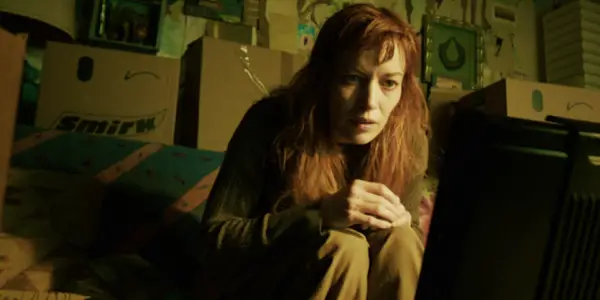
Deliciously delirious. I’m always up for a mindf**k of a movie, especially one that leans into disorientation without completely abandoning intention. A film that rattles you first, then lets the meaning catch up later. Sender is exactly that kind of experience.
In his feature debut, director Russell Goldman doesn’t so much ease us into a psychological thriller as throw us headfirst into one. Adapted from a short Goldman had made, it’s a story that deserves a longer take, even if some edges could have been shaved. Is it bizarre? Absolutely.
Distrust as the Point
Julia (Britt Lower) is in recovery. At an AA meeting, she sits slightly off to the side, disengaged, scrolling online instead of participating. When Whitney (Rhea Seehorn) talks about her struggles (especially around leadership and being the boss) Julia snickers, loud enough to be noticed.
It’s a small moment, but it tells us everything.
Sender (2026)- source: Comet Pictures
Soon after, Julia asks Whitney to be her sponsor and they exchange numbers. The interaction is stiff, awkward, unresolved. Not long after, Julia starts receiving packages she didn’t order. At first, it seems innocuous enough; annoying, maybe unsettling, but not invasive.
Then the pattern sharpens. The items are specific. Uncomfortably so, as she receives she needs a that she’s recently searched for.
This is where Sender really locks in. The packages stop being a gimmick and instead become pressure points — physical manifestations of surveillance, overexposure, and the quiet horror of feeling watched without knowing by whom. Tatiana (Anna Baryshnikov) her sister is also checking in unexpectedly, overbearingly adding to Julia’s unease.
As the deliveries pile up, so does Julia’s paranoia. Her delivery driver, Charlie (David Dastmalchian), offers to help when she explains what’s happening. Their relationship exists in a constant gray area: caring but suspect, comforting but never fully safe. The film thrives in that tension. I loved their interactions and genuinely wanted their team up to shine.
Trust, in Sender, is never stable. Institutions don’t feel reliable. People feel slippery. Even Julia’s own perspective is up for debate. Goldman never clarifies more than he has to, trapping us inside her fractured mental space. His screenplay allows for the performances to take center stage with a confident combination of editing and score to amp up the relentless, trippy story.
Sender is fully committed to pulling you under; whether you want to go or not. Whether that immersion feels exhilarating or exhausting will depend entirely on your tolerance for anxiety-driven cinema, but there’s no denying how singular its energy is. The ending has bite, and provides a showdown that feels earned.
This isn’t a movie interested in release. It resists it. Sender lingers in an invasive way, clinging to the brain long after it’s over. This is not comfort viewing; it’s provocation by design. Even when it had me at my most unnerved, it still had me.
Performance-Driven Unease
This is a genre lover’s dream cast.
Britt Lower carries the film and is brilliant. Even when Julia becomes unreliable, Lower keeps her grounded in something emotionally legible. David Dastmalchian‘s role is different than we’ve seen before and further reminder of his unique presence. Rhea Seehorn cuts through the film with a quiet authority, while a brief appearance from Jamie Lee Curtis adds disturbing depth.
Formally, Sender is exhausting; and it knows it. The editing leans hard into discomfort, creating a rhythm that oscillates between hypnotic and grating. At times, it’s almost annoying. That feels purposeful. Paranoia isn’t polite or elegant; it’s loud and overstimulating. This is a film that captures that feeling well.
That’s what makes this such a polarizing film. Sender refuses to sand itself down for accessibility. It’s messy on purpose, confrontational by design, and deeply uninterested in being pleasant.
And yet — it works.
Conclusion:
For all its chaos, the mess feels intentional. A reflection of the mental state it’s trying to trap you inside. I admire the film’s audacity, and I respect Goldman’s confidence in letting it stay in that grayish, discontent.
There are pieces that could be refined, sure, but for a first feature, Sender arrives loud, aggressive, and unapologetically strange. He’s a filmmaker to watch and Lower is a rare talent. I’ve gone back and forth trying to reconcile my anxiety and my admiration for this film into something neat and cohesive. It turns out that’s impossible, and maybe inappropriate. Those contradictions live inside Sender itself. Another loose piece that fits, but never quite settles.
And honestly? That feels right.
Does content like this matter to you?
Become a Member and support film journalism. Unlock access to all of Film Inquiry`s great articles. Join a community of like-minded readers who are passionate about cinema – get access to our private members Network, give back to independent filmmakers, and more.