By
By 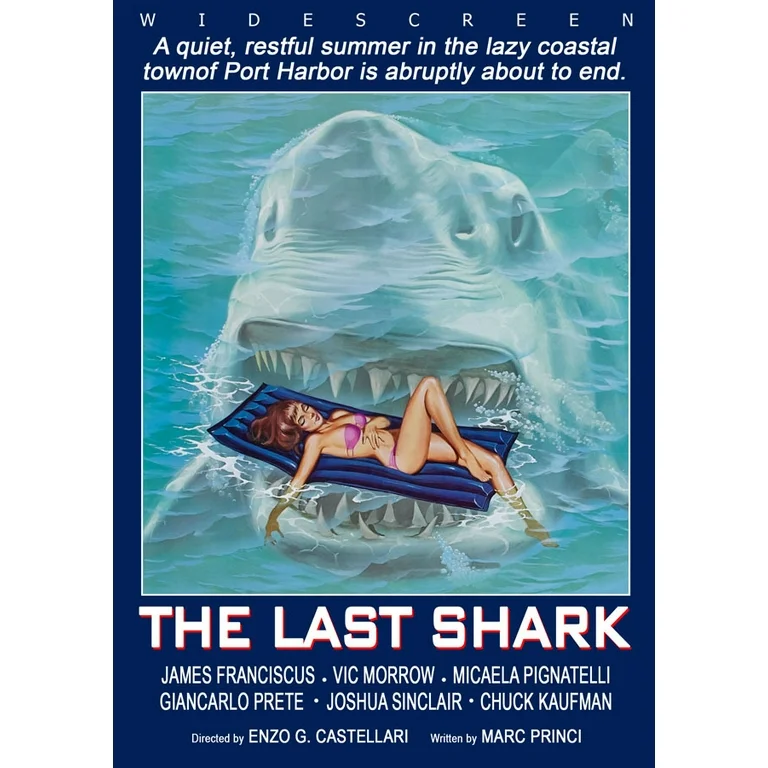
Once more, DwC returns for another instalment in his long-running series – Masterpiece Theater – where he looks deeper into movies to discover hidden depths and uncover some unrecognised classics. This time: The Last Shark (1981).
The Last Shark
Directed by Enzo Castellari. Written by Marc Prinzi and Ugo Tucci. Starring James Franciscus and Vic Morrow.
**This analysis will contain spoilers**
It’s regatta time in South Bay, Georgia, and the town is gearing up for the big event and the influx of tourists it will bring. But another tourist is about, one that isn’t so welcome: a massive killer shark.
As the beast claims more victims, it’s up to a novelist, a seasoned shark hunter, and myriad locals to stop the carnage.
Yet a skeptical mayor with aspirations for higher office and a news crew that will stop at nothing to get a story are creating unnecessary obstacles and putting more lives at risk.
As the shark shows signs of heightened intelligence and the stakes rise, it’s up to the small team of determined townsfolk to stop the beast once and for all. But will they all survive?
At the start of 1975, the New Hollywood revolution was in full swing, rewriting the rules and changing the game at everyturn. As significant as these changes were, nothing could compare to what Jaws would do later that year.
A cloud was forming on the horizon, “a cloud…” to quote Peter Benchley in his brief cameo, “…in the shape of a killer shark.”
When the tempest broke, Steven Spielberg’s adaptation of Benchley’s novel would completely change the business. The era of the summer blockbuster had arrived, bringing with it its malformed twin, the nature-run-amok movie.
If there were an animal capable of killing people, a movie would be made about that animal killing people. Snakes, alligators, bears, mutant bears (Dear God, do I love you, Prophecy!), piranhas, and octopi were all fair game.
When they ran out of animals that could kill people, films about animals and insects that could never, in a million years, kill people: frogs, ants, slugs, and even earthworms got their day in the sun.
One of the most famous of these was Grizzly, produced by Film Ventures International(FVI), an independent studio led by Edward L. Montoro, but we’ll get back to him in a bit.
Boy, will we ever.
Grizzly featured a freakishly large, rogue animal on a killing spree in a clearly defined area, and an authority figure who refuses to close said area, leaving it to a lower-ranking official, an animal expert, and a rugged helicopter pilot to stop the beast.
Sound familiar? It could have been called Jaws on a Mountain. That’s how closely the plot mirrors Spielberg’s film, and, much to the chagrin of Universal Studios, it was a massive hit.
So massive that it became the most profitable independent film of all time, a title it held for two years before being surpassed by John Carpenter’s Halloween.
Italiano Productions
The appetite for these films was there, a fact not lost on the Italians.
In 1980, producer Ugo Tucci was still getting high off the fumes of his success with Lucio Fulci’s Zombie, and he was chasing that dragon when he and Maurizio Amati hatched a plan for their next big score.
Their rationale was sound; Jaws wasn’t just a massive critical and box-office success; it was one of the greatest films ever made.
Then there was Jaws 2, which was, uh, also a box-office success. Logic dictated that combining Jaws and Jaws 2 into a single film, pairing the sheriff and sea captain from part one with the idiot teenagers from part two, would result in something spectacular, and so the idea for The Last Shark was born.
Scriptwriting duties fell to Marc Prinzi, based on a story idea by Ugo Tucci, with the legendary Enzo Castellari directing.
Production started in Georgia, and the opening scene highlights the beautiful coastal waters as we get some beach time set to an ’80s pop song composed by Guido and Maurizio De Angelis and sung by Yvonne Wilkins.
There’s a windsurfer hot-dogging it while his buddies, including Billy Joe Wells (Gian Marco Lari), son of the powerful local mayor, and Jenny Benton (Stefania Girolami), watch from the beach.
The film then cuts to shark-POV-cam as it hunts down the doomed windsurfer. He feels a bump, turns to see his board has been bitten in half, and is suddenly launched into the air before disappearing under the waves.
Somehow, no one on the beach sees this.
The Cast
We’re then introduced to the rest of the cast:
Marinebiologist/acclaimed author Peter Benchley/Peter Benton (James Franciscus), and his wife, Gloria (Micaela Pignatelli). Jenny, whom we just met on the beach, is their daughter.
Across town are Mayor Wells (Joshua Sinclair), a greasy politician and our human antagonist, his assistant, Matt (Ennio Girolami), and an overzealous news crew, Dave (Chuck Kaufman) and his cameraman (Bill Starks).
The best character intro is reserved for Ron Hammer (Vic Morrow), a grizzled sea captain who’s a shark expert with a thick Scottish accent and the coolest name ever.
As he examines a piece of the windsurfer’s board, he doesn’t say a word, but he knows: a bastard shark is responsible.
Aboard his boat, he calls the Coast Guard after telling Peter that it wasn’t a floating chainsaw that destroyed the surfboard and recommends calling off the regatta.
Mayor Wells and his toady, Matt, aren’t convinced it was a shark, but when the Coast Guard finds a boat drifting about with nothing but a human arm on board, they change their tune in a hurry.
Wait, no, they don’t; the event is going to be a big boost for Wells’ campaign for governor, so goddammit, South Bay will have its regatta!
You have to give him credit, though; he does order some pretty serious precautions: cages, netting, sharpshooters, etc. He tells the press to keep quiet and that “absolutely nothing is going to happen”, so I’m sure it’ll be fine.
But Ron Hammer isn’t buying it, and ominously tells Peter there’s only one kind of shark big enough to cause the damage he’s seen, and it’s not a tiger shark or a mako.
The Approaching Regatta
As the regatta approaches, Peter debriefs the security team on what they’re dealing with before he hands things over to Ron Hammer, who delivers the kind of scientifically accurate description of shark behavior you’d expect from an Italian production in the early 1980s.
“It’s had a taste of human flesh, and it’s developed a craving madness. It’s not hunger; it WANTS to kill. You either get out of the way or hold your ground. And fire.”
I must say that New York City native Vic Morrow’s Scottish accent is a glorious thing to behold. Just a brilliant performance.
Regatta day is here, and about thirty seconds after the netting is deployed, the shark eats through it. While tearing through the netting, it gets snagged on a pink buoy, betraying its presence beneath the water.
I don’t know why Universal got so uppity; this is nothing like Jaws. In that film, the shark was hooked to yellow barrels, not a pink buoy. Totally different.
Anyway, Matt starts the windsurfing race, and it’s instant chaos as Ron Hammer spots the buoy, realizes its significance, and tries to get everyone out of the water.
The shark sends windsurfers flying, then zeroes in on Matt’s boat, ramming it with such force that Matt briefly looks like a stiff, rigid mannequin with no bendable joints as he’s launched 20 feet into the air.
Then we finally see it; the shark sticks its gigantic head out of the water in all its hyper-realistic glory before disappearing under the waves. Seconds later, Matt is pulled under.
As Wells is hammered with questions, Ron Hammer, surprisingly, comes to his defense, displaying that fabulous Scottish accent once again:
“Security measures were taken! But not for a great white of this size. I’ve never seen anything like it, and I’ve hunted sharks all over the world! So put THAT in your paper!”
Oh, Vic, you were a goddamned national treasure.
Good Idea?
As Mayor Wells is berated by an advisor, his son Billy Joe gets an idea; he and his buddies are going to steal Dad’s boat and kill the shark. With a shotgun.
At sea, Peter and Ron Hammer are donning some real fine expensive gear to hunt the shark: TNT, explosive harpoon tips, diving equipment, the whole nine yards, while Peter’s wife, Gloria, takes control of the boat. We’re gearing up for a showdown, baby!
All the while, the news team is scheming to get some better footage of the shark. Apparently, the close-up shot of its head popping out of the water just before it ate Matt isn’t good enough; they need to film this thing underwater for some reason.
I wonder if their behavior will lead to tragedy later?
The film cuts from Ron Hammer and Peter to Wells’ son, his pals, and Peter’s daughter.
Peter and Ron Hammer are scuba diving when the stock-footage shark deliberately traps them in a cave. They blast through with TNT, but flying debris severs Ron Hammer’s air hose.
Peter gets him to the boat just in time; he’s not breathing, but it’s nothing a little CPR and Johnny Walker Red can’t fix. They head in, spying Wells’ boat in the distance.
That’s when Billy Joe spots the shark, so he and his asshole friends start taunting it and shooting at it with the shotgun from about 50 yards away.
The shark doesn’t take too kindly to this, so, knowing exactly how boats work, it swims right into the propeller, stalling it.
On the dock, Peter and Ron Hammer tell everyone the shark is 30 goddamned feet long, not like that pussy 25-footer in Jaws, and ask Wells how he got back so fast.
But Wells is confused; he hasn’t been on his boat all week. That’s when the harbor master tells him that Billy Joe took his boat. They jump in the chopper and fly to the rescue, but they arrive too late.
‘Tis But A Scratch
When the shark jammed the prop, Peter’s daughter fell in. Just as they pulled her out, it bit her leg off. You don’t taunt this shark.
Peter is with her at the hospital, but she’s quite groggy. They share a touching moment, and he assures her she will walk out of there.
I’m not sure how he plans on her doing this, what with only having one leg and all, but you gotta hand it to James Franciscus; he acts his ass off in this scene.
Jenny stirs and begs him for help, imploring him to kill the shark.
Out in the waiting room, after Billy Joe gets a slap in the chops for being so stupid, Wells apologizes to Peter because he should have known his son would take the boat.
You know, for a slimy politician, he doesn’t seem like that bad of a guy. Peter assures him it wasn’t his fault, but Wells is pissed. He takes the chopper to kill the shark himself, using his wife’s Sunday roast hooked to a winch as bait.
He immediately catches the shark… and it pulls the winch right off the chopper, knocking Wells into the water. Just as he grabs the skid and is being lifted out, the shark leaps out of the water and bites his legs off.
Blood pours from his stumps, and after a couple of seconds, he falls into the shark’s mouth in the film’s bloodiest moment. That’s not enough, though, so the shark wrecks the helicopter and kills the pilot.
As Wells is getting the ‘shaken, tenderizin’, down you go’treatment, Peter and Ron Hammer are back at sea. They’re searching for the shark when they spot the helicopter wreckage.
After an argument, it’s decided that Ron Hammer will go blow up the shark. He loads his belt with plastic explosives and drops into the water. Seriously, is going into the ocean the best way to fish for a giant man-eating shark?
Anyway, Ron Hammer is searching the chopper when the shark traps him. Peter sees some shit float to the surface and knows Ron Hammer is in trouble, so he jumps in to help.
Tied Up
Unfortunately, Ron Hammer is tangled in a rope, and before Peter can cut him loose, the shark drags him to his doom. Peter surfaces, revs the boat, and starts chasing that son of a bitch. Nothing kills Peter Benton’s Scottish friend and gets away with it.
Now the press team’s plan is revealed: they’re going to lure the shark by chaining their wives’ Sunday roast to the edge of the pier, then the shark hunter they enlisted, Briley (Romano Puppo), is going to kill it.
He’s an arrogant dick, so it’s all but guaranteed nothing horrible will happen to him.
The result is immediate; the shark grabs the bait, rips the end of the pier off, and swims away with Gloria, Briley, the cameraman, and several others afloat on it.
It starts eating what’s left of the pier, having developed a taste for wood after eating a rocking chair once, and knocks the cameraman into the water.
They pull him out just as he’s bitten in half; his torso lying on the pier while the camera, in a cruel irony, captures one last shot of his anguished face.
The shark rams the pier again, sending everyone into the surf. Exactly five minutes after being introduced and having done nothing to advance the plot, Briley is eaten as Peter arrives to save the day.
He jumps on the pier, gets everyone on his boat, but the shark pulls the pier away with him still on it.
Now it’s just Peter and the shark. He fights it off with a piece of wood when Ron Hammer, still tethered to the beast, floats to the surface.
Peter has a moment with his dead friend before grabbing the detonator. He feeds Ron Hammer’s lifeless, explosive-laden body to the shark before diving into the water with a dramatic, DAMN YOU!
He slams the button, and the shark explodes in a glorious plume of blood and guts. Well, it just kind of snaps in half, but it’s still pretty fuckin’ cool.
Back on the dock, press guy Dave, none too upset that his cameraman just got bitten in half, is getting in Peter’s face, asking for a statement. Peter has had it with this guy, so he punches him in the mouth and drops his ass.
Roll credits.
Overview
The Last Shark was released in Italy in 1981. Although exact box-office figures appear lost to time, Italian film magazine Dossier Nocturno reports that it earned enough to rank among the highest-grossing European films of 1981.
This success further cemented the fact that making knockoffs of American blockbusters was a highly profitable venture, and the Italians were just getting warmed up.
Enzo Castellari would goon to make several homages to The Road Warrior, working with Morrow again on 1990: The Bronx Warriors. After that film wrapped, Morrow headed back to the States to restart his American film career.
Unfortunately, and please forgive the abrupt tonal shift, fate had other plans.
Vic Morrow was an Emmy-nominated TV star with an impressive film and television resume before he travelled to Europe in the 70s to work in Italy.
He returned home in 1982 for what was to be his American comeback role in The Twilight Zone: The Movie, playing a racist man receiving karmic retribution. But an unspeakable catastrophe loomed. Morrow and child actors Myca Dinh Le and Renee Shin-Yi were killed in a horrific accident during filming.
A years-long legal battle ensued, careers were destroyed, and Hollywood filmmaking changed in the aftermath. It was, sadly, as preventable as it was tragic.
Where things get truly interesting with The Last Shark, however, is not in Italy, but on the other side of the Atlantic Ocean in 1982. FVI ponied up for the film’s American distribution rights, and when they took the reins, Edward L.Montoro went all in. Literally.
He bankrolled the marketing with stacks of his own cash, paying for a huge aquarium with real sharks in the lobby for the Las Vegas premiere, inflatable shark toys, and even a promotional pop-up book for kids.
It worked like gangbusters. In fact, it worked so well that it drew the attention of Universal Studios, which filed an unsuccessful injunction to stop the film’s release.
Never Give Up
Unsuccessful for now, but Universal wasn’t going to give up so easily.
The Last Shark opened in March 1982 and grossed over $18 million within one month. You can imagine how muchHollywood suits hated that their films were being plagiarized in Italy, presumably by filmmakers who did so while sticking up their middle fingers and yelling:
“That’s for putting spaghetti in a can and calling it Italian cuisine!”
But there wasn’t much they could do, and if they could, it usually wasn’t worth the legal cost. That wasn’t the case when these films were producing hefty returns, however. That shit got you noticed.
Universal sued FVI once again, this time for plagiarism. And this time, they won.
The Last Shark was pulled from theaters after four weeks, and Universal was given control of the film, seizing every reel in the country.
Truth be told, it’s likely Universal was less concerned about plagiarism than about the production of Jaws 3 being a shit-show. Over budget, behind schedule, and guaranteed to be as entertaining as a colonoscopy, they would be damned if some cheapy foreign production was going to steal their thunder.
As a result, there hasn’t been a proper release of The Last Shark in North America since that month in ‘82.
This was devastating for FVI, setting in motion a chain of events that would lead to the studio’s demise and to one of the greatest boss moves you’ve probably never heard about.
Edward L. Montoro was no stranger to controversy or to releasing rip-offs of successful films; it was practically his business model. He would acquire rights to foreign films that were “inspired by” American ones and release them in the States.
Having just walked away relatively unscathed from a lawsuit filed by Warner Brothers over the similarities between The Exorcist and Ovidio Gabriel Assonitis’ Beyond the Door, he probably thought he was bulletproof.
The judge ordered FVI to alter the posters to make them less derivative of The Exorcist, and WB received either a small cash settlement or a small percentage of the profits, a paltry sum for a film that reportedly made over twenty times its budget in American theaters.
But with The Last Shark, Montoro flew too close to the sun, and hubris caught up with him.
A Losing Battle
Losing the legal battle with Universal took a heavy personal toll; blowing millions of his own dollars promoting the film strained his home life, and he separated from his wife a year after it was pulled from theaters.
He then fell seriously ill with an undisclosed ailment, spending months in the hospital. When he emerged, friends say he was a changed man. The usually relaxed, casually dressed Montoro now wore suits and was all business.
Things briefly improved for FVI when The Incubus and They Call Me Bruce overperformed at the box office, but it was short-lived. Over the next two years, after releasing several films that did not overperform, Montoro saw one last chance to right the ship.
He bet all the studio’s chips on the underrated 1984 classic Mutant, a remarkable film about two brothers stranded in a small town besieged by townsfolk turned into bloodthirsty vampire-zombie hybrids by toxic waste.
It’s fantastic. In a perfect world, it wouldhave been the biggest hit of 1984, but it failed spectacularly. When it did, Montoro knew it was over.
To make matters worse, his wife had filed for divorce and was set to receive half of everything.
With the divorce about to cripple him financially and his studio collapsing, Montoro said screw it: he strutted into a bank, Andy Dufresne style, withdrew $5 million from the FVI account…
…and vanished without a trace.
He left the bank, cash in hand, and was never seen again. He left behind his house, yacht, beloved film studio, and an ex-wife who probably never realized she had spent years sleeping next to a man with gigantic balls, hand-sculpted by God himself from solid marble.
To this day, no one even knows if he’s still alive. A year later, FVI closed its doors for good, leaving behind a legacy of great films and a ‘fuck the system’ story for the ages.
So this is for Big Eddie; hopefully still sitting on a beach in some tropical paradise with his wise black friend Red, surrounded by babes, and sipping piña coladas. Cheers, you fucking legend.
10 mangled torsos out of 10
-DwC
The post Masterpiece Theater: THE LAST SHARK appeared first on Last Movie Outpost.