By
By 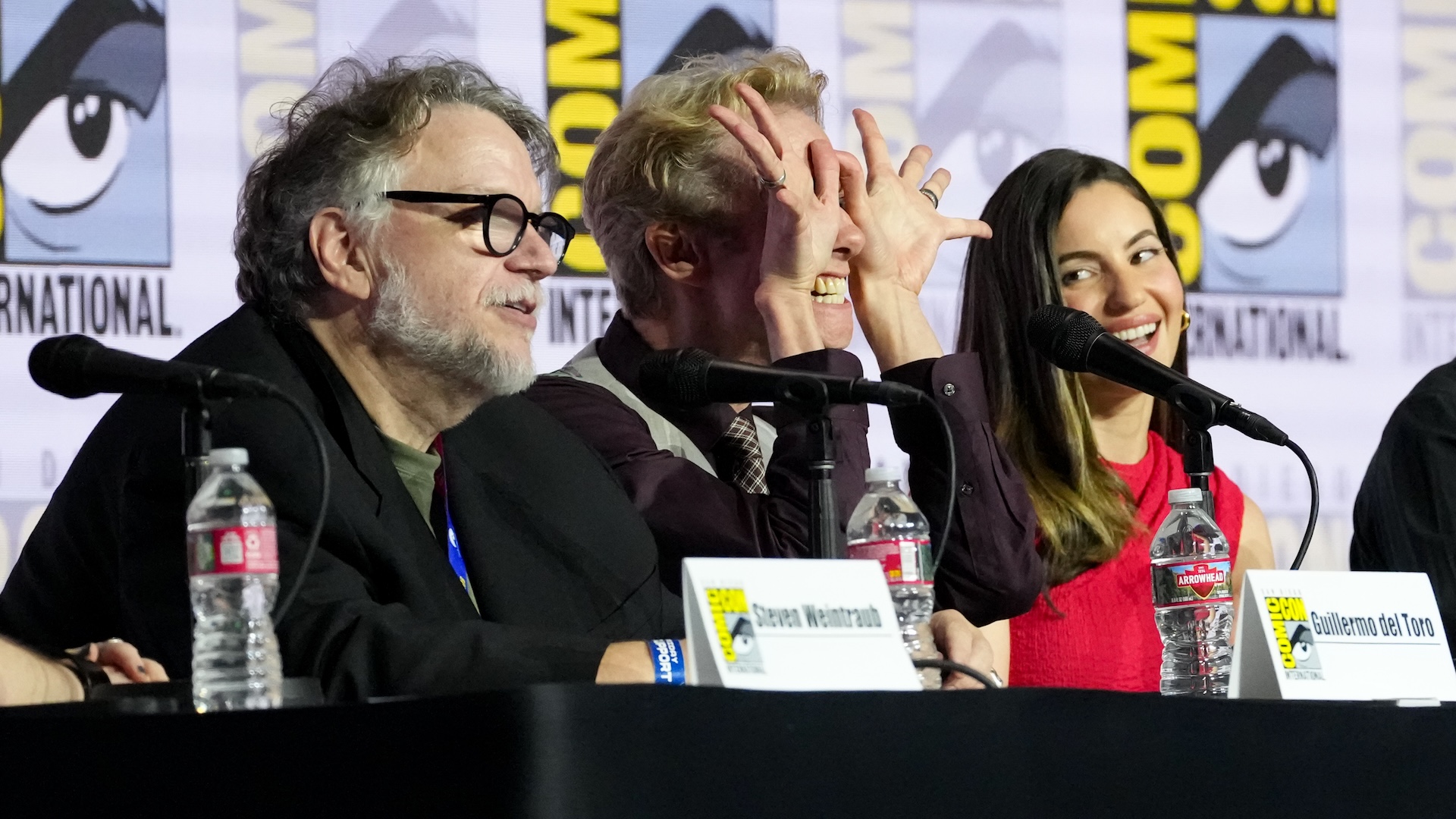
The world of Pan’s Labyrinth unfolds with tenderness, pain, and spirit over its two-hour runtime. Each frame of the film displays a care and intentionality that few other cinematic experiences achieve. At this year’s San Diego Comic-Con, Den of Geek attended a Hall H panel celebrating the now-classic film’s 20th anniversary, caught up with several folks who helped bring it to life, and took in an exclusive access screening of two 3D scenes ahead of the movie’s imminent re-release.
Del Toro’s magnum opus, the 2006 war drama-meets-dark fantasy upended what cinema could be upon its release. Pan’s Labyrinth tells the story of Ofelia (Ivana Baquero), a young girl who moves with her mother (Ariadna Gil) to a new home in Francoist Spain’s countryside with her stepfather, the sinister Captain Vidal (Sergi López). While the conflict between the fascist Spanish government officers and the Maquis, a resistance force against the Franco dictatorship, is igniting around her, Ofelia is caught in a fantastical adventure to prove she is Princess Moanna of the fairy realm. Guided by sprites and Faun (Doug Jones), a forest spirit with vague intentions, Ofelia must face the fantasy and human worlds together.
Pan’s Labyrinth flits between fairy tale and war story, with each plot feeling distinct yet connected by a young girl perceiving two struggles separated by magic. That girl, expertly played by an at-the-time 11-year-old Baquero, is the emotional core of the film. Baquero and del Toro each went to great lengths to ensure the link between the two worlds was understood, and that even the mature themes were processed.
“I was prepped going into it,” Baquero tells us. “Guillermo del Toro made it a point to really make sure that I understood the world and there was a lot of inspiration that we drew from. He sent me a bunch of comic books and movies to watch so I was aware of Ofelia’s world and the pain that she had to go through. I was very much present and connected to the material, and Guillermo guided me through that.”
Depicting the contrasting worlds of fantasy and fascism was not an easy task, but the Oscar-winning cinematographer behind Pan’s Labyrinth, Guillermo Navarro, sought out ways to distinguish both narratives visually.
“The real reality we addressed as real reality, in the fascist world and in the people’s fighting world. Since we had another narrative to take care of we have to differentiate them very well,” Navarro says. “Going through one to the other, we ended up finding the tools to navigate that.”
This differentiation, Navarro says, manifests in the film’s color palette; the real world is drenched in dark blue hues and shadows, while the fantasy realm is well lit and warm toned. Additionally, Navarro said the camera crew used nature (tree trunks, leaves, etc.) to transition between the two narratives in the film.
In addition to being a timeless vessel for themes of violence and childhood, Pan’s Labyrinth also introduced several iconic creatures. Faun and the Pale Man, both portrayed by Jones, have each become symbols of del Toro’s religion of monsters. Jones weighed each character’s motives and narrative purpose when playing them in front of the camera.
“The ambiguity of the Faun really attracted me because you don’t know if he’s a good guy or bad guy till the very end,” Jones says. “Is he leading her down a good path or a bad path? We don’t know. Turns out he’s a good guy in the end, and he just needed to put (Ofelia) through the tests.”
He contrasts this with the Pale Man, a much less ambiguous creature and a now-iconic antagonist, but also jokingly points to the suspected financial motivations del Toro had when tapping him for both roles.
“The Pale Man is just pure evil, but he doesn’t know he’s evil,” Jones said. “He just woke up hungry and children seem to be his appetite. I thought that Guillermo was being a cheap ass to just get, you know, two characters for the price of one.”
Pan’s Labyrinth was always going to be a special movie, but few — if any — people working on it thought it was going to be the figurepiece it is today in film history, according to Baquero.
“I don’t think anyone knew that it was going to be what it’s become,” Baquero says. “A lot of people obviously believed in the movie very much and fought for the movie to be made, and I was well aware, but the impact it had back then, but also how much of a movie it has become, I think no one expected that.”
The stars of the film each brought life experiences into the proceedings while taking new ones away from it. As time has gone on, those lessons have evolved alongside the movie’s cultural impact. This allows the retrospective looks at their performances to reveal new angles of their various creative choices.
“It’s like being a parent and a grandparent now,” Jones says. “I know what it’s like to guide a child to the right decision, hopefully. And so the Faun character, I felt very playful with him, but I wanted her to test and to trust her own instincts. Here’s a task for you to do (or however many tasks I had set forth in front of her), let’s just see how you play this out. Maybe you’ll make the right choice, maybe you won’t. Let’s find out in a very playful sort of way. So he could relate to the child in her.”
At the Hall H panel, del Toro, Navarro, Jones, and Baquero shared stories from the set, discussed the film’s legacy, and began hyping up the theatrical re-release audiences can look forward to in October. In particular, del Toro vocalized the reaction to the film that has been his favorite: that of the young painters, musicians, and writers who are inspired by it.
“Art saves your life sometimes,” del Toro said. “You know, sometimes, especially when you’re young, you’re vulnerable, and you’re down and you’re crushed; in comes a piece of music, a song, a movie, an illustration, an image, a character that tells you ‘Hang on, hang on. It gets better.’ This movie connects like that with artists.”
The re-release will be a touched-up version of the movie, with the ability to see it in 3D for the first time, and will be released on October 9, a birthday present for del Toro himself.
The post 20 Years Later, Pan’s Labyrinth Still Reflects the Reality You Want to See appeared first on Den of Geek.