By
By 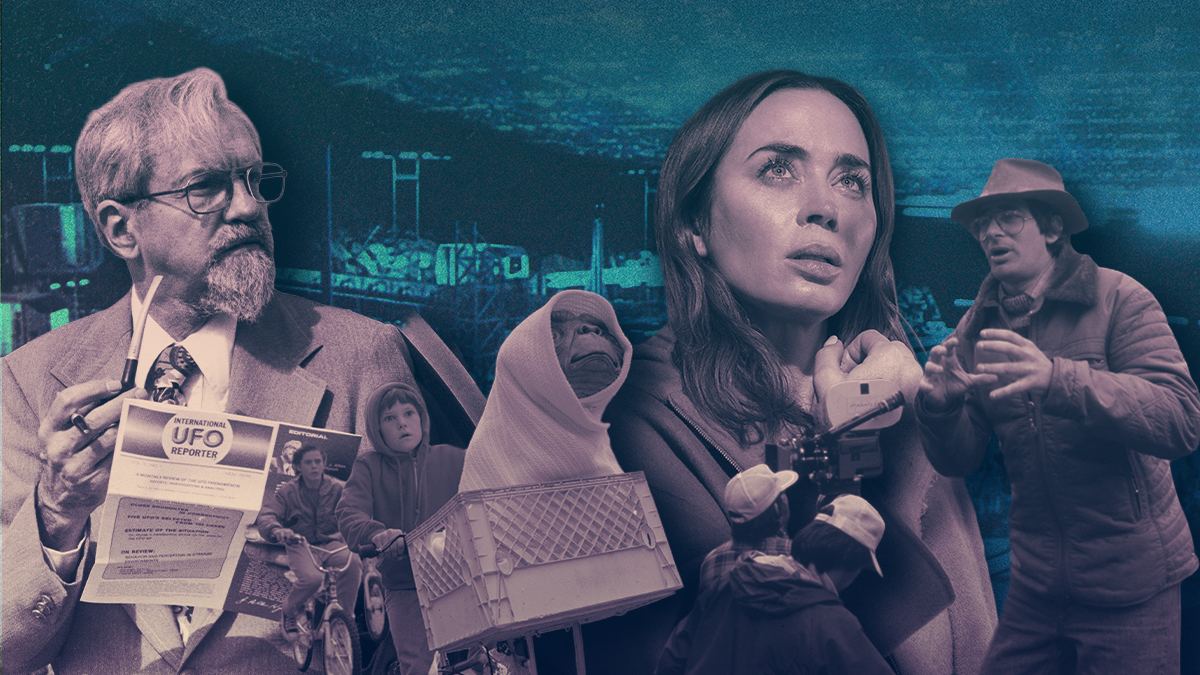
This article appears in the new issue of DEN OF GEEK magazine. Find out how you can subscribe to get the full physical copy right here!
What if I told you that one man might be (technically) responsible for the existence of both Close Encounters of the Third Kind and E.T. the Extra-Terrestrial… and it is not Steven Spielberg? While the Disclosure Day filmmaker has had a yen for UFOs since his dad first took him to a New Jersey meteor shower as a child, astronomer J. Allen Hynek had already been examining the phenomenon for the government since 1948… the year after the term “flying saucer” was coined by pilot Kenneth Arnold.
In my upcoming book Stranded on Earth: How Night Skies Became E.T. the Extra-Terrestrial, I trace the evolution of how Spielberg’s 1982 classic came to be. And it truly begins with Professor Hynek, a civilian scientist who, after aiding the U.S. Navy during the Second World War, would see his life changed forever by the government and questions about inexplicable lights in the sky.
Following the war, Hynek found himself teaching in the Department of Physics and Astronomy at Ohio State University when the Air Force first approached him about Project Sign, a new study tasked with examining various sightings of unidentified flying objects. While the stated intent was to use the scientific method to determine whether or not there was a known/mundane explanation for any given case, his real job was to debunk first and ask questions later.
“Dr. J. Allen Hynek was initially a UFO skeptic when they enlisted him,” says Dan Harary, a co-founder of Hollywood Disclosure Alliance. “He’s like, ‘Oh, this is silly. This is nonsense.’ Then the more he researched it, the more he spoke to people on the ground who had remarkable encounters, he realized it was a real phenomenon, not people who are batshit crazy.”
Although he did not prefer the term “believer,” the logical astronomer certainly expanded his horizons as to what he accepted was within the realm of possibility.
Explains Harley Peyton, a writer and executive producer on History Channel’s fictional Project Blue Book series, “Hynek was bringing a scientific method to something that not a lot of people believed in, but when you read those stories it’s hard to ignore it. That’s clearly what happened to him. Over time, it was just impossible for him to not enter into certain belief systems based on what you’re seeing with your eyes and hearing with your ears.”
For Hynek, the line between scientific truth and convenient theories began to blur. As he became a more prominent mouthpiece for the Air Force in debunking sightings for Sign—which evolved into Project Grudge, then the infamous Project Blue Book—the explanations got more far-fetched. When Air National Guard pilot Thomas F. Mantell died chasing down an unidentified object above the Franklin, Kentucky skies in 1948, Hynek chalked it up to Mantell seeing light from Venus. In 1957, a bright hovering craft reportedly shut down the engines of at least 10 vehicles in Levelland, Texas, and Hynek told the press it was “ball lightning.” He was mocked in political cartoons by explaining away a 1966 mass sighting in Dexter, Michigan as resulting from will-o-the-wisp, or “swamp gas.”
“The turning point was when he had to tell the world a UFO sighting was swamp gas,” says Harary. “He got incredibly criticized for it. He knew it wasn’t swamp gas, but the Air Force told him, ‘You have to debunk it, that’s your job.’ He became very, very conflicted.”
“For my father, I think there was an accumulated frustration at his role of tamping down hysteria as a PR exercise,” son Paul Hynek says. “In 1952, they started the Air Intelligence Service Squadrons. They would have been the ones dispatched to crash retrieval sites; that was their charter. It wasn’t originally for UFOs, but for any kind of crash landing. They had Russian speakers and all that, probably got the pick of the litter for cases, and Project Blue Book got the ones they thought they could explain easily enough.”
Even by 1958, over a decade before Blue Book was finally shut down, Hynek expressed his resentment at the “completely negative and unyielding attitude of the Air Force. They wouldn’t give UFOs the chance of existing, even if they were flying up and down the street in broad daylight. Everything had to have an explanation.” He also was startled by “the caliber of the witnesses… quite a few instances were reported by military pilots.” He began to think maybe there was something to all this.
A few years after Blue Book was officially shuttered, all while the space program was in full swing, Hynek would publish his 1972 tome The UFO Experience: A Scientific Inquiry. This was a Divine Comedy-esque settling of scores with the Air Force’s bad faith endeavor to rubber-stamp dismissals of any experiencer’s possible close encounter. Deriding government efforts as “totally inadequate,” Hynek founded his own investigative group in 1973 called the Center for UFO Studies (CUFOS) in Evanston, Illinois. It was intended as a place where people could report their sightings without fear. Hynek became a beacon for destigmatizing the phenomenon.
As journalist Leslie Kean says in the documentary UFOs: Investigating the Unknown, “He would go on lots of TV shows and radio interviews. He was a public figure advocating for official recognition and study of UFOs.” And as luck would have it, CUFOS came about at the same time a hot young filmmaker named Steven Spielberg was hatching a big screen take on UFOs at Columbia Pictures.
Produced by the Oscar-winning team behind The Sting, Michael and Julia Phillips, the film was initially scripted by Taxi Driver’s Paul Schrader from Spielberg’s own story. It was about a government debunker not unlike Hynek. In the first draft, the fictional government coat was named J. Paul VanOwen, a skeptic who becomes a true believer in the UFO phenomenon. After this dark and unwieldy take, Schrader was shown the door, and focus shifted to the everyman Roy Neary, played by Richard Dreyfuss in the finished film.
The project was at various times titled Watch the Skies, Kingdom Come, and eventually Close Encounters of the Third Kind. The final title is derived from The UFO Experience, where what became known as the Hynek Scale was introduced to classify the intensity of any given report. It goes as follows:
1. Nocturnal lights
2. Daylight discs
3. Radar-visual
4. Close encounters of the first kind (CE1, aka “Sightings”)
5. Close encounters of the second kind (CE2, aka “Physical Evidence”)
6. Close encounters of the third kind (CE3, aka “Contact”)
After adopting that latter name, Spielberg bought the rights to use it from Hynek for $1,000. He then brought the scientist on board as the project’s official UFO consultant. Hynek also had a cameo as a pipe-smoking scientist during the 1977 movie’s finale.
Explains son Paul Hynek, “He had a lot of calls with Spielberg, met several times, and my father gave him accounts of real reports. A lot of things in the movie came from reports, like that toll booth on the border of Ohio and Pennsylvania, or the sunburned face.”
As Dr. Hynek himself explained in 1978’s Starlog #12, “Anyone who has investigated the UFO phenomenon will realize that Steve Spielberg did his homework, indeed very well. There isn’t anything in the picture that isn’t rooted or based on actual reports. The public is going to look at this as a science fiction movie, and it really is not. The various effects, the sunburn, the physical effects of the vibrations and so forth, the precognition, have all been reported. At the Center for UFO Studies, we have a computerized data bank with over 60,000 reports… going on 2,000 reports of encounters of the third kind.”
Nearly half a century later, the impact of the film is still tangible. Pointing to Contact in the Desert, an annual conference for UAP enthusiasts, Harary tells us, “If you asked 3,000 people there, most of them would say Close Encounters was their favorite movie, including myself.”
While many of the case files in The UFO Experience were translated directly to the screen, a few did not match up to CE3K’s depiction of the extraterrestrials as essentially benign. One such case in August 1955 involved a group of hostile aliens reportedly attacking the Sutton family at their Kentucky farm. The clan apparently huddled in fear throughout one long night as they warded off the invaders with shotguns and rifles. Known as the “Kelly-Hopkinsville” or “Hopkinsville Goblins” incident, Hynek described the event in The UFO Experience as “another classic Close Encounter of the Third Kind.”
Though his boots were not on the ground at the Kelly farm, Hynek coordinated a Blue Book investigation with two associates, a local Kentucky radio man named Bud Ledwith and New York-based UFO investigator Isabel Davis. Both conducted extensive interviews with the witnesses, primarily the Sutton family, and found their sketched descriptions and testimonies did not waver.
Spielberg contemplated including a terrifying alien invasion scene at a remote farmhouse for a CE3K scene involving Melinda Dillon and Cary Guffey, then decided the dramatic encounter at Kelly-Hopkinsville would make an ideal follow-up to his 1977 hit. A script was developed with writer John Sayles, initially titled Watch the Skies.
As Spielberg told Entertainment Weekly in 2011, “It’s a story that’s well-known in the world of ufology, and we based our script on that story, and Rick Baker actually started developing some of the grays.”
The project, later called Night Skies, took the essential elements of the Kelly Goblins while modernizing the family, as well as making the aliens more active and terrifying. They invade the outside and inside of the home, all while perpetrating several animal mutilations. Even with renowned production designer Ron Cobb set to direct, a young Kathleen Kennedy coordinating, and Baker already building the creatures with incredible detail, Spielberg eventually got cold feet. He cherrypicked elements of Sayles’ script, including a nice alien’s friendship with a small boy, and wildly reimagined it from a horror movie to a kid flick called A Boy’s Life, then E.T. and Me, and finally E.T. the Extra-Terrestrial. In 1982 it became the most financially successful movie ever made up to that point.
In 2009, Paul Hynek was working for Giant Studios as it did motion capture on The Adventures of Tintin when he was summoned by Spielberg to come by and reminisce about his father:
“Kathy Kennedy said it was Close Encounters that got her into movies, and then they both told me that Spielberg had been working with her for a year trying to do a movie about Kelly-Hopkinsville. He was very friendly, very complimentary about my dad.”
Night Skies remains one of Hollywood’s most enticing unmade films, and the myriad ways it influenced E.T., along with other projects, makes for a fascinating story. If not for the efforts of J. Allen Hynek to legitimize the study of UFOs, we might never have had Close Encounters, E.T., or even Disclosure Day—a movie where Spielberg plays with famous cases like the crash in Roswell, the fireball in Kecksburg, and the abduction of Betty Andreasson.
Building off the public’s awareness of the work of Hynek, the Hollywood Disclosure Alliance seeks these days to provide “a more unified voice in the media leading up to, and following, the impending revelation of the presence of extraterrestrial life—disclosure—through storytelling in feature films, documentaries, and TV programming.” It was founded by Harary, alongside Washington D.C.-based disclosure advocate Stephen Bassett.
Says Harary, “In May 2023, Stephen came to L.A., and we had lunch. At the end he said, ‘Dan, I’m a disclosure guy. You’re a Hollywood guy. What can we do together?’ Now we are a 501(c)(3) nonprofit with 250 members around the world, including some famous people. It’s a group where UAP and ET experiencers, researchers, and disclosure advocates can network with Hollywood writers, producers, directors, and performers to share ideas and story pitches.”
One of the founding members was writer/producer David O’Leary, who in 2018 created the two-season TV drama Project Blue Book. The original pitch was “Ufology meets Mad Men.” It centered on a highly fictionalized version of J. Allen Hynek played by Game of Thrones’ Aidan Gillen. It is appropriate that Hynek was transformed from the full-time professor/part-time UFO guy he was in real life into a Carl Kolchak-type paranoid supernatural investigator. After all, executive producer Robert Zemeckis got his start writing Kolchak: The Night Stalker.
“Kolchak is a great reference, one we talked about in the writer’s room,” says Harley Peyton, a Twin Peaks vet who served as a writer on the show. “Aidan’s such a good actor and he did the usual research one does when you’re portraying a real person, whether that’s certain habits or the pipe he smokes. Aidan’s bringing some of himself to that as well, particularly when the character is a little more active in the world than the real person was, so you try to find a good middle ground. You’ve got family members looking at your work. Paul would sometimes say, ‘Yeah, my dad would never do that.’”
Paul looks back fondly on the experience of consulting on the series, along with his brother Joel.
“We talked with our family and said, ‘Look, this is going to be most likely a positive portrayal of our parents,’” Paul says. “We got all the scripts and had a good relationship. Both actors who played my mom and dad talked to us quite a lot about what they were like so they could get a sense of their real emotional core. I think my dad would have thought, ‘Oh, it’s a damn good yarn.’ My mom would have said something like, ‘Oh, it’s a waste of time.’”
The TV version of Hynek’s adventuring even extended to a Project Blue Book episode in which he is actually in Kentucky uncovering Kelly-Hopkinsville conspiracies, while wife Mimi Hynek (Laura Mennell) does her own investigation, standing in for real-life Isabel Davis. As the episode’s writer Peyton says, “Close Encounters was fairly benign, even beautiful, but the fun thing about Hopkinsville was you were doing a horror story. That was one of the things I brought to the episode, looking for that tension.” He adds that Hopkinsville and all the other real cases explored in the show exist within the sphere of folklore that “has become a consistent part of our culture.”
While folks like Harary speak adoringly of Hynek, framing him as a pioneer in ufology, Paul views his father as a scientist first and foremost. Now a professor in his own right at Pepperdine University, Paul has been developing an offshoot of the Hynek Scale, a classification system to characterize evidence from close encounters.
“Our father was an astronomer; that’s how we thought of him,” Paul says. “He had a side gig of UFOs. He wasn’t a UFO guy to us, so I’m very comfortable with the scientific method. I’m a grant reviewer for the National Science Foundation, and I’m very comfortable with scientists. To me, it is an effort to help experiencers have better conversations with scientists so we don’t have to worry about the table scraps the government gives us.”
J. Allen Hynek’s ultimate legacy was to show that not only does science have a place in ufology, but it is also unscientific to dismiss the possibility of other life in the universe so long as there is a fragment left for us to explore.
Max Evry’s Stranded on Earth: How Night Skies Became E.T. the Extra-Terrestrial publishes in October.
The post The Man Who Inspired Steven Spielberg’s UFO Obsession appeared first on Den of Geek.