By
By 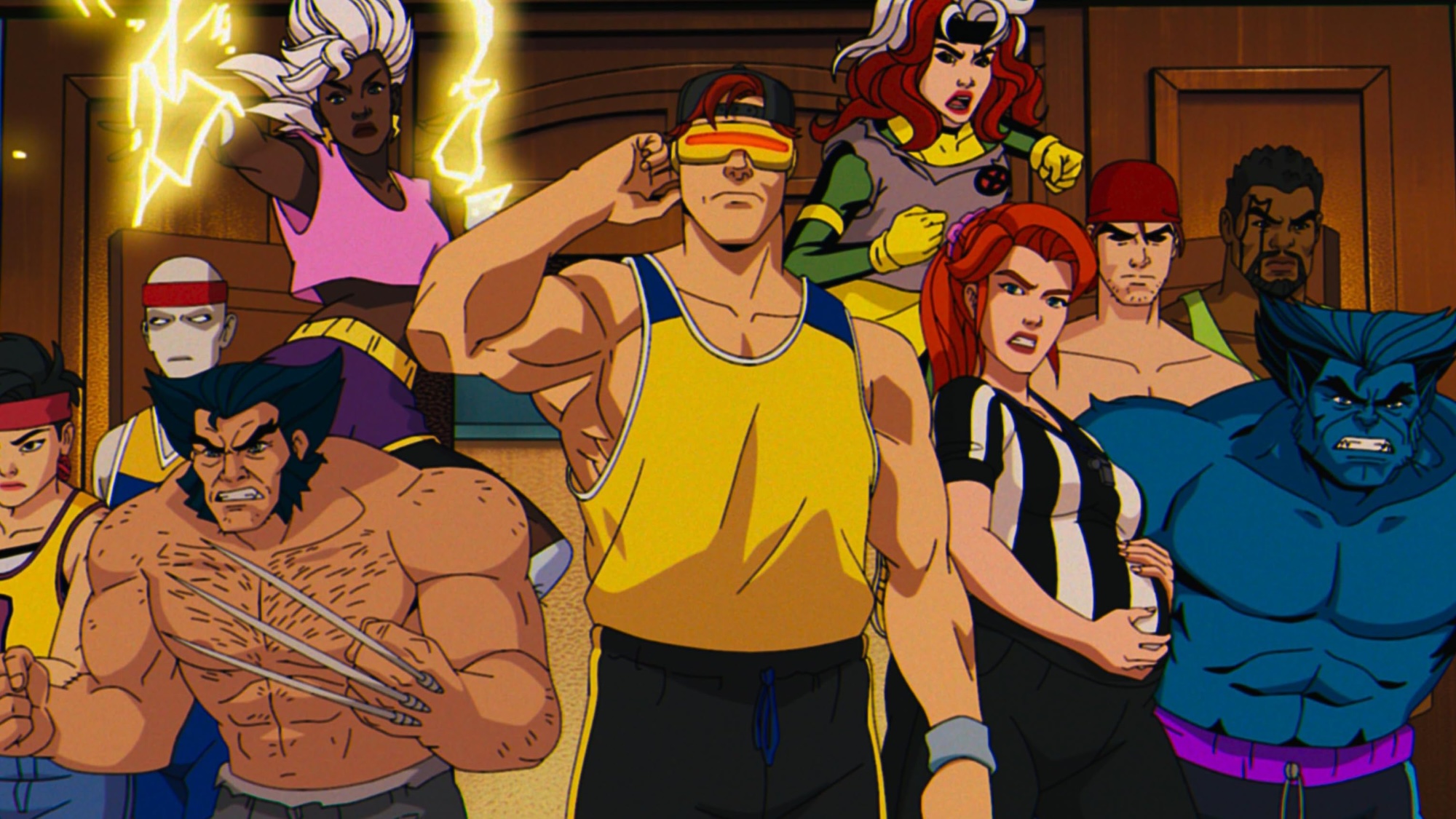
It’s not necessarily a surprise when we catch up with some of the original minds behind the game-changing X-Men: The Animated Series that none of them saw a major film festival premiere in the series’ future. A film festival premiere for a revival, or companion series, nearly 35 years after X-Men’s debut on Fox Kids in 1992, to put a finer point on it.
Yet folks like Eric and Julia Lewald, the husband and wife duo who primarily ran the writers’ room on the now iconic superhero cartoon, and Larry Houston, the lead storyboard artist on the series, were there at the Tribeca Film Festival this past weekend to celebrate the legacy and lore of their original show, as well as to help usher in season 2 of X-Men ’97, the Disney+ sequel series that took fandom by storm in 2024, and for which they’re all consulting producers on.
It’s quite a turnaround from a series that began, at least in Eric’s mind, as an epic struggle to put out something compelling, transformative, and honestly far more sophisticated than any superhero cartoon—or for that matter most caped movie adaptations—had been up to that point.
“[Back then], it was ‘Alright, we’ve got six months of work and diapers and mortgage,’” Eric tells us at the X-Men ’97 press line. “Then it was successful after it took off, and we all realized it was something special, but it was a real struggle until it premiered. All sorts of people wanted it to be a different show. It’s so much different from the Saturday morning animation that came before it, people were very nervous: TV affiliates, advertisers, said, ‘Are you sure you don’t want to dumb this down and make it younger, or give them a silly sidekick?’”
Originally, the series began for the Lewlands as a call on Sunday night about the prospect of pitching the following day an X-Men animated series, something that had never really made it past the pilot stage (supporting bits in the Spider-Man and His Amazing Friends fiasco notwithstanding).
Remembers Eric, “On Monday morning we’re meeting with Stan Lee, saying, ‘Okay, what are you going to do with the show?’ And I didn’t really know the books at all. So I looked, and there had been 29 X-Men from 1963 to 1992. We needed to get that down to six or seven, with also Xavier. And the only agenda that I and my head writer Mark Edens had was to try and make the most dramatic television animation that we could. We had both been working in the field for seven or eight years, and we said this was the great equivalent of making an hour drama in kids animation. So we just made decisions pulling from the X-Men lore that fit.”
Wife Julia also gives special credit to the support they had from crucial corners at the then-emerging kids division of Fox. It provided the runway to make something as sophisticated as X-Men (or for that matter Batman: The Animated Series).
“I want to give a shout-out to Margaret Loesch,” Julia tells us. “She was the new president of Fox Kids, which was a brand new network, and she loved the X-Men books. She had worked with Marvel and with Stan Lee, and when she decided, ‘We’re going to do an X-Men show for Saturday morning,’ she got tremendous pushback from the folks above her. But she understood the books deeply and that just gave us the opportunities to tell the stories that the books were telling. So that protected all of us.”
While Eric learned to be a fan as the series came together, Houston was a lifelong fan before X-Men came his way.
“My impression was that there had not been an accurate adaptation back in 1992, and what I wanted to do was make the show as close to a comic book as I could,” says Houston. That meant character designs that looked like they were ripped straight from Jim Lee’s sketchbook on X-Men #1 (1991), but stories that just as earnestly filled in the cracks of the source material. For instance, Eric points out that fan favorite Rogue seeking a cure in the first season of The Animated Series was not based on any single comic book, but rather just a natural development for a character whose powers deny her the ability to touch another human being or mutant.
And foritiously for going into X-Men ’97 season 2, the writers and animators essentially took one of the X-Men’s many less popular villains in Apocalypse and turned him into one of the most iconic existential threats in all of comicdom.
“When we did him in 1992, all those details didn’t exist,” Houston points out about Apocalypse. The character was still relatively mysterious on the page, which allowed the cartoon creators to only hint at his Ancient Egyptian heritage while going their own way with it. “But in the 26 years since my series started and X-Men ‘97, all of that backstory is there. So they’re exploring the future, the past, so you’re getting a chance to see how Apocalypse came to be, and how he became such a badass and have the attitude that he has.”
Still, a lot of that badass attitude comes down to the original series Houston worked on, as well as the voice actor who was cast in the part.
“He’s so different and from everyone and everything in that world,” Julia explains. “[We had] tremendous fun in creating the line ‘I am the rocks of the eternal shore. Crash against me and be broken!’ Writing for him is the fun of being able to not just go over the top, but write something that Apocalypse would say, because Apocalypse is so much bigger than everyone else. And shout out to the original voice talent, our first Apocalypse, and that was John Colicos, who was the first Klingon to first appear in the original Star Trek series, and we didn’t know that when we were doing our show!”
Says Eric, “One of my five favorite lines out of the tens of thousands in the original series, was when Apocalypse suddenly pauses and says, ‘Wait a minute, am I like Sisyphus? Is this just futile and I’m going to live forever and never die, never change, never accomplish anything?’ So the good lines are he is this immortal creature who knows he is this immortal creature… and we were writing him before we knew the voice, but one episode in [with Colicos] we were like, ‘Oh God, we gotta write more for this guy!’”
As the writer explains it, Apocalypse might’ve only been in six or seven episodes of the original show without Colicos’ vocal choices and inflections. Instead he’s in 17 episodes. “There lots of villains we never got around to using, but we kept coming back around to him because he was just such a joy to write for,” Eric explains.
And in X-Men ’97, the character Colicos helped define is about to get a whole timey-wimey season where the X-Men will have to face him in the future, past, and 1997 present.
“Apocalypse is an exciting character, [and I’m] so happy to bring him back to the screen,” says Brad Winderbaum, an executive producer on X-Men ’97 and the current head of streaming, television, and animation at Marvel Studios. “He represents, I think, a horrible future and destiny for the X-Men that they’re always trying to avoid. So he serves a very specific, and very awesome purpose.”
Winderbaum also gives us a few teases for the upcoming season, including how the new season will explore the characters of Cyclops and Jean Grey as they attempt to become parents to their son Nathan, who they have discovered in a far-flung dystopian future (it’s comic book levels of complicated).
Says the exec producer, “For Scott and Jean, that idea of wanting to be parents, of wanting to be together and have a family drives them, and the world is always in their way. Circumstances are always in their way. Destiny is always in their way. Bigger problems are always in their way. So the fact that they get to spend this time with Nathan and get to raise him for a short period, is a beautiful reward for them.”
Among the characters who will be experiencing a lot of the give-and-take of destiny and personal needs, however, is Rogue, who has been voiced since 1992 by Lenore Zann. Rogue experienced the most heartache in the first season following the death of Remy LeBeau, aka Gambit, and that turmoil will continue in the second season.
“Rogue is on a mission, she still wants to get revenge for what happened to all of the other mutants in season 1, the Genosha genocide, but she’d also really love to get Remy back,” Zann teases. “And I mean true love, when you feel that feeling for somebody and you’ve lost somebody, it takes a long time to get over, so she’s still on an emotional roller coaster… anybody who’s lost someone knows there are many stages to the grief, including rage. So she’s going to be through a lot of emotions again this season, and she’s going to have to make some tough decisions.”
Zann also has been a long roller coaster with Rogue, a character she gave that now iconic Southern twang to, and whom she knows so personally that she was able to rewrite lines for in X-Men ’97, specifically a crucial bit in the episode preceding Gambit’s death.
“Let’s put it this way, I have definitely added some lines here and there,” says Zann. “When I’m in the booth, [I’d ask the producers] could I try saying this instead of that line? And I would do both. I would do their line and then I would do my own line, and sometimes those are the ones that stayed. So in the first season, when I’m dancing with Magneto in the ceiling in the sky, and we kiss, and then I pull away, and you think I’m going to say ‘I love you’ or something, instead of the line that was written, I say, ‘Thanks for the dance sugah, but Remy was right. Some things are deeper than skin,’ and they kept that line.”
Keeping true to the roots and the core of who the X-Men are might be the greatest legacy of this series. More than three decades after the original series, Houston marvels that Freddie Prinze Jr. once sought him out to chat with him about the series as a fan of it growing up. Meanwhile Julia reminds that while still Prime Minister of Canada, Justin Trudeau had the voice talent of X-Men ’97 visit his office.
‘Justin Trudeau knows the X-Men how is this possible?!” Julia laughs. “Are we influencing policy up here in Canada?”
But it’s the pull the series has had with fans, which keeps its legacy vital.
“We had no clue that it would go worldwide like it has, but it really has,” Eric considers. “If I wear an X-Men hat in Singapore, someone’s going to say ‘I watched your show growing up!’ It’s weirdly, amazingly gratifyingly well-received.”
X-Men ’97 premieres on Disney+ on July 1.
The post How X-Men: The Animated Series Revolutionized Superhero Adaptations appeared first on Den of Geek.