By
By 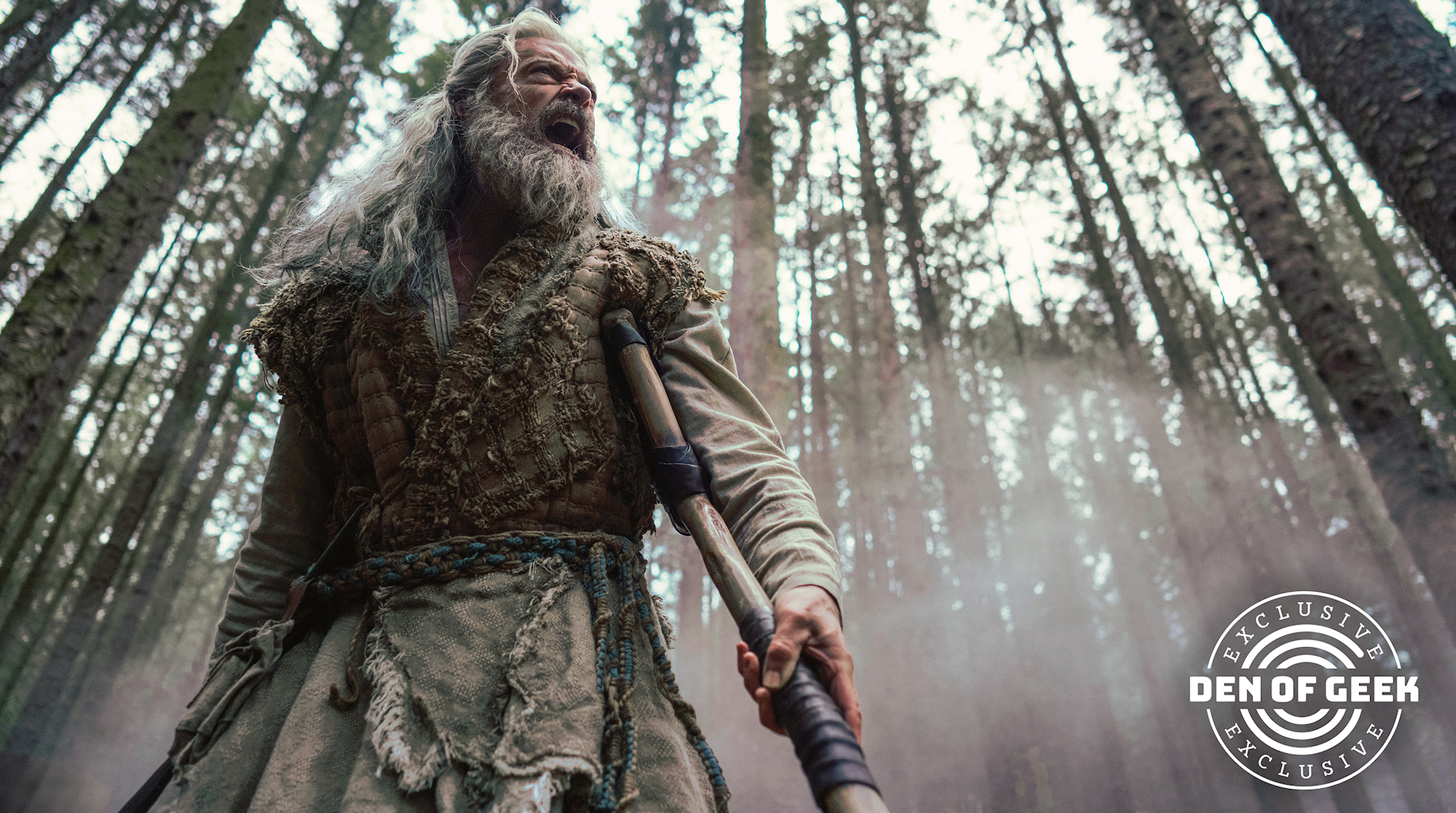
Most folks do not like it when their heroes die. A quick glance at online discourse about franchise movies that ended with icons perishing will remind you of this. But the resistance to fictional mortality dates back far longer. There are dozens upon dozens of Robin Hood movies, for example, yet only one previously has made a serious attempt at adapting Robin’s death. Even fewer have genuinely sought to examine the events of “A Gest of Robyn Hode,” a ballad dating back to at least the 16th century that is our oldest surviving account of Robin’s demise.
Yet for Michael Sarnoski, the writer-director of Pig, A Quiet Place: Day One, and this month’s A24 release of The Death of Robin Hood, it was always the story of brave Robin’s end that most intrigued, beginning with when the headmaster of his school handed him a collection of ballads written down in a previous century.
“I was fascinated by it and I was confused by it,” Sarnoski muses about his reaction to Robin Hood dying. “As a kid, you’re like, wait a minute, he’s this heroic, folkloric immortal character that has persisted through the ages, yet he also has a very human, quiet, simple death? The seeming paradox of that really fascinated me as a child, and it was all kind of happening right around the time that I lost my own dad.”
Raised previously by his parents to think of Robin Hood as a swaggering talking fox, courtesy of the 1973 animated Disney movie, Sarnoski suddenly found himself confronting the very real prospect of mortality—and all at the same time he was introduced to a Robin fading away in a bed, watched over perhaps too eagerly by the Prioress of a nearby nunnery.
“I’m 10 years old and realizing these iconic symbolic characters are human beings, I’m talking about parents in this situation, and they can fail and die just like any other person can,” he continues. “They can suffer. It’s when you’re coming to terms with what mortality is and what growing up is, and I think it all just sort of hit me right around the same time.”
The impact of that hit lingered in Sarnoski’s mind for decades, seemingly expressing itself in strange ways. The filmmaker swears he wasn’t thinking about Robin Hood when he named Nicolas Cage’s vaguely outlawish chef living in the self-exile of a forest “Robin” on Pig, but he won’t deny the similarities between that story and the Robin Hood movie he would begin writing soon afterward—or even his A Quiet Place prequel. It was in fact the prospect of tackling the latter, which led to him finally returning to that elegiac ballad about Robin and the Prioress.
“I was getting ready to write A Quiet Place, and it was just like this moment of ‘screw it.’ I’m about to go do a studio movie, so let’s just write this thing that’s always lived inside me and that I’ve always wanted to get out on paper. I know it could be a dumb idea to make another Robin Hood movie, who needs that? But I gotta get this thing out of me to see if it’s something that I wanted to put aside and leave behind, or if it’s something I wanted to pursue someday.”
What came from Sarnoski’s pen is, in some ways, a faithful adaptation of the earliest, bloodiest medieval ballads of Robin Hood, before daring exploits in the Holy Lands or Locksley lands and titles were later granted to the character’s name. In other ways, however, it’s a total inversion in which the violence is extreme, and so is the spiritual penance Robin unconsciously receives when he ends up on an island with a true holy woman.
At a glance, it could be perceived by audiences as another hero at sunset movie like Logan or the last Indiana Jones movie. It indeed stars the Wolverine himself, Hugh Jackman. But right down to the way the film ruthlessly deconstructs that romantic image from its opening scene, where Jackman’s titular highwayman is introduced more like the monster in the woods than a gruff hero, there is something darkly subversive to the material. Hence its appeal for the Wolverine actor.
“Early on in my first meeting with Hugh, we [acknowledged] there are similarities to Logan that people are going to see about this aging hero,” says Sarnoski, “but I think he got that this performance was going to go in a totally different direction. You can start with an aging man of violence. That’s a classic character trope. But there are so many ways you can go with it, and I was excited to dive into that and show people we can take it in a completely different direction, and emotionally it’s going to feel vastly different…. You’re not going to be seeing Wolverine with a bow.”
The first sequence is shockingly violent as an unexpected monster-slayer seeks out Robin in his aged isolation in order to extract a debt. But then, much of the film’s first half hour is by design relentlessly brutal, even if it barely scratches the surface of the earliest ballads Sarnoski researched.
“The world was rough and scary back then, so even children’s stories needed to be pretty rough and scary,” Sarnoski observes. “Like it’s supposed to be funny [in one story] when Robin cuts off people’s heads and wears them into town as like a little head-mask. Just pretty grotesque, horrible stuff.” While nothing that extreme happens in Sarnoski’s movie, there was a desire to remove as many of the flourishes that writers and filmmakers introduced centuries later, from Sir Walter Scott to Michael Curtiz—right down to the choice of setting The Death of Robin Hood in 1247, more than 50 years after the backdrop of most Robin Hood movies.
Explains Sarnoski, “My feeling was let’s go back to those earliest sources and try to create what the character might have looked like from those and get rid of the later additions… So the Crusades? They weren’t part of the earliest Robin legends. All of the Richard the Lionheart Crusades [elements], that was something added on. Robin Hood is not a real character. At best he’s probably an amalgamation of a few maybe real people, but [due to] the earliest versions, 1247 is a theorized date that some people have thrown around for when maybe his death might have taken place.”
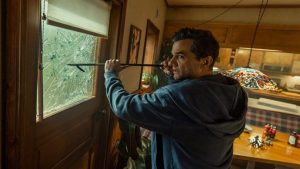
While certain elements from the legend remain—Jackman’s Robin is scarily good with a bow—others were intentionally omitted or shrewdly shifted.
“The only characters in the movie that wear green are Little John and his family,” notes the director, “as if he’s the only one that sort of maintained that romantic idea of Robin and what they were, embracing it in some strange way. Whereas Robin is always in browns and grays, and then we introduced blue to the palette when they get to the priory, and suddenly there’s color and life that kind of comes into all of the costumes.”
Indeed, the first half hour is savage, with Sarnoski suggesting he wanted to give viewers everything they’d expect in a Robin Hood movie—robbery, adventure, sword and arrow play—but for it to “feel almost like a horror movie or a war movie, so that by the end of it, you’re like, this is unpleasant.” Only then does Robin and the movie’s world turn upside down as Little John (Bill Skarsgård) takes the antihero to rest at a priory on an island out in the Irish Sea. The film becomes about a haunted folk hero (in the loosest sense), but also something more elusive and ephemeral. It’s where Robin at last meets the woman who will give him grace, and whom is played by the infinitely graceful Jodie Comer.
“So I had met Jodie right after Pig, and we sort of immediately had this feeling of ‘it’s not going to be right now, we don’t have something yet, but we’re gonna work together,’” says Sarnoski. “There was some sort of creative soul connection going on there. And then when the Prioress popped up, I never really write for a specific actor, but it was just really obvious early on that this is the one for Jodie.”
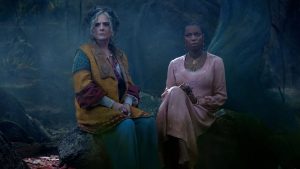
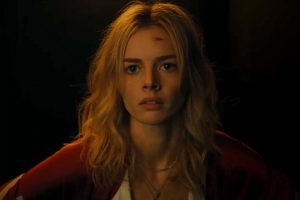
With her full name of Sister Brigid, the Prioress lives in a pastoral oasis drenched in sunlight and inviting greens. She brings an air of mystery to the film, but also a sense of intense empathy and humanism as she collects broken folks like Robin and an even more enigmatic leper played by The White Lotus’ Murray Bartlett.
“[Robin] sees her and he’s like ‘who is this person?’” Sarnoski explains. “‘She is sharper and more observant than anyone I’ve ever met. She rivals me with her keenness, but then there’s also some sort of mystery and some sort of paradox to her.’” She brings out a core theme in the film, which goes beyond mere redemption.
Says the director, “It would be sort of simple to say this is a story about redemption. It’s more complicated than that, and it’s not simple redemption. It’s coming to terms with many disparate understandings of who you are as a human being and how those things can integrate and live together.”
The core connecting tissue is humanity, the humanity of a man as broken as Robin, and as delicately rebuilt as the woman who will give him absolution. In many respects, it is still in dialogue with the sorrows of Pig and A Quiet Place: Day One, as well as their triumphs.
“I learned what I had to from Pig and Quiet Place, as far as making a big and small movie,” Sarnoski says. “So I was excited to be like, ‘Okay, I have the tools to make this sort of Robin Hood at this sort of scale where it’s going to be a grown-up adult drama, but at a price that makes sense.” It is a Robin Hood movie that no one else would make, which might be why it aims so true.
The Death of Robin Hood opens only in theaters on Friday, June 19.
The post The Death of Robin Hood: Exclusive Look at Hugh Jackman’s Unmasking of a Legend appeared first on Den of Geek.