By
By 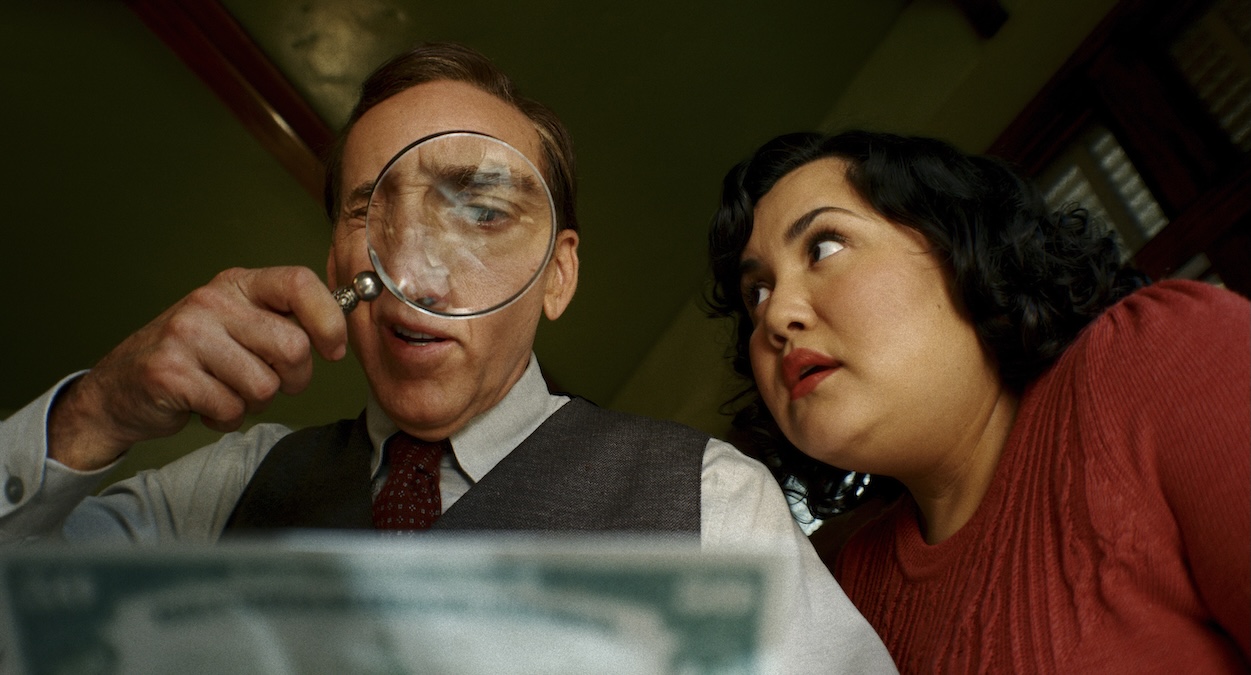
This post contains spoilers for Spider-Noir, and also 30-year-old comic books.
Every part of Spider-Noir has the senses of every viewer tingling, with its gangster movie take on Spider-Man‘s adventures. But the most shocking moment may come when our hero Ben Reilly (Nicolas Cage) meets an elderly stranger. When the stranger (Andrew Robinson) reveals that he’s actually much younger than Ben, that he went by the nickname “Freckles” when they were both in the military, we learn a compelling secret: Ben Reilly isn’t Ben Reilly. Instead, he was born under a different name, a name he changed to Ben Reilly after the war.
Freckles doesn’t tell us Ben’s real name, but the reveal is enough to warn any reader of Spider-Man comics that danger is coming. Any mention of Ben Reilly and mistaken identity brings to mind the first time Ben Reilly appeared in the comics, an infamous debacle known today as The Clone Saga.
The Death of Gwen, The Birth of Ben
The Clone Saga actually dates back to the mid-1970s, shortly after the death of Gwen Stacy in Amazing Spider-Man #121–122 (1973). In the next year’s Amazing Spider-Man #129, by Gerry Conway and Ross Andru, we meet a new supervillain called the Jackal, a mysterious guy in green fur (who has just won over a guy called the Punisher, also making his first appearance). Soon, we learn that the Jackal is biology professor Miles Warren, who long harbored feelings for his student Gwen. Blaming Spider-Man for her death, the Jackal sought revenge by creating a clone to destroy the Wall-Crawler.
That story seemed more or less finished in 1975’s Amazing Spider-Man #149, with the clone apparently dying in an explosion. Flash-forward two decades to 1994, when a mystery man said to look exactly like Peter Parker begins appearing. Although the stories left open the possibility that the mystery man was Peter, who was suffering from a nervous breakdown that made him think of Spider-Man as a separate identity, the Power and Responsibility arc that ran across the four series published at the time—Web of Spider-Man, Amazing Spider-Man, Spider-Man, and Spectacular Spider-Man—established that the clone made by Miles Warren had lived.
After some hero-on-hero fighting, Peter and the clone come to an arrangement. The clone takes the name Ben Reilly, after the first name of his uncle and the surname of his Aunt May, and begins fighting crime as the Scarlet Spider. At the same time, more clones appear, including another copy of Peter called Kaine and a clone of Miles Warren, once again masquerading as the Jackal.
So far, so good, right? Yes, there are a few too many clones, but nothing that out of the ordinary for a superhero comic. Plus, Marvel gets a few new Spider-people to play with, just as the novelty of Venom has worn off.
What A Tangled Web We Weave…
But that’s when Marvel editorial gets an idea. The brass had long worried that Spider-Man comics had lost the plot. Peter Parker began as a teenager, and his stories from the ’70s portrayed him as a young adult who had to balance dates, money troubles, and freelance jobs with his superheroing. By the mid-’90s, Peter had grown up, married super-model and actress Mary Jane, and the two were expecting a baby.
They saw the emergence of Ben Reilly as their ticket out. Thus, the stories began to retcon the original Clone story from 1975. The comics revealed that the explosion in Amazing Spider-Man #149 gave Peter amnesia, and it was the clone who walked away from the wreckage. The man we knew as Ben Reilly was in fact the true Peter Parker. The man we’ve been following as Peter, the man who married Mary Jane and was expecting a child, was in fact the clone.
So Marvel attempted a great switcharoo. The Peter we’ve been following dyed his hair blonde and moved to the West Coast with Mary Jane, taking on the identity of Ben Reilly. The guy we thought was a clone took up his rightful name of Peter Parker, and stayed in New York City as Spider-Man.
At least, that’s what Marvel started to do. When word of the company’s plans got out, fans revolted, not buying the simple solution that Marvel pitched. And so, several issues later, it turns out that Ben Reilly was the clone, and our Peter was the real Peter all along. And also his hair was going to stay brown. And also, he’s staying in New York.
If this summary sounds messy, the execution was even worse. Not only did editorial take what began as a slightly ambitious and ridiculous sci-fi story and spiral it into a spaghetti mess that changed on the fly, but they also stuffed their resolution with the return of Norman Osborn, who had been dead since he accidentally impaled himself after killing Gwen Stacy back in 1974, and the disappearance of Peter and MJ’s baby. Oh, and also Aunt May seemed to die again, but it turns out she’s alive.
A Simple Saga
To this day, The Clone Saga stands as the ultimate example of editorial run amuck. And yet, Marvel keeps returning to it again and again. The Clone Saga was adapted into The Animated Series, remade in the Ultimate Universe, and given sequels. Even poor Miles Morales got his own Clone Saga in recent years.
Spider-Noir does have a mad scientist, so it’s not entirely out of the realm of possibility that some clone shenanigans could be afoot. But going by Freckles’s intimation, Spider-Noir may give us the best possible version of the story, with Peter changing his name to Ben Reilly after the war, to get a fresh start from the horrors he experienced. At least, this version of the story won’t give comics fans terrifying flashbacks.
Spider-Noir is now streaming on MGM+ and Prime Video.
The post Spider-Noir Cleans Up an Infamous Spider-Man Debacle appeared first on Den of Geek.