By
By 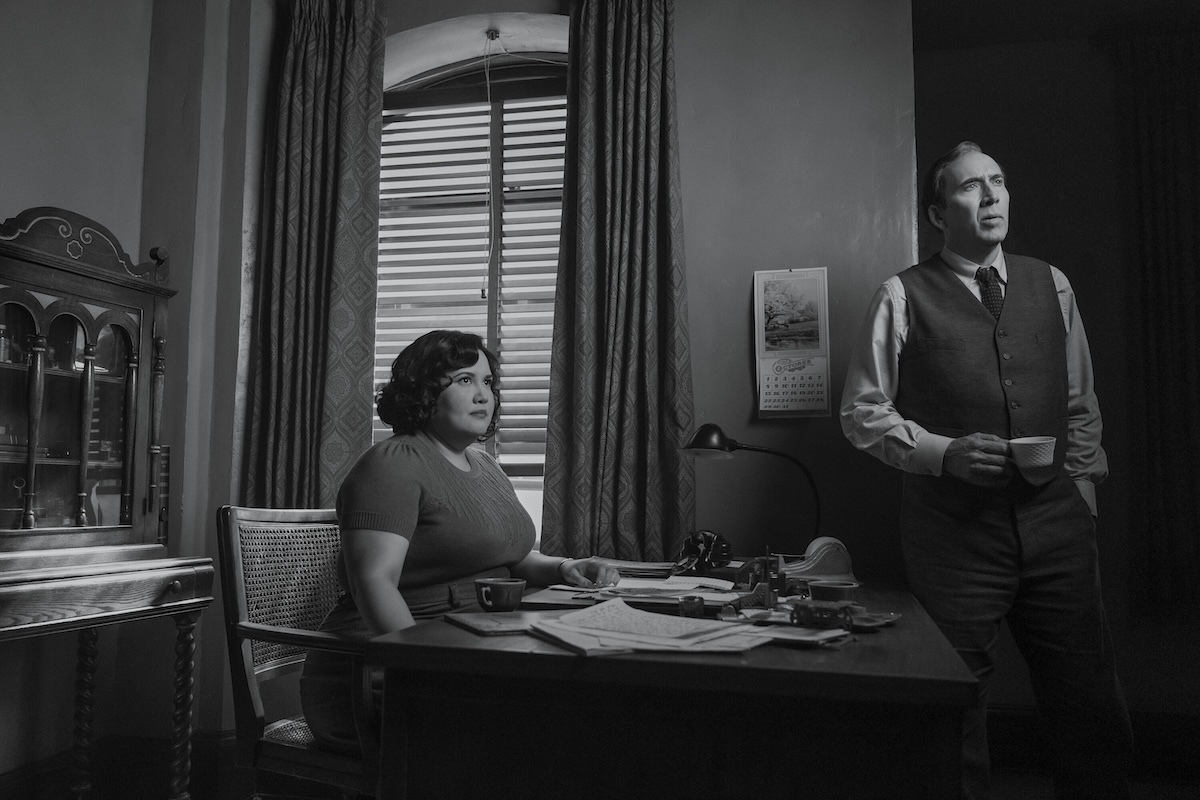
Spider-Noir may be about a guy who can shoot webs fighting people with electrical powers and super-strength, but it is fundamentally a riff on noir films. Literally “dark film,” film noir was the term that French critics applied to the crime movies that Hollywood made from the 1930s and through the early ’50s, movies such as The Third Man, Double Indemnity, and The Big Heat.
A cursory look at the trailers for Spider-Noir emphasize the show’s connection to those movies. Even when he’s wearing a mask, Ben Reilly a.k.a. the Spider (Nicolas Cage) keeps his fedora and trench coat on, just like Humphrey Bogart and Glen Ford before him. The show’s supervillains don’t wear tights and don’t have robot limbs, choosing the types of suits and flatcaps donned by Sidney Greenstreet or Richard Widmark.
The Spider-Noir trailers also match the color of classic noirs—or, rather, the lack thereof. MGM+ and Prime Video will stream Spider-Noir in two modes, black and white or technicolor. So what’s a true believer to do? Swing across the color spectrum with the Spider or brood with Ben Reilly in black and white?
The answer is slightly more complicated than similar questions posed by Mad Max: Fury Road or Godzilla Minus One, films that released grayscale versions after the standard color prints first played in theaters. Both of those movies came to audiences in full color, vibrant color in the case of Fury Road, and were shot by filmmakers who used the full palette. Takashi Yamazaki may have been gesturing towards the original 1954 movie with Godzilla Minus One, but the blocking, costuming, and lighting of that movie were designed with the expectation of color. Thus, the black and white versions of the movies play like cover songs: not without value or pleasures, but largely meaningless without the original.
That’s not the case with Spider-Noir. Even if the fact that the opening titles play in black and white, regardless of the stream you’re watching, doesn’t tip you off, it’s clear that Spider-Noir was designed with black and white in mind. Showrunners Oren Uziel and Steve Lightfoot employ directors who know how to make use of shadow and strong contrast. The Dutch angles that appear in every episode aren’t just nods to filmmakers such as Fritz Lang and Robert Siodmak; they’re tools to keep the visuals dynamic without colors.
The black and white print helps sell the tone of Spider-Noir, which functions much more like a hard-boiled detective story than it does a superhero tale. Even though the series, and Cage in particular, cannot help but gesture towards Bogart and Orson Welles, it largely works as a continuation of the genre, not just a self-satisfied set of allusions. For that reason, the shades of grey underscore the series’ worldview.
But this isn’t to say that Spider-Noir doesn’t work in color at all. Instead of just shooting the series in the same flat colors as every other series, the directors work to emulate the bright technicolor of a Hitchcock movie. Everything is oversaturated and unreal, making the show not only visually distinct, but also as heightened as the black and white version.
So, what’s the best way to watch Spider-Noir? To this writer, black and white is clearly better. But the color stream has its charms too, and the showrunners gave it enough character to be distinct from every other show on television right now. You’ll lose something offered by the black and white stream when you choose the color route, but you’ll gain some unique visuals that make for their own satisfying experience.
In the end, the choice is yours. But unlike every noir hero from Bogie to Ben Reilly, you don’t have to wallow in self-loathing if you make the wrong decision. You can just click to the other stream and let Spider-Man do the brooding.
Spider-Noir streams in color and black and white on MGM+ on May 25, 2026, and on Prime Video on May 27, 2026.
The post Spider-Noir: Should You Watch it in Black and White or Color? appeared first on Den of Geek.