By
By 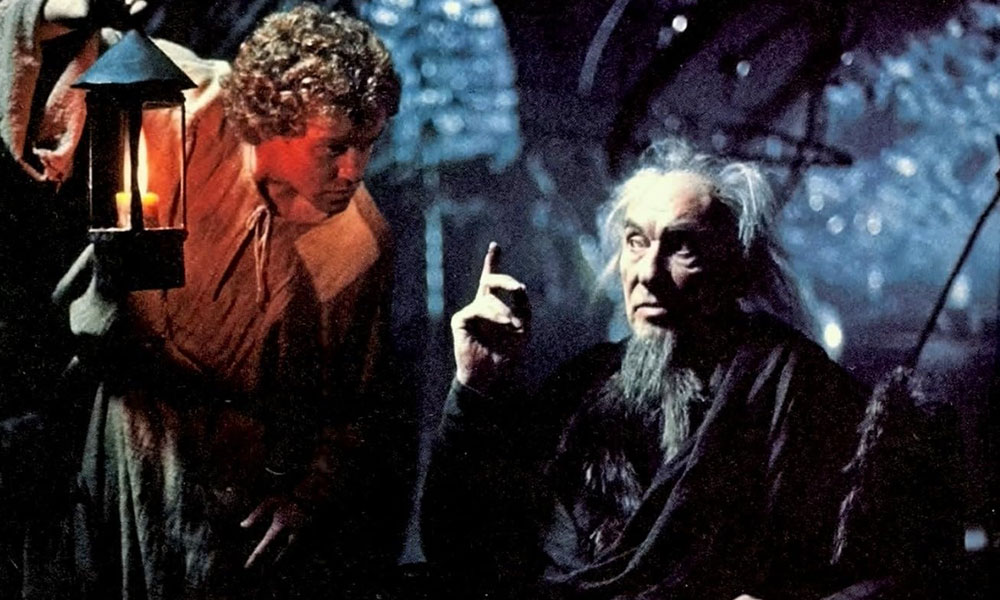
Dragonslayer makes a person jump up and say, “Yas, slay, queen!” It’s style remains visually distinct even now. The movie’s epitomous creature, Vermithrax Pejorative, is still referred to as the best dragon on film to this day.
Dragonslayer hit the screen in 1981 as a co-production between Paramount and Walt Disney Productions. Disney displayed interest in producing more adult films at this time, including The Black Hole, The Watcher in the Woods, Something Wicked This Way Comes and Never Cry Wolf.
Dragonslayer is the story of a magician’s apprentice who sets out on a journey to slay a dragon, which threatens the kingdom of Urland. It’s a dour landscape of craggy mountains, thick forests and grassy plains under gray skies filmed in Wales and Scotland.
The movie makes a concerted effort to avoid the visual tropes of medieval films. Villages are not quaint. Castles are not regal. Banners and gowns are in short supply. It is truly the Dark Ages. Everything looks like it was birthed from a coal mine.
For my money, Dragonslayer is the best Lord of the Rings-adjacent film. One can imagine Frodo and crew going about their quest a couple of mountains over. In fact, I’d rather watch Dragonslayer than the Lord of the Rings films.
Dragonslayer
Writer/director Matthew Robbins is the main architect of Dragonslayer.
Who?
That’s a fair question. Believe it or not, Robbins is a sneaky talented filmmaker and is still active to this day. He worked with Spielberg on The Sugarland Express, Amazing Stories and Batteries Not Included. These days he is a favorite of Guillermo Del Toro, working on Mimic, Don’t Be Afraid of the Dark and Crimson Peak.
Robbins will even show up on the credits list in 2026 with Brad Bird’s latest, Ray Gunn. He also gave us The Legend of Billie Jean, which requires some Pat Benatar…
With Dragonslayer, Robbins takes a simple cliched story and imbues it with enough hints of depth to give it more resonance than expected. Dragonslayer is a story where everything is not quite what it seems.
The story begins with the death of a character, but it is not what it seems. Another character takes up the mantle and tries to convince people he is more than he seems. A third character pretends to be something they are not. Meanwhile, the entire kingdom tries to convince itself it made a reasonable deal with the devil, even though the price is their own children. Finally, the entire pagan worldview of Urland is about to be swept away by the arrival of Christianity.
To a small degree, Dragonslayer is a companion piece to The Wicker Man. The Wicker Man is the story of Christianity and paganism coming into direct conflict. The neat thing about it is how it simply presents the arena and doesn’t take sides. The pagans won, but the Christian also won through martyrdom and pronouncing judgment.
This dynamic is not as overt in Dragonslayer, but it is present in a way that also makes Dragonslayer a companion piece to The Wild Bunch. Both films have a theme at play that presents various characters as people who time is rapidly passing by.
Dragonslayers
The Dragonslayer cast is compact but powerful. A disconcertingly young Ian McDiarmid (Dirty Rotten Scoundrels) appears briefly as a Christian missionary. Ralph Richardson (Time Bandits), who makes dottiness ethereal, chews the scenery as a sorcerer. John Hallam (Lifeforce) is a knight in unshiny armor.
The main players are a one-two punch.
Caitlin Clarke is a damsel who is not in distress. She is helpful but not overpowering. She also needs to be feminine enough to motivate a man to want to slay a dragon. Clarke does this with pure tomboy energy that somehow works. She is kind of like Marion in Raiders of the Lost Ark…not as spunky but with more of a sleeper build.
Clarke did not have a big career, and I was sad to see she already left us more than 20 years ago. Ovarian cancer got her in 2004 at age 52.
The main star of Dragonslayer is Peter MacNicol. This absolutely should not work, but like the film itself, things are not as they seem. MacNicol seems pure beta, but he is actually pure alpha in Dragonslayer.
In the 1990s, MacNicol made a career as a comedy glue guy, and I maintain his lunacy is what made films like Ghostbusters II and Adams Family Values work. In Dragonslayer, he is an apprentice who steps up like David vs. Goliath in the battle against the dragon. He doesn’t have what it takes, but he makes it work with sheer sincereity.
Smart writing helps MacNicol in the journey. For example, of course he shouldn’t beat a trained warrior in a sword fight. Yet, he does because the trained warrior gets too caught up in toying with MacNicol and doesn’t understand the superior weapon MacNicol wields.
In the end, viewers have little issue believing MacNicol is the most badass pansy boy ever put on film.
Enter the Dragonslayer
The real star of Dragonslayer is Vermithrax Pejorative. The only thing to complain about is that the creature doesn’t get enough screentime. That’s because Dragonslayer was made in 1981, and guys had to legit find a way to put a living, fire-breathing dragon on screen.
Graphic artist David Bunnett based the dragon’s physiology on the pterosaur Rhamphorhynchus, which I find utterly delightful because that was the first “weird” dinosaur name I learned to pronounce.
Special effects auteur (or is that autistic) Phil Tippett also came into play to operate the stop-motion effects and used his giant brain to develop a new technique called go-motion. This eliminated the jerkiness of stop-motion effects to add motion blur to the images.
The model is a rod puppet. The models are attached to motors linked to a computer that can record each movement. When enough movements are made, the model is reset, the camera rolls and the motors take the puppet through its paces. Originally, Tippett planned to do Jurassic Park with go motion. Test footage exists, but CGI pushed far enough ahead to make that unnecessary. The rest is history. The quirky glory of armatures moved a frame at a time died.
Lifesize pieces were also built by Chris Walas, who turned Jeff Goldblum into The Fly five years later. Lifesize pieces included a head, claws and tail.
If that’s not enough of a dream team, visual effects lord Dennis Muren came in to do the camerawork. All of it paid off. Vermithrax looks great, and the shots of the final battle against a cloudy, starry, eclipsed sky achieve a feeling of apocalyptic doom not seen in any other film.
Dragonslayer should have won an Oscar, but it had to compete against a little film called Raiders of the Lost Ark.
Year of the Dragonslayer
To show the prowess of writer Robbins even Vermithrax displays a hidden side. The deal is Vermithrax gets a virgin sacrifice twice a year to refrain from terrorizing the kingdom.
But what are two virgins a year to a dragon? A dragon the size of Vermithrax that needs energy for flying and breathing fire could require up to 600,000 calories a day (I arrived at that number by asking Google).
Meanwhile, one human female provides roughly 140,000 calories. Two females twice a year has no real value to Vermithrax.
So, what does have value to a dragon? Being left alone has value. Vermithrax is old and in pain and probably one of the last, if not the last, dragon. It knows that too much human interaction will get it killed. Two virgins twice a year ensures it gets the solitude it needs to, perhaps, raise its children to adulthood.
See, Tippett is the only autistic person here…
Once Vermithrax’s children are killed, the final battle is no longer about dominance. Vermithrax knows it’s time is over and simply wants to die. It’s last battle is a suicide mission.
Dragonslayer
Dragonslayer brought in $14.1 million on an $18 million budget.
The week Dragonslayer came out, it was directly up against For Your Eyes Only, The Great Muppet Caper, Roadgames and Stripes. Seven days before was The Cannonball Run, Herbie Rides Again, Superman II and Swiss Family Robinson. The week after was Escape from New York and The Fox and the Hound.
Never mind, Raiders of the Lost Ark, Arthur, Chariots of Fire and Time Bandits also happened that year. That’s a murderer’s row of competition. Nevertheless, Dragonslayer lived on as a fairy tale with teeth.
“You can’t make shameful peace with dragons. You must kill them…”
Dragonslayer isn’t just about a world passing by, it was made by a world passing by. The people who crafted Dragonslayer needed to cast real magic to put its images onscreen. Pity they are no longer needed and won’t be with us much longer. Yet, they lived as heroes to a lot of kids, and their tales will continue to be told for years to come…
The post Retro Review: DRAGONSLAYER (1981) appeared first on Last Movie Outpost.