By
By 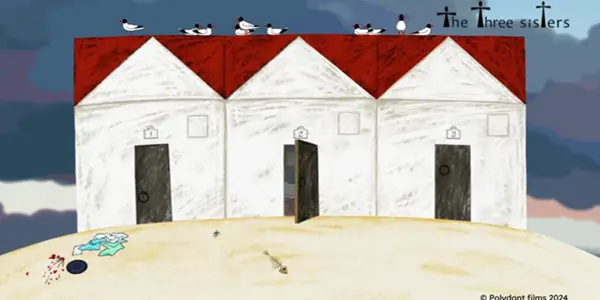
Unless you frequent the film festival circuit, you’re probably relatively unfamiliar with the short films nominated across the Animated, Live Action, and Documentary categories when the Oscars roll around every year. We should revisit the vintage concept of screening one or two shorts (and maybe even a newsreel) before feature films playing in movie theaters; alas, the powers that be prefer that we sit through a cavalcade of advertisements and trailers for coming attractions instead. Fortunately, all three sets of the 2026 Oscar-nominated short films are coming to theaters in the lead-up to this year’s awards. Distributed by Roadside Attractions and presented by filmmaker Taika Waititi—a nominee for Best Live Action Short in 2004—this year’s nominated shorts span countries, cultures, and genres, and in the particular case of the animated shorts, a vibrant array of visual styles.
The Three Sisters
It’s unfortunate that the short film program begins with The Three Sisters, as this was my least favorite of this year’s animated shorts. (Just know that it only gets better from here!) From Israel and Cyprus, the dialogue-free film tells the tale of three sisters who live on an isolated island in the middle of the sea, each one of them in their own little house. When a moment of seagull-induced chaos leads to the sisters losing the bag of money that they use to pay for supplies to be delivered to the island, they decide the only way to make up their losses is to rent out one of the houses.
source: Roadside Attractions
Enter a burly, bearded sailor, whose arrival on the island throws the three sisters into an uproar. They abandon their drab, frumpy clothes for colorful, stylish frocks, throwing off their kerchiefs to reveal vibrant hairstyles. One sister takes it upon herself to wash all of the sailor’s clothes, another is always present with a light for his pipe, and another carries a flower that he gave her around as though it were a precious heirloom. Naturally, they all bristle with jealousy whenever one sister gets more attention than the others.
In summary, The Three Sisters is basically a film about how women will become utter fools and betray each other as soon as they encounter a man, so it shouldn’t surprise you to learn that it was written and directed by a man (Konstantin Bronzit) as well. While the story leaves a lot to be desired, I did enjoy the old-fashioned, two-dimensional style of animation; the backdrops were particularly beautiful, and portrayed the changing light over the island and the sea remarkably well. The film also deserves some credit for being the most upbeat and least depressing among this year’s nominated animated shorts, with some legitimately funny moments. Still, the story feels as though it belongs in a film made in the 1950s, not the 2020s, and for the most part, I found it very irritating.
Forevergreen
The most adorable yet predictable film in this year’s slate of nominees is Forevergreen, a warm and fuzzy morality tale from the United States about a bear cub raised by a fatherly evergreen tree. Directed by Nathan Engelhardt and Jeremy Spears, the film follows the bear cub as it learns to avoid porcupine quills and feasts on the fruits of the forest. However, a chance encounter with a bag of potato chips—who among us has not succumbed to the siren song of processed foods?—results in a series of selfish choices that threaten to destroy everything the bear holds dear, including its loving relationship with the tree.
source: Roadside Attractions
Despite being dialogue-free, Forevergreen is packed to the brim with important, albeit incredibly obvious, messaging about valuing the natural world around us and avoiding easy temptations that could have repercussions on others besides ourselves. When these messages are presented via cutesy animation involving a bear cub and an anthropomorphized tree, it’s all too easy to succumb to the emotional manipulation of it all, even if it is undeniably heavy-handed. The animation in Forevergreen is computer-generated, but mimics the style of stop-motion; everything in the film, including the bear cub, has the texture and appearance of wood. And while real stop-motion would have been more impressive, the visuals are still effective and enjoyable to look at; they reminded me of children’s book illustrations, which felt fitting considering the subject matter.
However, when the film fades out into a Bible quote as a Christian folk song plays, the spell cast by all the pretty pictures is immediately broken, as you realize that this whole time you’ve just been watching a faith-based version of The Giving Tree. There’s not really anything wrong with channeling your religious beliefs into a film with such a positive message as Forevergreen, but you shouldn’t need to rely on Jesus to convince the audience that selfishness is bad and preserving the environment is good—especially since we all know that a lot of so-called Christians are not terribly familiar with those values anyway.
The Girl Who Cried Pearls
From Canada comes The Girl Who Cried Pearls, a stunning stop-motion story in the style of a gothic fairy tale. Directed by Chris Lavis and Maciek Szczerbowski, who were nominated in this category in 2007 for Madame Tutli-Putli, the film tells the tale of a poor boy in early 20th-century Montreal who falls in love with a sad girl whose tears fall as flawless pearls. Desperately in need of money, the boy gathers some of the pearls and sells them to a merciless pawnbroker, who tells him to come back the next day with more. The problem is, to acquire more pearls, the girl will need to cry—and the boy wants her to be happy. Which will he choose: love or wealth?
source: Roadside Attractions
The Girl Who Cried Pearls is the most impressive of this year’s nominated shorts from a visual perspective; the puppets, props, and sets are all incredibly detailed and beautiful. The film’s aesthetic feels like a mix of the Chilean animated horror film The Wolf House and the haunting work of the Quay Brothers, with a twist of Tim Burton thrown in for good measure. When viewed directly after Forevergreen, it’s also a reminder that, as lovely as that previous film’s imagery may be, computer-generated imitations of stop-motion cannot hold a candle to the magic of the real thing.
The story tells a compelling tale of the temptation that wealth can pose at the expense of real happiness…until the final act, which leads you to question everything that came before and forces you to contemplate whether a good story is more valuable than the truth. I found this twist incredibly abrupt and unsatisfying, especially since this kind of trope is one of my least favorite in all of storytelling. Overall, The Girl Who Cried Pearls is far more enjoyable due to its style than its substance, though it’s still a worthwhile and entertaining film.
Butterfly
By far my favorite of this year’s contenders, Butterfly tells the story of Alfred Nakache, a Jewish man from Algeria who rose to fame as a decorated, record-breaking swimmer before being imprisoned in Auschwitz by the Nazis. Not only did he swim for France in the 1936 Olympics in Berlin, but he also competed in the 1948 Olympics in London, making Nakache one of only three known Jewish athletes to compete in the Olympics after surviving the Holocaust.
source: Roadside Attractions
Director Florence Miailhe’s father knew Nakache; this personal connection to the story powers every frame of Butterfly, which Miailhe animated by painting by hand on glass. This results in a series of fluid, amorphous images that flow and melt into each other, an ideal aesthetic for a film set during the final swim of Nakache’s life. As he powers through the water, memories rise to the surface of his mind: from his mother encouraging him to overcome his initial fears of water in their North African homeland, to his professional and personal triumphs in France—including meeting and marrying his wife, Paule, and becoming a father to a daughter, Annie—to being stripped of his French nationality and banned from the pool by the French collaborationist regime, to being captured by the Gestapo and separated from his family, who he would never see again.
Some of the images in Butterfly are almost abstract in their simplicity, such as the crowd at the Berlin Olympics doing the Nazi salute in unison, rendered solely with dots for faces and lines for hands that pop up and down mechanically like levers. However, this style does not make these scenes any less powerful to behold; if anything, it strips them down to their emotional core, which is all too fitting for a film made out of memories. And while it may be an awards-season cliche to want to give the Oscar to the movie that features the horrors of the Holocaust, Butterfly deserves its flowers all the more for treating these horrors sensitively, without resorting to the cheap and easy explicit exploitation of trauma. Nakache’s life is presented as full and vibrant as it no doubt was, punctuated by tragedy as well as triumph; both he and the film he inspired are worth celebrating.
Retirement Plan
Directed by John Kelly, Retirement Plan is the only one of this year’s nominees that runs less than ten minutes, yet it has just as much to say, if not more so, than many of its longer peers. Narrated by Domhnall Gleeson, this charming little film from Ireland involves a middle-aged man named Ray listing all the things he plans to do when he retires and finally has time to do it all, including exploring new activities (and discovering that some, like camping, he actually hates), growing as a person (such as learning to say yes, and also no), and learning more about the world around him (including what leeks look like, and what to do with them).
source: Roadside Attractions
Retirement Plan is animated in a two-dimensional style that appears simple but suits the story. Gleeson’s delivery of Ray’s increasingly extensive and ambitious list of things he plans on accomplishing is wonderful; the film’s script, by Kelly and Tara Lawall, is endearing and funny, and also painfully bittersweet. As the film progresses, the audience—if not Ray himself—begins to realize that by putting off everything we hope and dream to do someday, we might not end up getting the chance to do it at all. Time is not unlimited, especially once you reach retirement age and your mind and body begin to feel the wear and tear of your life thus far.
As Ray’s bucket list grows more and more unwieldy, one is reminded that it is better to live now, in the present, than to perpetually put things off for a future that might never come, or at the very least, might not last as long as we’d like. I found Retirement Plan very relatable, especially living in a world that every day seems to be splitting apart more and more at the seams.
Conclusion
The program concludes with a bonus film from this year’s Oscar shortlist, the Irish folk tale Éiru. Directed by Giovanna Ferrari, the film follows the titular character, the youngest child of an Iron Age clan, who is not taken seriously by the hulking warriors around her. However, when the clan’s well dries up, it is Éiru who must step in to save the day; along the way, she learns powerful lessons about the importance of not allowing differences to cause division. I didn’t care for the visual style—perhaps that’s why it didn’t make the final five nominees—but the story is entertaining and should appeal to audience members of all ages. It makes a fine capstone to the theatrical program of Oscar-nominated animated shorts.
This year’s Oscar-Nominated Shorts, distributed by Roadside Attractions, opened in theaters in the U.S. and Canada on February 20, 2026.
Does content like this matter to you?
Become a Member and support film journalism. Unlock access to all of Film Inquiry`s great articles. Join a community of like-minded readers who are passionate about cinema – get access to our private members Network, give back to independent filmmakers, and more.