By
By 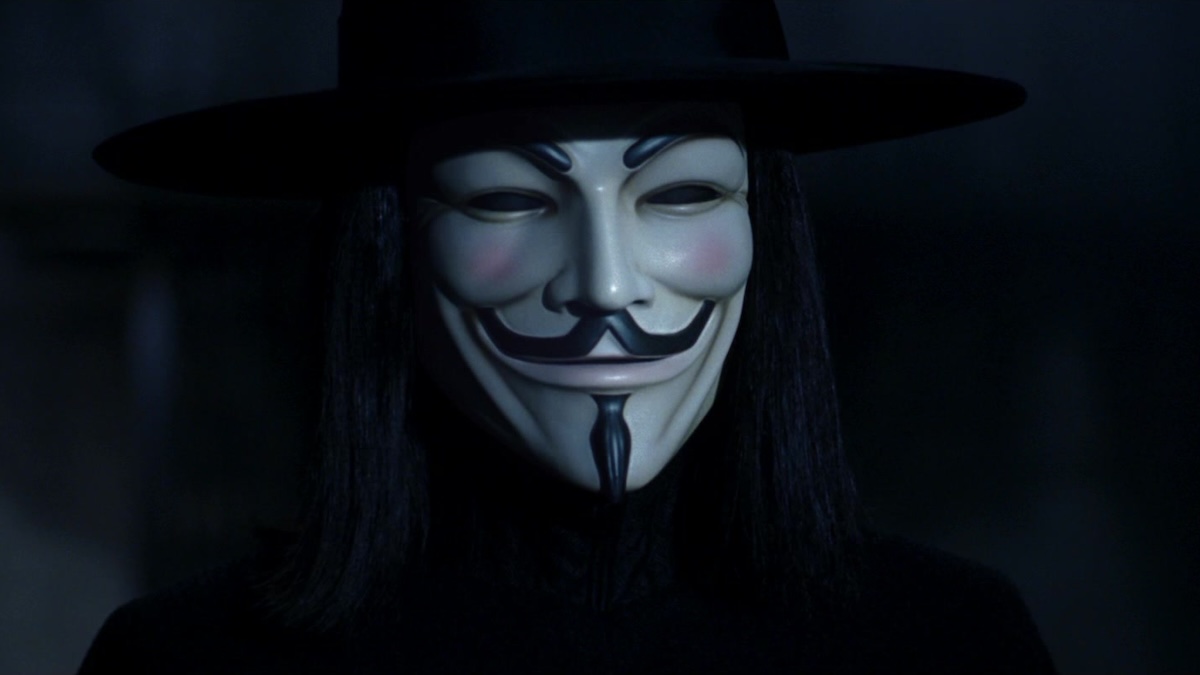
“Remember, remember, the fifth of November.” So goes the English poem commemorating the arrest of Guy Fawkes on November 5, 1605, for trying to destroy Parliament with explosives. These days, the image of Guy Fawkes is as prevalent as ever, but few remember the Gunpowder Plot at all. Instead, they associate the face with the mask worn by V, the protagonist of the 1982 comic book V for Vendetta and the 2006 movie adaptation.
And that’s just fine with James McTeigue, director of V for Vendetta. “I think people really got what the movie was about,” McTeigue told Den of Geek. “And people get what the mask is about, too. It has cultural legs beyond the film. It’s about your right in a free society to protest, that there’s more strength in ‘we’ than there is in ‘I.’ The mask affords you the ability to protest without vilification or being arrested.”
Written by Lana and Lilly Wachowski, V for Vendetta stars Hugo Weaving as a masked vigilante known only as V, who recruits/forces young woman Evey Hammond (Natalie Portman) into his crusade against a fascist English government. Set in the near future, the film shows how the Norsefire party, under the control of leader Adam Sutler (John Hurt), uses media and censorship to create a compliant populace. In addition to recovering works of art and pop culture that the government tries to destroy, V seeks to inspire the people to fight back, while waging his own personal war against those who ran the concentration camp that transformed him into the man he is today.
“What jumps out to me is how timeless it actually is to tell the truth,” McTeigue says of revisiting the film after 20 years. “The political environment hasn’t really changed that much from when I made the movie 20 years ago. And I’d guess Alan Moore and David Lloyd would tell you that the political environment that they made it hasn’t changed that much from when they made the book in the ’80s. I think we’re in another cycle of that, and I’m really appreciative of people who watch the film and recognize that.”
The continuing rise of reactionary politics in the West certainly has helped the film remain relevant. But V for Vendetta also remains a favorite because of the incredible performance by Weaving, who came in late in production to replace James Purefoy and did his entire part behind an unmoving, unchanging Guy Fawkes mask.
“I called him up and said, ‘Hey, Hugo, I’m in a bit of trouble with the actor I got in the mask at the moment. I think I’m gonna have to make a change.’ Then I said, ‘But don’t come over if you’re gonna have a problem being in a mask. And he’s like, ‘I won’t have a problem being in a mask. I want to be in a mask.’
“It was a challenge he’d never had. He did mask work at drama school, working through the Greek theater and Norwegian theater. So he came over and was amazing. He knew exactly what to do. He saved me.”
While he is quick to credit Weaving for making V come to life without the use of his face, McTeigue also deserves credit for finding ways of shooting the mask and making it look interesting.
“I wanted to get the different facets of what made his character, so I would light it differently. I did a bunch of tests to make him look benevolent, to make him look crazy, to look sinister. The secret of it was just to treat it like a face, as I normally would. In a dramatic moment, I would push the camera in, even though the face wasn’t doing anything. It showed that if you watched closely enough, V’s telling you everything about himself.
“Even in the moment on the sofa, where V and Evey just watched a movie, and the news breaks in about the death of Lewis Prothero (Roger Allam), the Voice of London. Evey turns around asks if V killed him. We’re in this wide shot when he just answers, ‘Nope.’
“Other times, though, I wanted them to have a connection. So I’d cut from a close-up of V to a close-up of Evey, just to get the juxtaposition. Part of it was playing off the character with him in the scene, whether it was the crazy priest Lilliman (John Standing) or Evey. I thought it was important that you saw them as equals.”
The movie’s depiction of Evey Hammond differs quite a bit from the version that Moore and Lloyd created in the comic. Where the original Evey was a timid 16-year-old who gets forced into joining V’s crusade, the version in the film is older and has more agency.
“Don’t be slavish to the graphic novel,” McTeigue says as advice to anyone adapting comics to the screen, even when working with a writer as lauded as Alan Moore. “I think in Alan Moore’s brain, he would have just put the graphic novel on a pedestal or just put the pages on screen.”
Joking aside, McTeigue did translate some images directly from the comics. In particular, he recreates a shot from a flashback sequence, showing a naked and unmasked V in silhouette standing in front of the flaming concentration camp.
“It was a crazily graphic image, so I had to do it in the movie. And in the same way it’s important to the graphic novel, it’s important to the film. You need to see who he is and what formed him. That’s the point when V’s being reborn. He’s filled with rage, but he’s filled with hope too.
“By the way, the guy that I used in the burn suit in the movie was Chad Stahelski, director of the John Wick movies,” McTeigue adds. “It was raining that night, and I told him what I wanted to do. He was game, came out and did it, and we got it all in one take.”
While Lloyd’s art provided some guidance, McTeigue had to make stronger decisions to bring the comic into live action.
“For the other visuals, we had to make a distinction between the state-run media and the rest of the film. Everything that was run by the state had this very video-esque quality to it, like a surveillance camera. And then we had John Hurt as the Leader, which is a callback to Big Brother and the 1984 movie [in which Hurt played protagonist Winston Smith], with a big pixilated head.
“In contrast, I wanted V’s headquarters, the Shadow Gallery, to feel warm. It was a repository of great art, music, and film, and a lot of my tastes got in there, the books and movies that I thought were important. I took inspiration from Gordon Willis, who shot all the Godfather movies, or Gregg Toland, who shot Citizen Kane. I borrowed from the paranoid thrillers of the ’70s like The Parallax View, some of which Willis shot, as well as Bonnie and Clyde, Dog Day Afternoon, The Battle of Algiers… A lot of things influenced me.”
Classic as the influences may be, the real power of V for Vendetta retains its revolutionary spirit, a spirit not diminished by the unfortunate real-world situations that keep the movie relevant. The final moments of the movie see Evey leading a revolution against the Norsefire government after V’s death, with a crowd of people donning Guy Fawkes masks, including people who died earlier in the film.
“The ending still holds true, because there’s hope, right?” McTeigue contends. “That was the idea of including people who were killed in the movie, that the cost of their lives wasn’t for nothing. The power of the people would carry forward.
“The way that protests work now, in this country and other countries around the world, the things that were happening then are happening now: fear to justify stronger state power, the detention of groups that are seen as threats, controversies around state surveillance, struggle over political narrative, constant conflict with press and comedians, crises that increase executive authority—all of those things are in the film.”
In short, V for Vendetta remains just as pressing as it was 20 years ago. Hopefully, 20 years from now, we can just enjoy it as a great film.
V for Vendetta is now streaming on HBO Max.
The post V for Vendetta Director on the Movie’s Hope and Relevance 20 Years Later appeared first on Den of Geek.