By
By 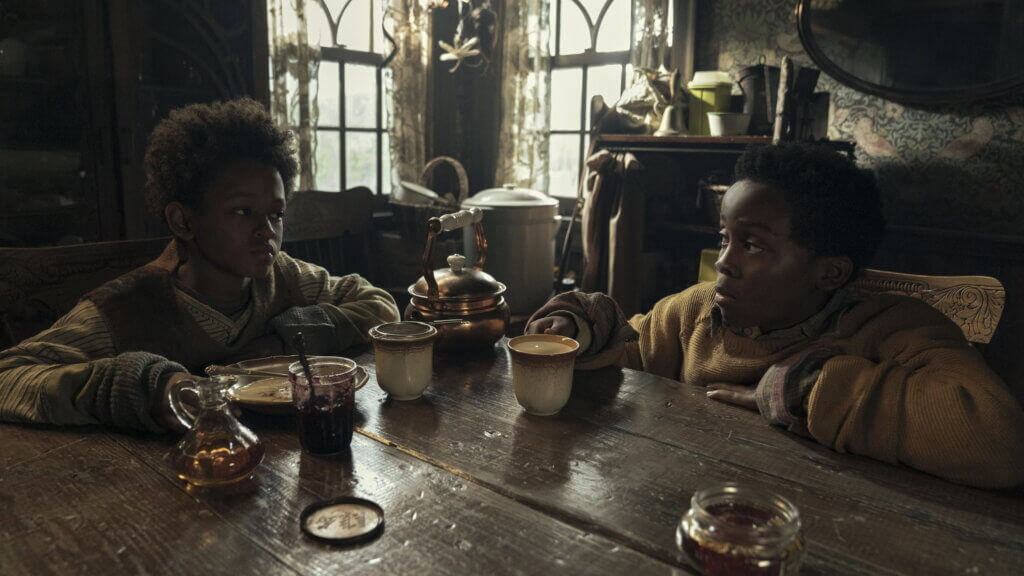
There is a compelling idea at the center of Alexandre Aja’s Never Let Go (2024): abuse reproduces itself. Trauma doesn’t remain sealed inside the person who first experiences it. It reaches outward, enters relationships, and teaches other people to live according to the same fear. In this film, that process becomes a literal monster. The Evil can possess anyone it touches, transforming emotional inheritance into physical contamination.
That idea kept me interested for most of the film, even when the horror itself didn’t frighten me very much. Aja creates an isolated world governed by strange but understandable rules. A mother and her twin sons live alone in a cabin surrounded by forest. Whenever they leave the house, they must remain connected to it by ropes. According to Mama, played by Halle Berry, an evil force has consumed the outside world. The house is their only protection, and letting go of the rope could allow the Evil to touch them.
Rent or buy Never Let Go on Amazon.
Never Let Go (2024)
The setup naturally evokes A Quiet Place. Both films place a family inside a survival system whose rules shape nearly every movement. Safety depends upon obedience, while a small mistake can threaten everyone. Never Let Go is less interested in constructing a post-apocalyptic world, however, than in asking whether the danger exists outside the family at all. The forest may contain a supernatural threat, but the children’s most immediate reality is a mother who has taught them that curiosity could be fatal.
The cabin and surrounding woods are easily the film’s strongest assets. Their isolation gives Mama complete authority over what her sons understand about the world. She decides which stories are true, what lies beyond the trees, and what must be done to survive. There’s no teacher, neighbor, book, or functioning community against which the boys can test her claims. The ropes make that dependency visible. Although Mama describes them as protection, they also function as leashes.
Aja has worked effectively with isolation and claustrophobia in horror before, but here the confinement is psychological as much as geographic. Mama does not simply prevent her sons from traveling too far. She controls the limits of what they believe is possible. The world beyond the rope has become unimaginable except as a place of possession and death.
Never Let Go (2024)
This is where the film’s trauma metaphor becomes most persuasive. Mama genuinely loves Nolan and Samuel. She is also controlling, frightening, and abusive. At different moments, she can appear to be a damaged mother, a dangerous authority figure, or the only person capable of protecting her children. These identities do not cancel one another out. In fact, their coexistence is what makes the family dynamic believable. Harm is often passed down by people who understand their control as an expression of love.
The monster therefore works both literally and symbolically. The Evil spreads through touch, just as abuse reproduces itself through intimate relationships. The people closest to us are capable of shaping our understanding of safety, trust, and danger long before we know the language to challenge them. Mama inherited her own darkness, but instead of preventing it from reaching her sons, she organizes their entire childhood around it.
In this respect, Never Let Go shares something with Possum and its monster born from childhood trauma. Neither film treats trauma as a memory that can simply be placed in the past. It becomes an object with a continuing presence. The difference is that Possum commits fully to its monster as a psychological manifestation. Never Let Go remains suspended between metaphor and supernatural reality.
For much of the film, that uncertainty works. Nolan, played by Percy Daggs IV, begins to question whether the Evil exists. Samuel, played by Anthony B. Jenkins, remains more committed to Mama’s warnings. The disagreement between the brothers creates more tension than most of the monster’s appearances because neither position feels entirely safe. If Nolan is wrong, his skepticism could destroy the family. If he is right, obedience means accepting a life built on someone else’s delusion.
Never Let Go (2024)
I related more strongly to Nolan. Breaking away from a family’s beliefs can feel necessary and painful at the same time. Freedom brings relief, but it can also produce guilt, particularly when questioning what you were taught feels like a betrayal of the person who taught it to you. Nolan is not merely deciding whether he believes in a monster. He is deciding whether he can trust his own perception when it contradicts his mother’s version of reality.
That conflict gives the film considerably more emotional weight than a straightforward survival story. Mama offers the boys choices, but only within boundaries she has created. They can decide how to follow the rules, never whether the rules are legitimate. A similar distinction drives the discussion of control and the illusion of choice in Heretic. Nolan’s doubt threatens Mama because genuine questioning could expose the entire structure of their lives as a form of confinement.
Daggs and Jenkins are both excellent. The film asks them to carry hunger, fear, sibling resentment, devotion, and doubt without making either boy simplistic. Nolan may be the skeptic, but he is not fearless. Samuel may be more obedient, but his belief is not stupidity. Each child has developed a different strategy for surviving the same household, and the performances make those responses feel painfully connected.
They are also more convincing than Berry. Mama remains a believable character, but Berry’s performance often feels mannered. The physical and vocal choices are always visible as choices, which occasionally took me out of the story. Daggs and Jenkins appear to be living inside the family’s fear, while Berry sometimes seems to be presenting Mama’s instability to the audience. It’s not a disastrous performance, but the boys definitely outperform her.
Never Let Go (2024)
The film is also more unsettling than frightening. The ropes, the prayers to the house, and the rules surrounding contact establish a strong atmosphere, yet the creature appearances rarely generate much terror. I was more engaged by the possibility that Mama had constructed the threat than by the threat itself. Once the film moves closer to conventional supernatural horror, some of its psychological pressure begins to dissipate.
That problem becomes unavoidable in the ending. Without revealing too much, the final sequence continues suggesting that the Evil is both a manifestation of inherited trauma and a physically independent monster. Those possibilities could coexist. A supernatural force can still embody a psychological truth. The film, however, never establishes how the two readings illuminate one another. It keeps offering evidence in both directions without much thought into what that means.
Ambiguity is useful when competing interpretations deepen a story. Here, it eventually feels like indecision. The film spends so much time asking whether Mama’s fear corresponds to an external reality that some clarity becomes necessary. Instead, it arrives at the familiar horror conclusion that appears to provide an answer before adding one final suggestion that perhaps nothing has been settled after all. The result is essentially “The End…or is it?” dressed up as something more.
Never Let Go (2024)
I found that disappointing because the uncertainty had worked so well earlier. While Nolan was trying to understand his mother, the lack of an answer placed me inside his experience. By the end, however, the question was no longer revealing anything new about him, Mama, or the transmission of abuse. It had become a mechanism for preserving the possibility of another scare.
Even so, Never Let Go has more on its mind than most isolated-cabin horror films. Its central metaphor is clear and often effective: fear becomes a form of inheritance, protection turns into control, and abuse survives by teaching its victims to reproduce the conditions that harmed them. The forest, the ropes, and the young performances give that argument a convincing dramatic form.
The film falters because it will not finally trust its own ideas. A more decisive ending could have made the supernatural and psychological readings reinforce each other, or it could have chosen one and accepted the consequences. Instead, Never Let Go holds onto every possibility until none feels completely satisfying. Like the boys tied to the cabin, it never quite finds the courage to release the rope.
Never Let Go (2024) Rating: ★★★ out of 5
If you’d like to watch Never Let Go (2024), the film is currently available to rent, stream, or purchase via Amazon.
The post Never Let Go (2024): When Abuse Becomes a Monster appeared first on Philosophy in Film.