By
By 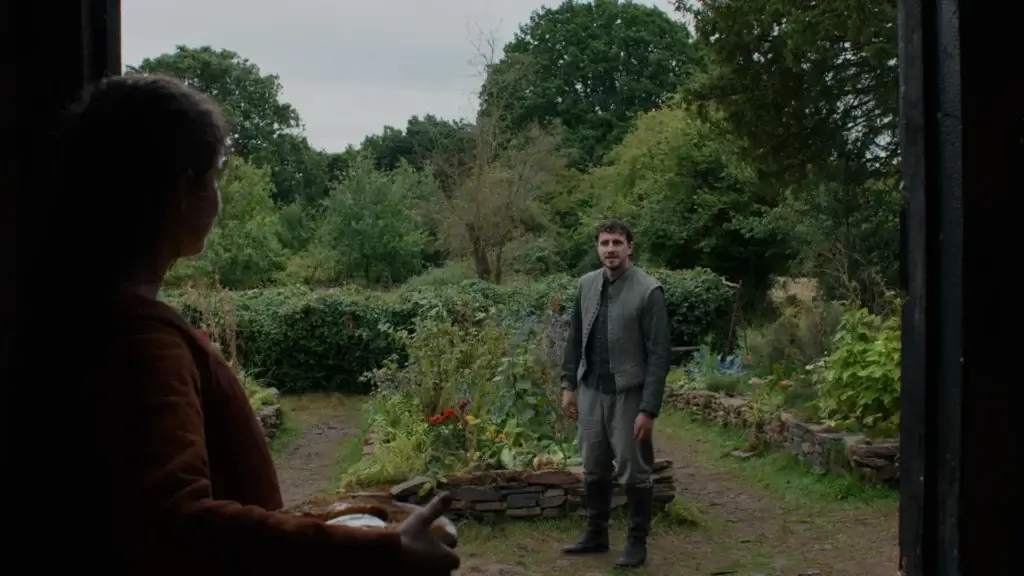
Chloé Zhao’s Hamnet (2025) is made with genuine care for its story; I just never fully understood why it’s about William Shakespeare.
Strip away the period costumes and the name, and this could be a story set in virtually any era. A talented but restless father spends most of his time away from home because of his work. His wife stays behind, raising their children and managing the household. When tragedy strikes, she has to live the grief daily while he finds somewhere else to put it.
That doesn’t make Hamnet a bad film. If anything, it gives the story a recognizable emotional foundation. I imagine plenty of people have known some version of this family, even if the father wasn’t off writing plays in Elizabethan London.
The early scenes establish Will Shakespeare (Paul Mescal) as a young man desperate to escape the life waiting for him in Stratford. He falls in love with Agnes (Jessie Buckley), whose connection to the natural world gives her a mystical presence. Their attraction is immediate and physical, and Zhao photographs the countryside with the kind of reverence usually reserved for religious spaces.
Agnes could have become another vaguely magical woman whose purpose is to inspire a great man, but Buckley makes her angry, strange, affectionate, and occasionally difficult. She feels like someone with an interior life that continues even when Will isn’t around.
Once Will leaves for London, however, the film settles into a much more familiar domestic arrangement. His absence becomes normal. Agnes stays with the children while his ambitions grow elsewhere. He returns periodically, but she carries the daily weight of the family.
Then their son dies.
Hamnet (2025)
The death itself is handled with considerable emotional force. Jacobi Jupe shows talent far beyond his years playing Hamnet, with a gentleness that keeps him from feeling like a child created solely to die and motivate the adults. Agnes howls, lashes out, and seems unable to understand how the world can continue.
That physical sense of grief reminded me of Alleviate, another film in which mourning becomes a kind of private imprisonment. Grief doesn’t automatically reveal some deeper truth. Sometimes it simply traps a person inside the same unbearable moment.
For Agnes, Hamnet’s death remains inside the house. She walks through the rooms he occupied and continues caring for the family he left behind. Will has a different option. He returns to London and turns his pain into work.
There’s an interesting tension here that Hamnet never examines as closely as I would have liked. Will gets to transform the family’s suffering into art. Agnes has to endure it as life. The film recognizes this imbalance, but it eventually treats his artistic response as a gift to her rather than asking whether he has taken ownership of a loss that belonged to both of them.
Almodóvar’s Julieta understands that the wounds of motherhood don’t disappear because someone finds a beautiful way to explain them. Hamnet seems less comfortable leaving Agnes without an answer. It needs Shakespeare’s art to redeem what happened.
Hamnet (2025)
This becomes the purpose of the final sequence. Agnes attends a performance of Hamlet and gradually realizes that Will has placed their son inside the play. The performance becomes his memorial, his apology, and his way of returning Hamnet to her.
It’s an effective scene in its own way. Buckley sells the recognition, and Zhao stages the theater as a place where the boundary between the living and the dead briefly collapses. I understand why the ending has affected so many viewers, but I still don’t think the connection works.
Yes, Hamnet and Hamlet were variants of the same name. Yes, Shakespeare wrote the play a few years after his son’s death. That’s an intriguing starting point for speculation, but the film treats it as a complete explanation. Hamlet is about a son mourning his father, not parents mourning their son. Its ideas about revenge, corruption, performance, political legitimacy, and moral paralysis don’t become clearer simply because Shakespeare had a dead child.
The Folger Shakespeare Library makes an even more basic point: an earlier version of the Hamlet story already existed by the time Hamnet died. Shakespeare’s loss may have shaped his treatment of the material, but reducing the entire play to that loss is far too convenient.
I don’t need historical fiction to prove that everything happened exactly as shown. I’m perfectly happy to accept invention if it leads somewhere interesting. The problem is that Hamnet uses an uncertain historical connection to give a fairly conventional family tragedy the appearance of revelation.
Hamnet (2025)
There was a more difficult film hiding here. What does it mean for an artist to turn shared grief into personal work? Is creation a form of mourning, or can it also become a way of avoiding the people who are still alive? Does placing Hamnet onstage honor him, or does it make his death useful?
My essay on Grave of the Fireflies looks at art as a way of working through trauma while also accepting responsibility. Hamnet reaches toward something similar, but it ultimately settles for catharsis. The play heals the wound because the film needs it to.
I can’t deny that parts of Hamnet affected me. Buckley and Jupe are excellent, the death sequence is devastating, and Zhao gives the family’s world a tactile beauty. But when the film finally reveals why this story had to involve Shakespeare, I was less convinced than moved.
Without the literary connection, it’s a familiar story about a father who works too much and a mother left at home to grieve. With the connection, it becomes an overconfident explanation of Hamlet that can’t be properly justified.
Hamnet (2025) Movie Rating: ★★★ out of 5
If you’d like to watch Hamnet (2025), the film is currently available to stream, rent, or purchase via Amazon
The post Hamnet (2025), A Film By Any Other Name… appeared first on Philosophy in Film.