By
By 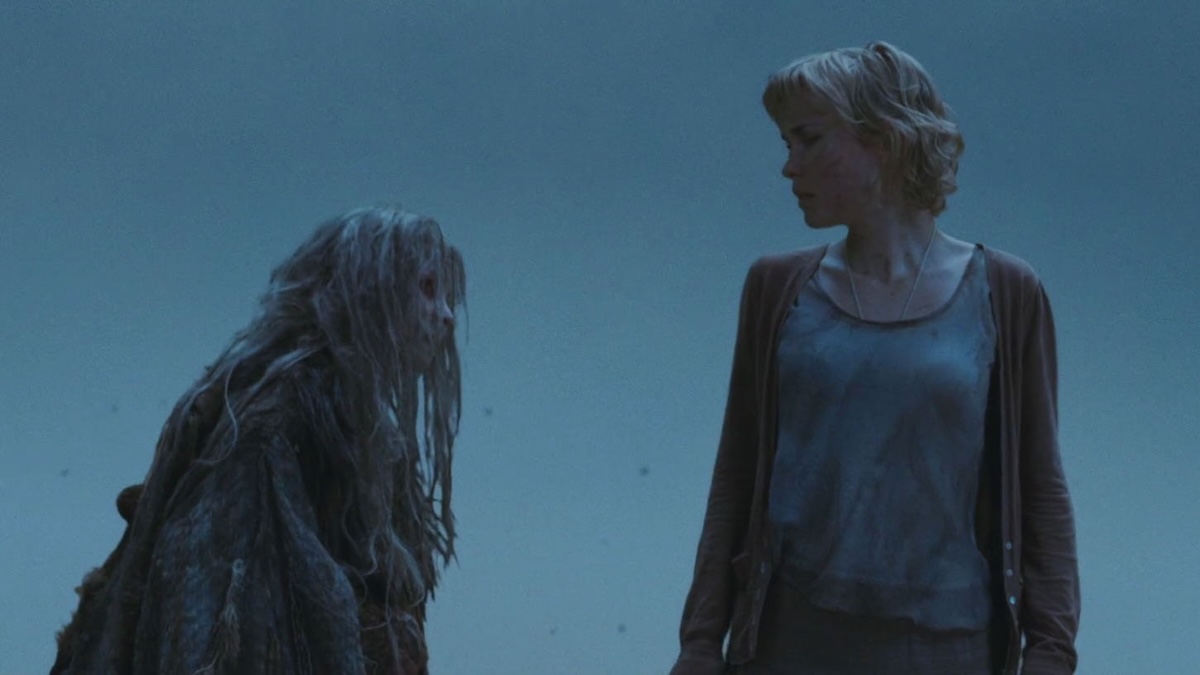
The first Silent Hill movie adaptation is far from perfect; shoddy acting and a bloated storyline keep it from achieving its ambitions. But its gruesome practical effects, tense atmosphere, and grim aesthetic, alongside the cultural relevance of its source material, have kept people rewatching the film since its 2006 premiere.
However, there are more layers of critique beneath the surface level themes of the film that also play a role in preserving its status as a movie worth seeing over and over. Under the crust of cult psychology and revenge lies an intersection of environmental, political, and feminist values present in few mainstream horror movies.
Silent Hill follows Rose (Radha Mitchell), a mother who is trying to uncover the reasons for Sharon (Jodelle Ferland), her adopted daughter, having nightmares about the town Silent Hill. After doing intense research, Rose discovers the titular town where the majority of the film takes place was abandoned due to a reported coal-seam fire — a real world phenomenon of extremely long-lasting blazes that are often caused by mining activity. She decides to take her daughter there, where things inevitably go wrong; she wakes up in a foggy alternate reality of the town she was looking for, and Sharon is missing. It’s up to Rose and police officer Cybil (Laurie Holden) to find Sharon in the twisted Silent Hill dimension.
While the original Silent Hill video game is set in an American town, with no specifics provided on which state it is in or what environmental catastrophe that led to the town’s abandonment, the film’s Silent Hill is in West Virginia, a state often defined by its economic reliance on the coal industry. This Appalachian setting encapsulates the fear its creators want audiences to feel. Horror filmmakers have used Appalachia as a setting to elicit a fear response from viewers for years, capitalizing on the long history of media misrepresentation and cultural othering the region has faced.
Silent Hill instead highlights a real life problem faced by West Virginia and many other parts of Appalachia without relying on stereotypical representations of Appalachian people. Where stereotypes have depicted uncivilized godless violence (Deliverance is a prime example), the local residents of Silent Hill are middle class fundamentalists, each of them devoted members of a cult called the Brethren.
This subversive depiction is further expounded on in flashbacks to before the disaster that made the town uninhabitable and created the alternate hellish reality. The residents of Silent Hill are economically comfortable, with lofty ideals of social compliance and snuffing out perceived abnormal behavior in cruel ways more in line with a critique of suburbia than Appalachia. This representation is a major departure from the traditional reliance on the imagery of scattered, violent hillbillies that has dominated depictions of Appalachian antagonists across mediums.
Although there is still a depiction of a violent populace, it’s a violence not rooted in the degradation of Appalachians as ignorant and uncultured but rather a more translatable depiction of conformity that could happen anywhere. The use of West Virginia as the setting highlights the real contemporary issues of environmental destruction caused by the extractive industries that have plagued the region for centuries.
The disaster that ultimately caused the supernatural creation of the Silent Hill dimension deepens the thematic strata of Silent Hill. Alessa (also played by Jodelle Ferland), a young girl from the days before the dimension opened, was ridiculed and villainized by the pious residents of Silent Hill for being born out of wedlock. Dahlia (Deborah Kara Unger), Alessa’s mother, allows Christabella (Alice Krige), the high priestess of the Brethren, to try a “purifying” ritual on Alessa after she is raped by her school’s janitor. Christabella and her followers then attempt to burn Alessa alive in an immolation ritual which is stopped by Dahlia and police officer Thomas Gucci (Kim Coates), but only after Alessa is horribly disfigured by the fire (this fire is ultimately what causes the coal-seam disaster that forced residents to abandon the town).
Torn apart by her hatred, Alessa creates the constantly-shifting nightmarish dark Silent Hill dimension, trapping a guilt-ridden Dahlia and members of the Brethren in her ashen, monster-laden hellscape. Alessa is thus split between Dark Alessa, a demonic entity feeding off her hatred, and Sharon, her innocence incarnate.
It is not a stretch to describe Silent Hill as an ecofeminist piece of media. Ecofeminism is defined as “both political activism and intellectual critique” by ScienceDirect. It is a framework that argues the harm done to women and the harm done to the environment mirror each other and manifest in a number of parallel ways societally and politically.
The coal-seam fire ignites after the residents of Silent Hill torture a girl who was the victim of an unspeakable crime. The primarily female cast showcases women fighting who, knowingly or not, are fighting environmental catastrophe alongside attempting to save a girl from an awful fate at the hands of conservative zealots. Alessa’s scarring by the fiery violence of the Brethren mirrors the scarring of West Virginia, her home state, done by mining and extraction. Violence against women and violence against the land, as well as women-led political action, are inseparable in Silent Hill.
At a time when human-driven climate change and rising fascism are joining hands and taking humanity into the sunset of doomsday, Silent Hill presents a surprising, yet poignant vessel for environmental and social critique that can only age better as time goes on.
The post 2006’s Silent Hill Contains Surprisingly Relevant Environmental and Political Themes appeared first on Den of Geek.