By
By 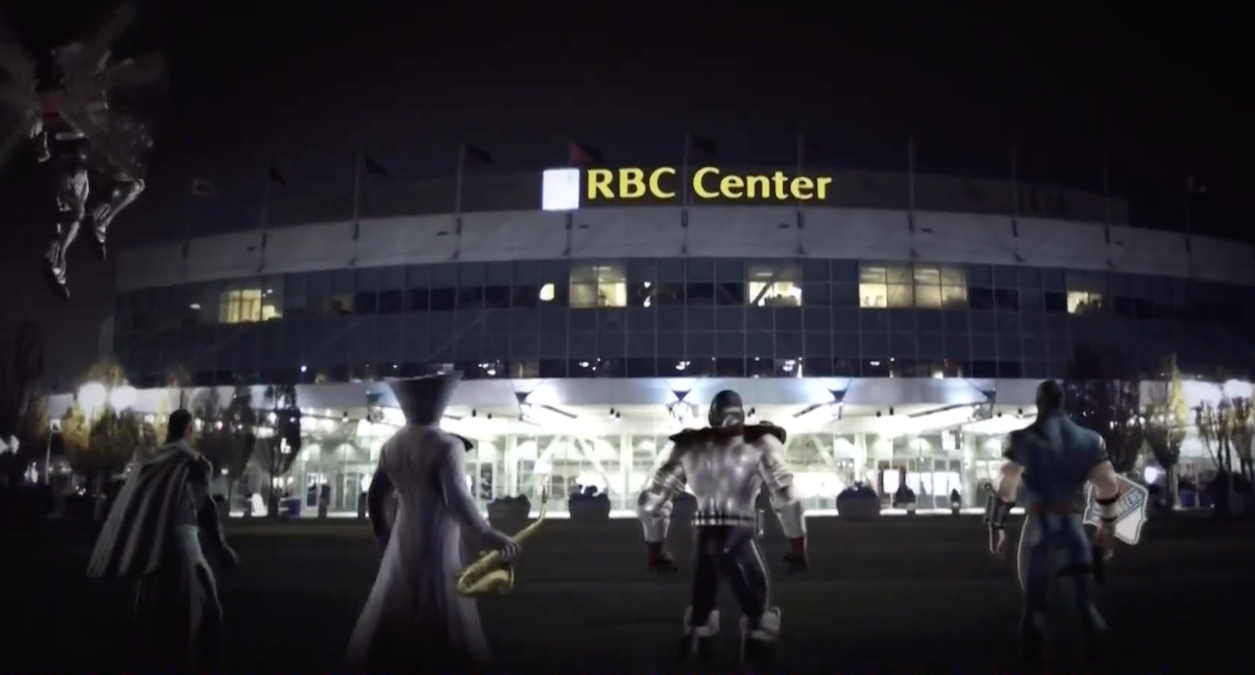
Stan Lee played a role in coming up with some of the greatest villains of all time: Doctor Doom, Magneto, Devin Dark. Oh, you don’t know that last one? Well, clearly, you weren’t watching the NHL All-Star Game on January 30, 2011, in Raleigh, North Carolina. That was not just the night when Team Lidstrom, led by the Perfect Human Nicklas Lidstrom, beat Team Staal, led by then-Carolina Hurricanes captain Eric Staal. It was also the night when the NHL Guardians gathered to do battle with the evil cloud man known as Devin Dark.
Okay, even if you were watching, you probably don’t remember. Because even though the flashy, CG-generated video of the Guardians saving attendees from Devin Dark ended on a cliffhanger, in which Dark kidnapped all the Guardians except the Hurricane and revealed the secret identity of the team leader, absolutely no one (except, perhaps, the hosts of the Puck Podcast) have mentioned it even once in the past 15 years. That’s because the Guardian Project was a spectacular failure, one that bored both fans of hockey and superheroes.
Not the All-Stars
The basic idea behind the Guardian Project did make a bit of sense. Each team has a cool mascot and they all wear colorful costumes. It shouldn’t be that much of a jump to turn them into superheroes, right? And Stan Lee created Spider-Man, the X-Men, and the Hulk, so who better than to make this new generation of costumed avengers? What could go wrong?
A quick glance at the Guardian Project quickly reveals the answer. Lee (or, more likely, some intern who will never be credited) created a hero for each of the (then) 30 teams in the NHL. And in every case, he went for the most obvious possible choice. It isn’t just that each hero just has the name of the mascot; eg, the Duck, the Devil, the King. It’s that they all have generic power sets, derived from already established heroes.
Take Pittsburgh’s Guardian, the Penguin. “The gritty young savior of Steel City,” reads the copy attached to his picture. “Can project ice missiles from his hands and travels on a frozen ice sheet.” Obviously, those are the same powers as Iceman from the X-Men. But to top it off, the Penguin wears a visor across his eyes, just like fellow X-Men Cyclops. Put together, the Penguin seems like Frozone from The Incredibles, but as a white guy in yellow and black.
Or maybe you’d prefer Montreal’s hero the Canadian, a guy in a blue and red power suit who shoots blasters from his hands, just like Iron Man. How about the Arizona Coyote, aka Wolverine in a trench coat, or the Panther, who imagines what it would be like if Black Panther came not from the futuristic utopia Wakanda, but from Florida? At least the Edmonton Oiler, with blocky costume and goo gun, had the decency to rip off a good character, Paste-Pot Pete.
Occasionally, an unwieldily mascot forced Lee to take some creative leaps. Sure, the Columbus Blue Jacket looks like a B-tier Go-Bot, but not often do you see a revived Civil War soldier with cannons in his robot legs. Lee didn’t just steal Falcon’s pet bird for the Detroit Red Wing, but embraced the team’s Motor City roots by sticking awkward wheels and pedals on what otherwise looks like Mach-1 of the Thunderbolts. And the St. Louis Blue may be kind of a rip-off of forgotten Ultraverse hero Night Man (jazz musician by night, superhero by later at night), but he looks kind of cool.
Ultimately, the dull designs and generic power sets bring to mind not legends in the making, but the drawings of some random kid who just watched Hockey Night in Canada. Which they are, canonically-speaking.
Unguarded Hockey
According to the shared universe lore revealed in the graphic novel The Guardian Project Special Edition, the Guardians actually came from the mind of Mike Mason, a nondescript teenager who sketched out a series of superheroes in his notebook. Somehow, the pictures came to life, giving 30 North American cities their own superheroes… at least until the Thrasher leaves Atlanta to become the Jet and the Coyote decides Salt Lake City is nice and renames himself the Mammoth.
The Guardian Project Special Edition boasts some supplemental artwork by the legendary Neal Adams and scripts by Chuck Dixon, then still closer to his incredible work on Batman and Birds of Prey and not the right-wing nonsense he does these days. It contains six-page origin stories for each of the heroes, all illustrated well and handsomely put together, but deadly boring.
You’ll have to take my word on that assessment, because unless you still have your copy from 2011 or want to buy a copy from an eBay seller (including one selling their copy for $5000 dollars), you’ll never read The Guardian Project. Not even any of the shady sites that retrain digital copies of Marvel‘s Christian comic The Illuminator or Superman‘s team-up with Jared from Subway have bothered to upload The Guardian Project, because nobody cares.
Sad as the Guardian Project is, it isn’t totally unexpected. Hockey has always been the fourth to seventh most popular sport in the United States, and Commissioner Gary Bettman has been willing to try almost anything to grow the sport, even putting a team in Utah. Even less surprising is the fact that Stan Lee would put his name on forgettable schlock. Lee was always more of a pitchman than he was a writer, and without guys like Jack Kirby and Steve Ditko to crib from, his projects have been uniformly cloying and dull.
With a Stanley Cup final that has already had one incredibly exciting game against the Vegas Golden Knights—who joined the League in 2017 and thus, never suffered the ignominy of having a Guardian—the Hurricanes have once again drawn the eyes of hockey fans back to Raleigh. Hopefully, this experience will be more memorable than the time the Guardians battled Devin Dark.
The post Remember the Guardians: Stan Lee’s Ill-Fated Collaboration With the NHL appeared first on Den of Geek.