By
By 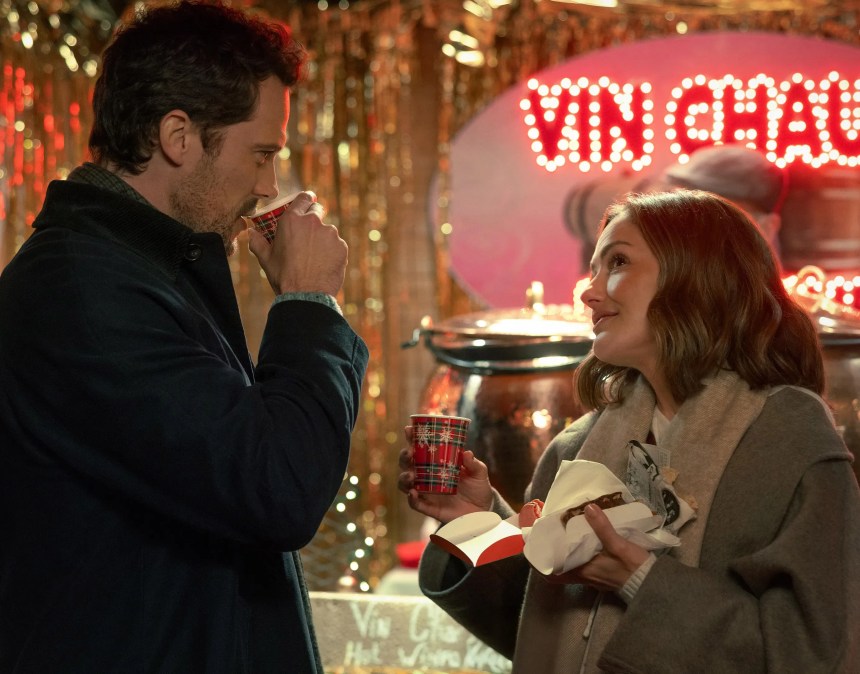
A SWEET BUT SAFE HOLIDAY ROM-COM
During the holiday Christmas season, seasonal feature films get their chance to shine, dazzling viewers with yuletide cheer and overly sentimental narratives centered on love, family, and Christmas traditions. A popular subgenre within this space comes in the form of romantic comedies (rom-coms), which take the familiar beats of the genre and blend them with the syrupy sweetness of holiday-themed storytelling. These films often thrive on charm, predictability, and emotional comfort, offering audiences a cozy, low-stakes escape, even as they sometimes struggle with formulaic plots and thin characterization. Still, their earnest simplicity and feel-good intentions are precisely why so many viewers return to them year after year. This category includes a wide variety of releases over the years, including but not limited to Love Actually, Last Holiday, Last Christmas, A Christmas Prince, While You Were Sleeping, The Princess Switch, The Holiday, and many others. Now, Netflix and director Mark Steven Johnson deliver the latest entry in the holiday rom-com lineup with Champagne Problems. Does the film prove its worth within the Christmas romance genre, or does it settle for a bland, run-of-the-mill effort with very little holiday cheer?
THE STORY
Sydney Price (Minka Kelly), an eager and ambitious acquisitions associate at The Ruth Group, a high-powered corporate firm where competition is fierce and success is measured by who closes the biggest deal. Constantly jockeying for position against her confident colleague Ryan Garner (Xavier Samuel), Sydney is determined to prove herself to her demanding boss, Marvin Roth (Mitchell Mullen). Her opportunity arrives when she is sent to Paris, France to help negotiate a potential acquisition of Chateau Cassell, a prestigious champagne house considering a corporate buyout. Encouraged by her sister Skyler (Maeve Courtier-Lilley) to embrace the magic of Paris during her short stay, Sydney steps outside her work-focused mindset and visits a local bookstore, where she meets the charming and enigmatic Henri (Tom Wozniczka). What begins as a flirtatious encounter quickly blossoms into a passionate night together, offering Sydney a glimpse of a life beyond corporate ambition. Reality soon sets in as Sydney dives headfirst into the high-stakes bidding war for Chateau Cassell, competing against rival business figures Roberto Salazar (Sean Amsing), Otto Moller (Flula Borg), and Bridgette Laurent (Astrid Whettnall). The situation becomes far more complicated when Sydney learns that Henri is actually the son of Chateau Cassell’s owner, Hugo Cassell (Thibault De Montalembert), a man deeply skeptical of corporate acquisitions and fiercely protective of his family’s legacy. Hoping to make the bidding process more revealing, Hugo invites all interested parties to spend a weekend at his family’s chateau. As business negotiations blur with personal emotions, Sydney finds herself torn between advancing her career and following her heart, forced to confront what truly matters in a city built on romance.
THE GOOD / THE BAD
Yes, I am a fan of Christmas movies, always have and always will be. The holiday season has held a special place for me since childhood, which is why the blend of yuletide cheer and cinematic storytelling found in holiday-themed films has always resonated. That appreciation naturally extends to romantic comedies set during the Christmas season, where wholesome charm, sentimental warmth, and heartfelt emotions come together, often wrapped in a deliberately corny and melodramatic tone that feels fitting for the spirit and values associated with the holiday.
As mentioned earlier, there has been no shortage of holiday and Christmas-themed rom-coms over the years, ranging from theatrical releases to smaller, made-for-streaming efforts and television productions on platforms like Netflix, Lifetime, and Hallmark. While I do not have a single standout favorite among them, these films often find their way into my viewing rotation during the season, sometimes as comforting background fare rather than must-watch experiences. Even so, holiday rom-coms will continue to be produced year after year, offering familiar formulas, cozy romances, and feel-good storytelling that exist to spread cheerful tidings and seasonal comfort.
This brings the conversation back to Champagne Problems, a 2025 romantic comedy and the latest entry in the holiday-themed rom-com lineup. To be honest, this was a film that largely flew under my radar when it was first announced. My initial awareness of the project came when the trailer dropped online, followed almost immediately by comparisons labeling it an “Emily in Paris knockoff.” After watching the preview myself, it is difficult not to see the similarities, especially in its Parisian aesthetic, glossy presentation, and Netflix-friendly tone.
That said, the trailer also leaned heavily into the familiar comforts of the holiday romantic comedy formula, something that many fans of the genre actively seek out. It promised a breezy, lighthearted experience filled with romance, charm, and seasonal warmth. While it did not appear to offer anything particularly bold or innovative, it looked pleasant enough, easygoing, and squarely aimed at delivering feel-good escapism rather than reinventing the genre.
I had every intention of watching the film upon its Netflix release on November 19, 2025, though a busy work schedule and a backlog of other reviews delayed that plan by a few months. With all of that out of the way, I finally sat down to see what Champagne Problems had to offer. The result is a film that does not reinvent the wheel or deviate far from established genre expectations, but still manages to get the job done. Within its syrupy melodrama of romance, Christmas cheer, and picturesque Parisian setting, the movie delivers a serviceable and pleasant holiday distraction. It may not be a quintessential holiday rom-com, but it succeeds as an easy, comforting watch for those looking to indulge in seasonal romance and festive spirit.
Champagne Problems is directed by Mark Steven Johnson, who is continuing his recent trend of leaning into lighter, more romance-driven fare. Earlier in his career, Johnson was known for comic book adaptations such as Daredevil and Ghost Rider, but in more recent years he has pivoted toward breezier romantic projects like Love, Guaranteed and Love in the Villa. With that background in mind, Johnson feels like a natural fit for a holiday romantic comedy, approaching Champagne Problems with a clear understanding of the subgenre and its expectations. To his credit, Johnson largely succeeds in delivering exactly the type of film this premise calls for. He fully embraces the syrupy, feel-good tone customary to holiday rom-coms, injecting that warmth throughout the entire runtime. The result is a movie that is easy to digest, straightforward in its storytelling, and deliberately familiar in its structure, making it accessible to casual viewers looking for seasonal comfort viewing.
One of the film’s stronger elements is that Johnson clearly knows what kind of movie he is making and unapologetically doubles down on the romantic comedy framework. The film is staged and framed with all the expected trimmings of the genre, leaning into its cute, sweet, and idealized portrayal of romance. Sydney’s journey is presented as a glossy, escapist tale of traveling abroad for business and unexpectedly finding love along the way, a setup that will feel instantly recognizable to fans of Hallmark-style romances.
That familiarity can be both a strength and a limitation. On the positive side, the romantic elements are wholesome and comforting, centered on attractive characters, blossoming chemistry, predictable conflicts, and ultimately satisfying resolutions. It is a feel-good movie through and through, packed with mushy sentimentality and an unmistakable commitment to happy endings. As for the comedy, Champagne Problems leans heavily into campy, cheesy humor. While it is not especially sharp or clever by modern comedy standards, the goofy jokes and light gags work well enough within the context of a holiday rom-com and rarely feel out of place.
Overall, while Johnson does not elevate the material beyond its genre trappings, he successfully captures the intended spirit of the film. The combination of lighthearted cheer, quirky humor, and swoon-worthy melodrama results in a pleasant seasonal offering that understands its audience and delivers on its promise, even if it never aims higher than that.
From a presentation standpoint, Champagne Problems is a surprisingly attractive production that successfully captures the warm, inviting aesthetics commonly associated with holiday romantic comedies. Making strong use of its European setting, the film leans heavily into Parisian charm, with director Mark Steven Johnson and his creative team crafting a visually pleasing backdrop that reinforces the film’s themes of romance, escapism, and seasonal cheer. The result is an atmosphere that feels cozy, polished, and intentionally comforting, aligning well with the genre’s expectations. Much of that visual appeal can be credited to the behind-the-scenes craftsmanship. The combined efforts of Simon Blanjoie (art direction), Kirk M. Petruccelli (production design), Cecile Charnallet, Ziveri Dylan, Nina Surguine, and Lena Valero (set decoration), along with costume designer Chattoune, help bring the film’s world to life in a way that feels both believable and gently romanticized. From interior spaces to exterior cityscapes, the film cultivates a warm, almost storybook quality that enhances its holiday ambiance without feeling overly artificial.
The cinematography by Jose David Montero further supports this tone, favoring soft lighting, intimate character close-ups, and occasional wide shots that highlight the charm of the Parisian setting. While the visual approach is not particularly ambitious or awards-driven, it is effective in reinforcing the film’s sweetness and emotional accessibility. Complementing the visuals is the musical score by Ryan Shore, which hits all the expected notes for a holiday rom-com. The music is light, sugary, and pleasant, underscoring emotional beats without overpowering them. While not especially memorable on its own, the score serves its purpose well, helping to maintain the film’s cozy tone from beginning to end.
The biggest issue with Champagne Problems lies in how rigidly it adheres to romantic comedy conventions while seemingly attempting to flirt with a mild sense of satire. In practice, however, that satirical edge never truly materializes. The film presents itself squarely as a rom-com and follows the genre’s familiar roadmap almost beat for beat. From beginning to end, there are no meaningful surprises, no noteworthy twists, and nothing particularly daring or unexpected. Nearly every narrative beat unfolds exactly as seasoned viewers of the genre would anticipate.
While this predictability can function as comforting “cinematic comfort food,” it also reinforces the film’s most noticeable weakness, its overwhelming sense of familiarity. The movie does little to distinguish itself from the countless romantic comedies, especially holiday-themed entries, released in recent years. As a result, the experience often feels generic, pleasant but rarely memorable.
To be fair, this outcome was largely expected, and it does not register as a major disappointment. That said, it is difficult to ignore how firmly the film clings to the status quo. Mark Steven Johnson, who pulls double duty as both director and writer, never quite pushes the material beyond its established boundaries. Rather than experimenting with the formula or injecting a fresh perspective, the film remains content to stay safely within the lines, delivering a by-the-book holiday romance without much ambition.
This becomes especially apparent when compared to stronger genre examples like Crazy Rich Asians, which embraced traditional rom-com elements while still offering energy, cultural specificity, and a sense of creative confidence. By contrast, Champagne Problems settles for harmless holiday fluff and a straightforward love story set against a whimsical backdrop, serviceable but lacking that extra spark.
The script does not help matters, relying heavily on corny and overly cheesy one-liners that occasionally veer into cringe-worthy territory. While this brand of dialogue is typical for the genre and unlikely to bother its target audience, it may test the patience of viewers hoping for sharper writing or more self-awareness. Again, this was not entirely unexpected, but it remains one of the film’s more noticeable shortcomings.
The cast of Champagne Problems is somewhat of a mixed bag, and I find myself a bit divided on their overall effectiveness. On one hand, the performers bring the appropriate level of charm, charisma, and theatrical energy expected from a romantic comedy. Everyone seems fully aware of the type of film they are in, leaning into the genre’s heightened tone and embracing its lighthearted nature. There is a clear sense that the cast is enjoying themselves, which does translate positively on screen. That said, the material they are working with does them few favors. The characters themselves are broadly written and feel fairly generic from the outset. While this is often part of the territory for rom-coms, it still results in a lineup of personalities that feel more like familiar archetypes than fully realized individuals.
Leading the film are Sydney Price and Henri Cassell, portrayed by Minka Kelly and Tom Wozniczka. Kelly, known for her work in Titans, The Butler, and 500 Days of Summer, delivers a solid and likable performance as Sydney. The character itself follows a well-worn romantic comedy template, the career-driven protagonist who is initially too focused on work to embrace love, only to gradually rediscover what truly matters. While the role does not offer much in terms of depth or originality, Kelly’s natural warmth helps make Sydney engaging enough to carry the film.
Similarly, Wozniczka brings the expected charm and presence to Henri. Best known for roles in Drops of God, Slow Horses, and No Limit, he fits comfortably into the archetype of the romantic lead, balancing charisma with a hint of emotional conflict tied to his family obligations. Like Sydney, Henri is a fairly standard character within the genre, defined largely by familiar traits and predictable internal struggles. Even so, Wozniczka plays the role effectively, even if his performance remains safely within the confines of rom-com expectations.
Together, Kelly and Wozniczka share a pleasant on-screen chemistry that helps sell the central romance. While their dynamic may not feel especially fresh or distinctive, it is strong enough to support the film’s emotional core and keep the audience invested in their relationship.
The rest of the cast, including actress Maeve Courtier-Lilley (Gran Turismo and The Outpost) as Sydney’s sister Skyler Price, actor Thibault de Montalembert (The King and All Quiet on the Western Front) as Henri’s father Hugo Cassell, actor Sean Amsing (Blame the Accountant and Noelle) as the flamboyant Roberto Salazar, actor Flula Borg (Pitch Perfect 2 and Ferdinand) as serious Otto Moller, actress Astrid Whettnall (The Missing and Road to Istanbul) as experienced savant Brigitte Laurent, actor Xavier Samuel (Blonde and Elvis) as Sydney’s co-worker Ryan Garner, actor Thierry Rene (The Bourne Identity and 15/Love), and actor Mitchell Mullen (Run On and About Time) as Sydney’s boss Marvin Roth, make up the remaining supporting players in the movie. While most play up the formulaic nature caricatures that usually accompany, the acting talent involved are still up to the challenge and do make for some delight (yet conventional) side characters throughout.
FINAL THOUGHTS
Seeking to secure a new business venture for her company, Sydney Price travels to France, only to find herself unexpectedly drawn to a charming heir apparent in Champagne Problems. Director Mark Steven Johnson crafts a film that leans heavily into the classic romantic comedy formula, dressing it up in a picturesque, French-infused holiday setting that is both visually appealing and easy to settle into. The result is a lighthearted, “easy in, easy out” viewing experience, complete with the genre’s signature dose of syrupy cheesiness. While the film does little to reinvent the wheel, relying heavily on familiar plot beats and well-worn character tropes, it still manages to find a comfortable groove within its intended lane. Thanks to Johnson’s steady direction, the film’s appealing presentation, and a cast that capably handles their roles, Champagne Problems succeeds as a piece of comforting, low-stakes entertainment. Its predictability is undeniable, but it also contributes to the film’s accessibility, making it an easy watch for those seeking something simple and feel-good. For me, the movie ultimately lands in the “just okay” category. It is by no means a bad film, as its “comfort food” qualities and easygoing nature allow it to maintain a certain level of charm throughout. However, it never pushes beyond the boundaries of the genre or challenges its own formula, resulting in a final product that feels a bit too safe and, at times, derivative. Still, I did find myself enjoying it for what it is, and I imagine many viewers, especially fans of romantic comedies, will feel the same. As such, my recommendation would be a breezy “rent it.” It is a straightforward, one-night viewing option that delivers exactly what it promises, nothing more, nothing less. While it is unlikely to become a holiday classic, it remains an easy and digestible entry within the genre. In the end, Champagne Problems may play things a bit too safe, but it still manages to deliver a warm, heartening experience, pairing a budding romance with just enough holiday cheer to leave viewers with a small, satisfied smile.
3.6 Out of 5 (Rent It)
The Official Website for Champagne Problems Link: HERE
Released On: November 19th, 2025
Reviewed On: May 27th, 2026
Champagne Problems is 99 minutes long and is rated TV-14 on Netflix
The post Champagne Problems (2025) Review appeared first on Jason’s Movie Blog.