By
By 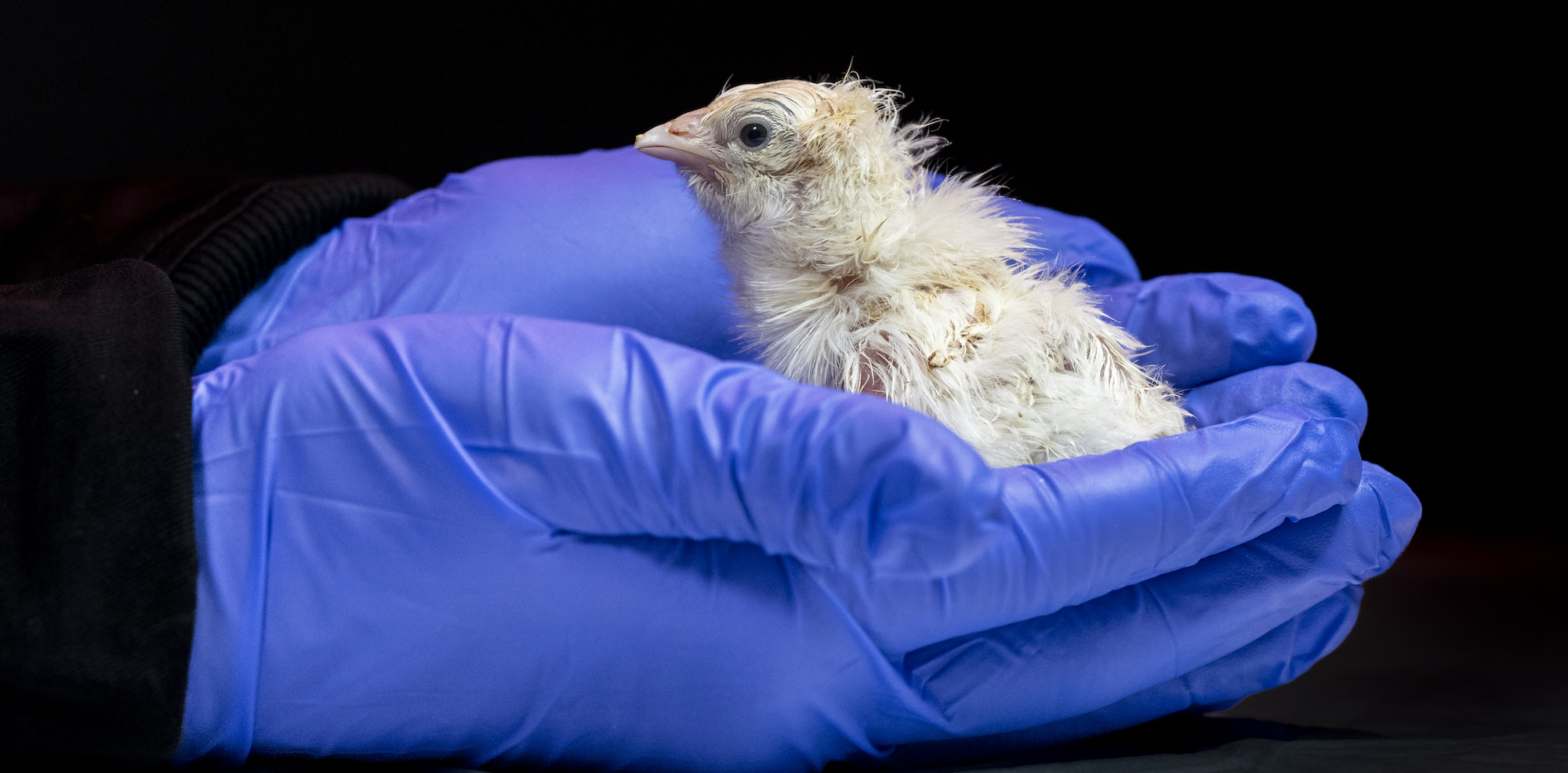
Since the dawn of time—or at least since humans started raising livestock instead of hunting and gathering—a simple question has perplexed farmers, philosophers, and (eventually) scientists: what came first, the chicken or the egg? While there might still be some semantic wiggle room to debate this, with the advent of the world’s first entirely artificial and synthetic egg being used to incubate and grow a chick inside a laboratory—a hundred of them, in fact—it would seem we have a possible answer.
“I think we have to assume the egg came first,” Colossal Biosciences CEO and co-founder Ben Lamm quips when we sit down for a Zoom interview. In truth, though, he notes the quandary is mooted. “It doesn’t matter what came first now that we have the egg.” And it’s an egg that might just change the world in both subtle and immediate ways.
The breakthrough itself is a feat in bioengineering: the world’s first shell-less incubation system that can support the development process of an avian embryo, from early stages to hatching. It also could have significant implications in everything from Colossal’s much publicized efforts in “de-extinction” to the biomedical industries and animal conservation fields. And it comes complete with the below video, which highlights how this was made possible.
Attempts at shell-less avian development has been a scientific inquiry since at least the 1980s when attempts were made to map a chicken egg’s development process. Yet at the time, the studies consistently resulted in instructive but limited results, in part because of how large quantities of pure oxygen tended to damage DNA genomes. However, by virtue of seeking to develop eggs big enough to birth a milieu of extinct species, including most prominently the great moa of New Zealand (a passion project for filmmaker and investor Peter Jackson), Colossal has spent the last four and a half years researching how to make a completely artificial egg that can bring the extinct moa back to term.
“We knew that there’s nothing large enough to gestate a South Island giant moa,” Lamm tells us. “Their eggs alone are eight times larger than an emu egg, so they’re just massive. So we always knew that for that project we’d either have to engineer a much larger surrogate, which sounds terrifying in itself, or you just have to figure out how to build an exogenous development system for birds where you could transport and supplement.”
While the bioengineering executive doesn’t necessarily rule out creating a great moa with a living surrogate as impossible, he speculates creating a mother large enough to do so could add another decade in genetic engineering, and certainly would not be… “elegant.”
Conversely, the image of the chicks brought to term in shell-less eggs are exceedingly endearing, even to Lamm who first held one of the hundred baby birds in the palm of his hand after it was transported from post-incubation.
“Obviously from an optics perspective and a weight perspective, it is the same,” Lamm says. “Which is good. It’s what you want, right? … You want it to look right and you want it to be healthy in the right size and shape and everything. But it is cool knowing that this is the most famous little chick in the world. That’s kind of fun.”
It’s also the result of a system that allows Colossal to currently produce up to 36 chicks at a time, although Lamm ensures us that they have no plans to grow more than the hundred that have been produced to date. The process was essentially a test to see if avian nature could finally be duplicated—if not perhaps improved upon.
Says Lamm, “[If] we’re going to reinvent the egg and completely re-engineer it, we don’t just copy nature; we want to improve upon it for our use cases.”
In the column of “reinventing” nature, one of the biggest challenges proved to be letting the chicken embryo breathe oxygen without damaging the genetic material. For the record, this is the same issue that scientists ran into in the 1980s and ‘90s.
“If you ask the average human, do eggs breathe, because they seem pretty self-contained, most people I don’t think know that they are porous,” explains Lamm. “But there is an atmospheric transference that has to occur.” The solution was to design a material that is gas permeable yet still supported the weight, integrity, and even pitch of an organic egg.
However, in the “improving nature” column, at least from a bioengineering perspective, the artificial egg did not need to just resemble an egg’s shell and be reusable; it needed to also be reconfigured for constant study and adjustment during the development process.
“If we’re going to reimagine the egg and we want to re-engineer it for additional use cases [and that includes] having this large windowing at the top that gives us accessibility,” notes Lamm. “We can attach it to a microscope, so that we can double-check to make sure that the changes that we’re making are showing up developmentally in stages… But [that means] we had to change the internal shape of the egg to compensate, because we’re changing the top of the egg. Since we’re not building just a replica of an egg, we actually have to re-engineer that pitch of the internal structures of your hexagons, as well as the base.”
Furthermore, they developed entire systems of mirroring and low, slanted slits around the egg, so as to not allow direct light to hit the developing embryo, even when studying it with different wavelengths of lights in proverbial dark rooms.
In a statement released to the press by George Church, a Colossal co-founder and Harvard professor, the geneticist said, “The embryo needs a place to grow that recapitulates the gas exchange, humidity, and mechanical environment of a natural egg—at whatever size the species requires. Colossal’s artificial egg solves the scalability dimension. It is a platform technology, and its implications extend well beyond any single species.”
Indeed, while the goal is to clearly size up an artificial egg for the great moa, Lamm tells us the company already plans to use the same tech to help breed their version of the extinct dodo bird, in addition to using a form of large chicken as a surrogate for the first generation. This parallel path is not necessary, but it will be instructive, similar to how the company is looking for a bird smaller than a chicken—probably a breed of pigeon—to examine how small they can take the artificial egg.
Via the longer term, the CEO sees the technology having major applications in the conservation space. While Colossal has not officially spoken with any conservation partners or governments about using artificial eggs to grow endangered species, Lamm would be eager to see this tech used to protect the Kākāpō, a flightless, heavy parrot indigenous to New Zealand.
“They are facing the same trajectory that a lot of other New Zealand birds are facing,” says Lamm. “The introduction of invasive species like the brushtail possum, rats, and others to the island of New Zealand are killing off bird species, specifically ground dwelling bird species. So this would be one that I would love to work on.”
Additionally there is interest in seeing how it could be used to develop and engineer specific attributes found in eggs via various PGC (primordial germ cell research) projects. Says Lamm, “I think the vaccine development in biopharma will be big.”
While Colossal’s breed of peculiar chicken may not grow larger than the first generation of a hundred birds, those flightless creatures might leave behind a sizable footprint. In the meantime, they are expected to spend the rest of their days on a free-range ranch.
“Our lab animals live quite well,” Lamm muses.
The post First Baby Chickens Ever Grown in Artificial Eggs Born in Texas appeared first on Den of Geek.