By
By 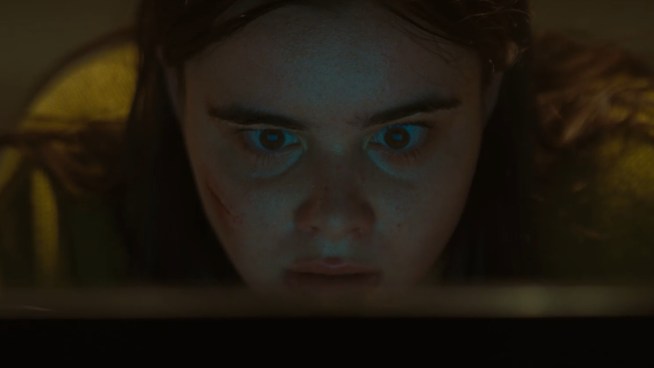
Directed by Daniel Goldhaber, who previously gave us the unsettling psychological horror Cam and the razor-sharp eco-thriller How to Blow Up a Pipeline, Faces of Death lands in a strange, in-between space in his filmography. It’s not quite a regression, but it does feel like a lateral move, or maybe a deliberate detour into something more openly pulpy. Where his previous work felt tightly wound and purpose-driven, this leans into a kind of grimy, grindhouse sensibility, stretching tone and taste just enough to keep it watchable. That is to say, Goldhaber’s latest creation is a proud B-movie to its core.
The film follows Margot Romero (Barbie Ferreira), a content moderator for popular social network Kino, a TikTok-esque platform that trades less in dance trends and more in algorithmically optimized trauma. Her job is to sift through the worst impulses of humanity, flagging drug use, sexual exploitation, and graphic violence before it can circulate too widely, though the film is careful to note that limiting said virality is more of a branding concern than a moral one. Margot exists in contrast to the ecosystem she helps sustain. She has no online presence of her own, a digital ghost shaped by the lingering fallout of a viral Kino train video that claimed her sister’s life. Her heightened backstory grounds the film’s more lurid instincts in something that resembles the reality of dumb kids ruining their lives for 15 seconds of internet infamy.
She frames her work as a kind of moral obligation, positioning herself as a watcher on the wall who stands between the chaos of the internet and the people naïve enough to believe it’s being responsibly filtered. That delicate sense of purpose begins to erode when she encounters a string of videos that appear to depict real executions, clips that slip through moderation not because they’re subtle, but because they’re constructed to confuse the very systems designed to catch them by looking too fake and staged to register as actual death.
The film’s title is both a knowing nod and baked directly into the narrative DNA. It explicitly draws from the legacy of Faces of Death, the infamous late-’70s shock film that blurred the line between staged and real violence for an audience eager to believe the worst. Here, that history becomes the remake’s framework. The killer is essentially a fan, recreating murders inspired by the original film, turning this remake into something closer to a hall-of-mirrors exercise. It’s a copycat killer obsessed with a movie that this movie is itself remaking, creating a recursive loop of influence and imitation that occasionally feels in conversation with Scream 2, if Scream 2 were less a student of meta genre cleverness and more a student of early 2000s torture porn.
The murders themselves lean into that idea of constructed authenticity. They’re strange, deliberately off in ways that make them feel both staged and disturbingly plausible, filled with mannequins, artificial textures, and just enough visual noise to trick both human moderators and automated systems. The gore and kills are undeniably a major player in the film’s appeal, and to its credit, they’re executed with a slick, queasy effectiveness that suggests a real affection for practical nastiness. But this isn’t quite the gore-fest snuff spectacle its premise might imply.
As Margot, Ferreira continues to make a compelling case for herself as a leading presence. The role doesn’t necessarily demand a huge emotional range, but she brings a kind of frayed, restless energy to it, always seeming like she’s on the verge of unraveling without fully tipping over. There’s something effective in that lack of control, in how openly raw and a bit manic the performance becomes as she leans into a shrieky, almost primal register at times, and you can feel her having fun digging into the film’s nastier edges without losing the thread of the character.
Opposite her, Dacre Montgomery’s Arthur embodies the hollow center of the film’s thesis, a serial killer who isn’t just committing violence, but curating it. His targets, independent filmmakers, influencers, news anchors, and the occasional bystander, aren’t random so much as strategically chosen, each one offering built-in audience appeal and their own promise of virality. He’s less a person than a feedback loop, performing emptiness for clicks, turning death into a kind of grotesque content vertical. The film gives him a darkly comic edge by making him a hypochondriac with an aversion to blood, a detail that feels a bit too cute and on-the-nose but reinforces that line between commerce and violence, even when one has to turn their nose up at it to get by.
Where Faces of Death ultimately lands as a critique of platforms that profit from violence while maintaining the thinnest veneer of responsibility, it never quite gives that idea real weight. Written by Daniel Goldhaber and Isa Mazzei, the film understands that moderation in this context isn’t about ethics so much as optics, maintaining the appearance of control while quietly benefiting from the very content it claims to regulate. Even its nod to Reddit and its merry band of amateur sleuths plays more like a gesture than a fully formed idea, framing them as self-appointed heroes without digging into the futility of their efforts. The suggestion is there that the same systems enabling this violence also create the illusion it can be solved collectively, that crowdsourced obsession might counteract algorithmic chaos, but like much of the film’s commentary, it’s raised more than it’s explored.
That said, it’s hard not to view this as slightly less incisive than Goldhaber’s previous work. Cam tackled similar territory with a lot more precision, dissecting the commodification of identity in a way that felt both intimate and unnerving, while How to Blow Up a Pipeline carried a clarity and urgency that this film occasionally trades in for pulpy indulgence. This is looser, moodier, and at times almost gleefully excessive, underscored by an over-the-top, synth-heavy score that leans hard into its B-movie sensibilities and eventually gives itself over to outright camp. The film gestures toward bigger ideas, the attention economy, the cyclical nature of remakes, our cultural fixation on repackaging violence and feeding it back through increasingly hollow platforms, but it rarely digs into them with much depth, opting instead to name-check these concepts rather than interrogate them. Still, there’s something oddly fitting about that surface-level engagement. Faces of Death is, after all, a schlocky B-movie remix of a that was itself a kind of cultural recycling project. If its commentary feels thin, it at least feels intentional, more interested in playing in the bloody mess rather than trying to clean it up.
B-
This ‘Faces of Death’ reimagining from Daniel Goldhaber isn’t going to convert any new horror fans, but this overtly schlocky, grindhouse B-movie takes the concept of “is it real or not” and drags it into the vertical video age to decent effect. It’s fun, if forgettable, and Barbie Ferreira makes a solid scream queen debut.
For other reviews, interviews, and featured articles, be sure to:
Follow Silver Screen Riot on Letterboxd
Follow Silver Screen Riot on Facebook
Follow Silver Screen Riot on Twitter
Follow Silver Screen Riot on BlueSky
Follow Silver Screen Riot on Substack
The post ‘FACES OF DEATH’ a Meta Remake That Knows It’s Not the Real Deal appeared first on Silver Screen Riot.