By
By 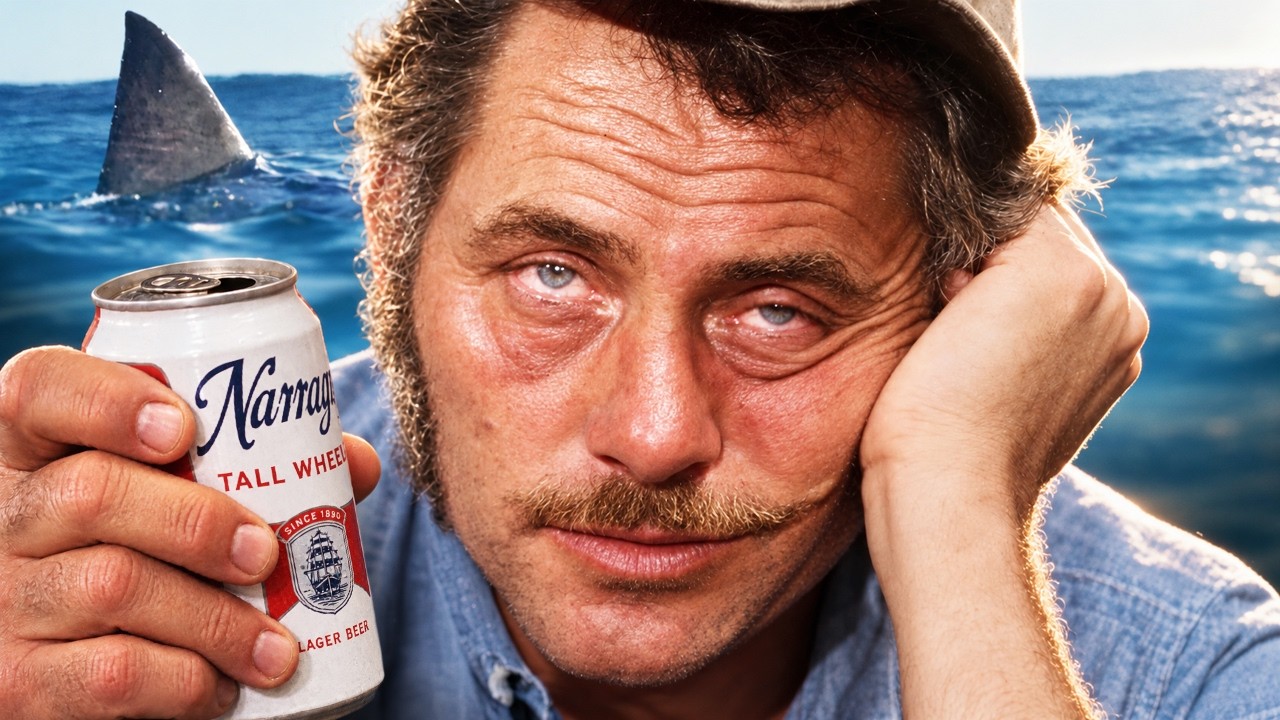
In addition to battling a mechanical shark that barely worked, miserable filming conditions at sea, clashing egos, and an inexperienced young director, the making of Jaws had another unpredictable force to contend with: Robert Shaw. Brilliant, passionate, intimidating, and legendary for his talent—and his drinking—Shaw brought something to Quint that couldn’t simply be written on the page, whether in a book or a screenplay. He drew from his own demons, his own appetites, and perhaps a little too much of himself to create one of the greatest performances ever put to screen.
But behind the ferocious grin, his beautifully haunting songs from the sea, his explosive anger at all things above and below the surface, and that unforgettable USS Indianapolis speech was a man whose drinking had already become part of his mythology. During the chaotic production of Jaws, the line between Robert Shaw and the drunken old sailor he was playing could sometimes become dangerously thin.
So, how much of the legend is true? Did Robert Shaw really drink his way through the making of one of the greatest movies ever made? Did this drunken sailor get a little too deep into character? Or is all of this just an exaggerated Hollywood urban legend? In the final years of Robert Shaw’s life, his drinking would become both a legendary drinking adventure and a tragic cautionary tale. This is the story of Robert Shaw’s drunken days on Jaws.
Robert Shaw was already a legendary drinker before Jaws
By the time cameras started rolling on Martha’s Vineyard in 1974, Shaw was already an accomplished actor, novelist, and playwright. He was also intensely competitive, famously mischievous, and part of that old-school generation of British and Irish actors for whom alcohol was almost considered fuel, like it was part of the job. Unfortunately, Jaws provided Robert with plenty of reasons to drink.
The movie was supposed to take just a couple of months, but it stretched into an endless purgatory on the high seas. The freaking shark broke. The weather changed. Boats drifted into frame. Anchors moved. Equipment sank. The Orca sank. And sometimes an entire day’s work consisted of waiting for a single sailboat to slowly cross the horizon.
Hollywood filmmakers have a phrase for this: hurry up and wait. On Jaws, it was more like hurry up and wait and wait and wait and just keep waiting. Plus, there was water, which just makes everything more difficult.
During the downtime between those long camera setups, Roy Scheider exercised and sunbathed, while Richard Dreyfuss talked and talked and talked. As for Robert Shaw? He himself cheerfully admitted during production, “I do tend to drink when totally bored.” And Robert Shaw was very, very bored. His beverages of choice? Scotch. Vodka. Gin. Or whatever you had.
How Robert Shaw started becoming Quint
Shaw increasingly spent time with the local fishermen, men who probably made more sense to him than Hollywood fat cats. He even based parts of his performance on the real fishermen around him. Somewhere during those long months, this sophisticated British actor began absorbing the rhythms and nature of Quint. He learned the songs, told the jokes, and spit out the insults.
Even little pieces of Shaw himself began sneaking into the character. During the famous scar-comparing scene, Shaw reportedly suggested removing the cap from one of his teeth, giving Quint yet another wound to brag about. He contributed bits of fisherman dialogue, sang their songs, recited their poems, and perfected their mannerisms.
After a while, Spielberg noticed that Shaw seemed to become more and more like Quint every single day. The character was coming to life and crossing over into reality. It may have been wonderful for the movie, but perhaps slightly less wonderful for everyone trapped inside the boat with him.
Especially Richard Dreyfuss.
Did Robert Shaw and Richard Dreyfuss really hate each other?
The legendary Shaw-Dreyfuss feud seems to have been exaggerated over the years, including at times by people who were actually there. Dreyfuss himself later pushed back against the idea that they genuinely hated each other, describing their relationship as something more complicated and nuanced. But Shaw absolutely knew how to get under Dreyfuss’s skin.
He mocked his weight, his dorky characteristics, his lack of stage experience, his youth, his strength, and even his worthiness as a man. Shaw would challenge Dreyfuss to physical contests he knew Dreyfuss probably wouldn’t win, then watch in delight as the younger actor desperately tried anyway. Dreyfuss later said Robert Shaw “had my number.” That may be the best description of it: Shaw knew which buttons to press, and when Shaw was drinking, he apparently enjoyed pressing them even more.
One day, Shaw was holding a glass of bourbon and reportedly lamented that he wished he could stop drinking. Then Robert Shaw asked Richard Dreyfuss to help him out. So Dreyfuss did. He grabbed the bourbon and threw it into the Atlantic, and the crew went silent. Spielberg later called it “the shot heard round the world.”
Robert Shaw took it all in and eventually laughed, but apparently, he did not forget. Soon afterward, while Dreyfuss was trying to perform a scene, Shaw got hold of a high-pressure fire hose and blasted him directly in the face. Dreyfuss later said that was the one day he genuinely lost his sense of humor.
Strangely enough, all that friction was kind of helping. Quint and Hooper weren’t supposed to like each other, and Shaw and Dreyfuss were providing Spielberg with something no screenplay could manufacture: genuine irritation.
Robert Shaw and Richard Dreyfuss had a complicated friendship
There was another side to Robert Shaw. Dreyfuss also remembered him as an enormously gifted, warm, funny, and generous person. He admired Shaw as an actor and especially as a writer. It wasn’t simply hatred.
In fact, years later, at a Jaws event, Richard Dreyfuss met Robert Shaw’s daughter. The meeting became so emotional for Dreyfuss that he reportedly broke into tears—happy tears. There clearly had been a friendship there. It was a complicated friendship, but meeting Shaw’s daughter appeared to mean something deeply personal to Dreyfuss. Maybe it brought some kind of closure.
And for all those stories about Shaw being difficult, when he could work, he worked his ass off. One time, he became violently seasick. He was reportedly so ill that crew members had to help him into position, and even being touched hurt. All Shaw had to do was turn around and deliver one simple line: “Hooper, you idiot. Ain’t you watching?”
Nobody thought he could do it, but what else were they going to do? They had to try. Spielberg called action, and instantly Shaw snapped into character as though he had suddenly been cured of his illness. He turned toward the camera and exploded with the full force of Quint. Perfect. Cut. Print. And right then and there, the seasick actor immediately collapsed again.
That was Robert Shaw. Sometimes alcohol could stop the performance. Sometimes the ocean could nearly stop the performance. But when that switch flipped and the actor started acting, there was Quint. And nowhere is that beautiful drunken contradiction more perfectly illustrated than in the USS Indianapolis scene.
The true story behind Robert Shaw’s USS Indianapolis speech
The monologue itself had passed through several hands. Howard Sackler conceived Quint’s connection to the real-life sinking, John Milius dramatically expanded the speech, and other writers reportedly took passes at it too. But then Robert Shaw—who, remember, was an accomplished writer himself—took the material and reshaped it into the iconic final version we know today.
Shaw understood that Quint could not simply recite history. He had to remember it. His soul had to relive it. Suddenly, this big, bad bully on a boat becomes a frightened young sailor again. The smile stays on his face, but the eyes go somewhere else.
This scene is the heart of Jaws. It pushes the movie from being very, very good to great. And naturally, Robert Shaw almost destroyed it by getting absolutely shitfaced, hammered, trashed, and wasted.
Robert Shaw got drunk trying to film the scene
Before filming, Shaw approached Steven Spielberg with an idea. He wanted a little drink, not because he wanted to party, but because Quint was drinking in the scene and Shaw thought a small buzz might help him avoid having to pretend. Then he could focus on other aspects of the character. In theory, yeah, it almost sounds like a good artistic choice.
Young Spielberg agreed, a decision he would later admit was stupid and partly the result of his own inexperience. But one drink became two, which became three, and then more and more. You know how it goes.
Before long, two crew members reportedly had to help Shaw aboard the Orca. They took his arms and helped this drunken actor down toward the boat, lifting him onto the ship like a rag doll drenched in bourbon. The man who had helped craft one of the greatest speeches in movie history could barely deliver it. Hell, he could barely stand up.
Spielberg finally stopped the attempt and sent him home. And here, the funny Robert Shaw drinking story suddenly becomes something else.
Late that night, Spielberg’s phone rang. It was Robert Shaw, totally and utterly ashamed. “Did I embarrass you?” That was what worried him—not whether he had looked foolish, but whether he had embarrassed his young director. He apologized and asked Spielberg to let him try again.
Robert Shaw returned sober and made movie history
The following day, Robert Shaw returned sober and gave us Quint. No chemical courage. No drunken method acting. Just talent. Raw, frightening, disciplined talent.
The great irony of Robert Shaw’s most famous drinking story is that alcohol nearly prevented him from creating the very performance people assume it helped create. The drunken sailor became immortal when the actor stopped drinking.
And perhaps that tells us something about the mythology surrounding men like Robert Shaw. Hollywood loves a talented drunk. We love the stories: Richard Harris emptying bars, Peter O’Toole raising hell, Robert Shaw terrorizing Richard Dreyfuss somewhere out in the Atlantic.
Those stories are funny. Those men seem funny. They’re larger than life. They make actors sound like pirates instead of employees. And Robert Shaw embraced and encouraged that mythology. When asked how he survived the endless waiting on Jaws, he openly joked about Scotch, vodka, and gin.
But behind the joke was something older, something more personal, and something darker.
Robert Shaw’s troubled history with alcohol
Shaw’s own father had struggled badly with alcohol before taking his own life when young Robert was only 12. Shaw remembered his father as charming and wonderful when sober and deeply troubled when drunk, which turned Shaw’s own story into a painful parallel, a pattern, or perhaps a vicious cycle of some sort.
The son grew into a brilliant, charming man whose personality could also change when alcohol entered the room. At one point, Shaw spoke about measuring his own life against his father’s, counting the years until he had lived longer than him—which ultimately would not be by much.
There is something haunting about that. Because deep down, Quint seems to know the shark will eventually get him. And deep down, Robert Shaw seemed to feel something similar.
Not a shark. Time.
Robert Shaw died just three years after Jaws
Robert Shaw would die of a heart attack in 1978 at only 51 years old. That was just three years after Jaws hit the big screen, three years after he helped create the summer blockbuster, and three years after he made Quint immortal.
It would be too easy, unfair, and irresponsible to reduce his death solely to drinking. Life and death and art and addiction are never easy to explain. And neither was Robert Shaw.
He was a writer. A father. A ferocious actor. A difficult co-worker. A generous friend. A competitive lunatic. A man who could drink too much, regret it deeply, wake up the following morning, and deliver one of the finest scenes ever filmed. Hangover be damned.
Robert Shaw’s talent, not the booze, gave us Quint
Perhaps that is why Quint feels so alive. The success of Jaws itself was created from failure. A shark that didn’t work produced better suspense. An ocean that wouldn’t cooperate produced authenticity. Two actors annoying the hell out of each other produced chemistry. And Robert Shaw’s own tastes, appetites, and demons produced Quint.
The booze gave us some wonderful behind-the-scenes stories and some fun movie trivia. But the talent gave us the movie.
Maybe sipping down a drink or two sometimes made Robert Shaw funnier, louder, or more fearless. And sometimes it made him impossible. That is the uncomfortable truth hiding behind this movie legend.
The bottle could make Shaw feel more like Quint, but it could never make him a better actor or a better person. It did not make him a better Robert Shaw. For that, he had to put it down.
And when he did, somewhere aboard that boat, surrounded by a broken shark and an exhausted cast and crew who desperately wanted to go home, Robert Shaw looked into the distance and told us about those men going into the water and described the fear, pain, and hopelessness they felt as they were literally eaten alive. The way he describes the eyes of the shark and the cries of the men makes you feel like you were there.
For those four minutes, nobody cared about the malfunctioning shark. Nobody cared about the exploding budget. Nobody cared about the schedule. Nobody cared whether Robert Shaw and Richard Dreyfuss liked each other. They just listened and took in that scene.
And now, even today, after all these decades, we still are too. Because in the end, the most intoxicating thing Robert Shaw brought aboard the Orca was not inside a bottle.
It was Robert Shaw himself.
The post Robert Shaw’s Drunken Days on Jaws: The Wild True Story Behind Quint appeared first on JoBlo.