By
By 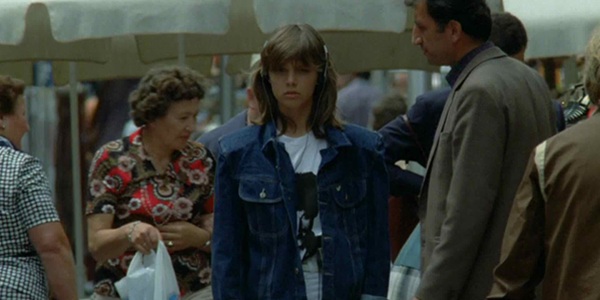
Parasocial fan culture seems to have reached its peak in our current moment. This is largely because social media lets celebrities share more of themselves directly with fans, without needing members of the media as a conduit. In turn, this allows fans to convince themselves they really know the celebrity’s true self. Never mind that what they’re seeing on social media is a painstakingly curated version of that self, one that several handlers have likely workshopped to death just to give the impression of real life. Still, fanaticism was alive and well long before the Internet; it blossomed differently, through different means, but still with similarly toxic results.
In Eckhart Schmidt’s controversial 1982 horror-thriller Der Fan (no translation required), a teenage girl becomes infatuated with a Neue Deutsche Welle pop star that she has come to know—or rather, believes she has come to know—through his music, magazine interviews, and television appearances. Instead of repeatedly commenting on his Instagram feed, she pens letter after letter to him, declaring that only she can make him happy. But her obsession takes a dark turn when she finally meets her idol, and her teenage dream devolves into a nightmare.
Der Fan has been rarely seen since its initial release for a variety of reasons, not least of which is the problematic sexualization of the film’s then-underage star. But now it’s available in a new 4K restoration from Fun City Editions, complete with its original stereo soundtrack for the first time since its original German theatrical run. It’s a deeply disturbing film that draws parallels between parasocial fan culture and the rise of Adolf Hitler, highlighting how the cultlike devotion inspired by charismatic individuals frequently leads to tragedy and destruction.
Your Biggest Fan
Simone (Désirée Nosbusch, only sixteen at the time of filming) is obsessed with the pop star R (Bodo Staiger, frontman of the Neue Deutsche Welle group Rheingold, who provided the film’s entrancing electropop soundtrack). She wanders through waking life like a zombie, alive only in her fantasies. She parks herself outside the local post office, praying that one day he’ll send a response to one of the many passionate letters she’s sent him, but to no avail. Eventually, she stops going to school and even eating, so consumed is she by her hunger for R’s love.
source: Metrograph
One day, Simone decides to hitchhike to Munich, hoping to meet R in person outside of the studio where the music television show Top Pop is recorded. And, at first, it appears that all of her fantasies are about to come true: Simone catches R’s eye, and he invites her to join him inside for the filming. She thinks that she has been singled out because they are meant to be; she doesn’t realize that, with her wide eyes and youthful naivety, she’s simply an easy mark for a predatory pop star. Simone believes they are soulmates, but R merely sees her as one of the disposable pleasures he’s entitled to as a celebrity, particularly one so popular with young girls.
While Simone watches R perform on Top Pop, she has eyes and ears only for him. But as the audience, we observe more: we see the way the adults in R’s entourage look at her, and we hear the whispers they exchange about the unfortunate way R has treated past conquests. They (and we) know what’s about to happen, even if Simone does not. But once R gets what he wants from her, the harshness of reality creeps into her fantasy, and Simone slips over the edge into madness. What follows is a bizarre, bloody sequence that is all the more chilling for how quiet it is; the only sounds you do hear are subtle yet sickening. It’s a phenomenally creepy bit of horror filmmaking.
Kill Your Idols
Unfortunately, it is this climactic portion of the film that Nosbusch spends largely in the nude, the camera lingering on her body in a way that can only leave a bad taste in your mouth. In a 2003 interview with Tagesspiegel, Nosbusch—a well-known teen television presenter at the time she made Der Fan—said that she was reassured during filming that hardly any of her body would be seen on screen, only for that promise to be broken and for her to be alarmed when explicit photos of her began appearing in magazines without her consent. And while Nosbusch says in the same interview that she had since talked it out with Schmidt after years of hating him for what he did, it’s still awful that this happened, especially since we all know that Nosbusch is by no means the first or last underage actress to be taken advantage of in this way (see also: Brooke Shields in Pretty Baby, Olivia Hussey in Romeo and Juliet).
source: Metrograph
That said, Nosbusch is phenomenal as Simone, giving a remarkable slow-burn performance. She spends so much of the film so quiet and hyper-focused on R that when she finally loses it, emitting feral screams of rage at R for using her, you are all the more shocked and disturbed. It also makes the animalistic violence that follows all the more believable, even in its extremity. The fact that Nosbusch was actually the age of the character she was playing only adds to the impact of her performance; she looks and acts like a real teenage fanatic. But casting someone her age was not the problem; unnecessarily showcasing her nude body onscreen was and still is, and as an audience member, you can’t help but feel complicit in her trauma as you are watching Der Fan.
Much in the same way that casting a real teen as Simone adds to that character’s onscreen authenticity, so does casting a real pop star as R. Bodo Staiger looks and sounds like a German Ian Curtis, crooning melancholic synth-pop tracks that are legitimately quite enjoyable to listen to; you can understand why a morose teenage girl would be drawn to this music and this man as an escape from the mundanity of her everyday life. The Top Pop sequence, in which Staiger performs almost completely still while surrounded by mannequins, is incredibly striking, and not just because it bears an uncomfortable resemblance to the opening scenes of Leni Riefenstahl’s famous Nazi propaganda film Olympia. Indeed, Schmidt doesn’t shy away from comparing Simone’s obsession with R and subsequent descent into madness with the German people’s fascination with Hitler and subsequent descent into Nazism—needless to say, another form of madness. He even drapes the room in which Simone and R sleep together in red, white, and black curtains that call to mind the Nazi flag and foreshadow the doom that is to come.
Conclusion
Der Fan is a film that exists to make audiences uncomfortable, and does so with bite and verve. This new restoration is worth seeing; however, I cannot blame those who will feel that the manipulation of the then-underage Nosbusch during filming is a line they are not willing to cross.
The new 4K restoration of Der Fan opens at Metrograph in New York on August 28, 2026.
Does content like this matter to you?
Become a Member and support film journalism. Unlock access to all of Film Inquiry`s great articles. Join a community of like-minded readers who are passionate about cinema – get access to our private members Network, give back to independent filmmakers, and more.