By
By 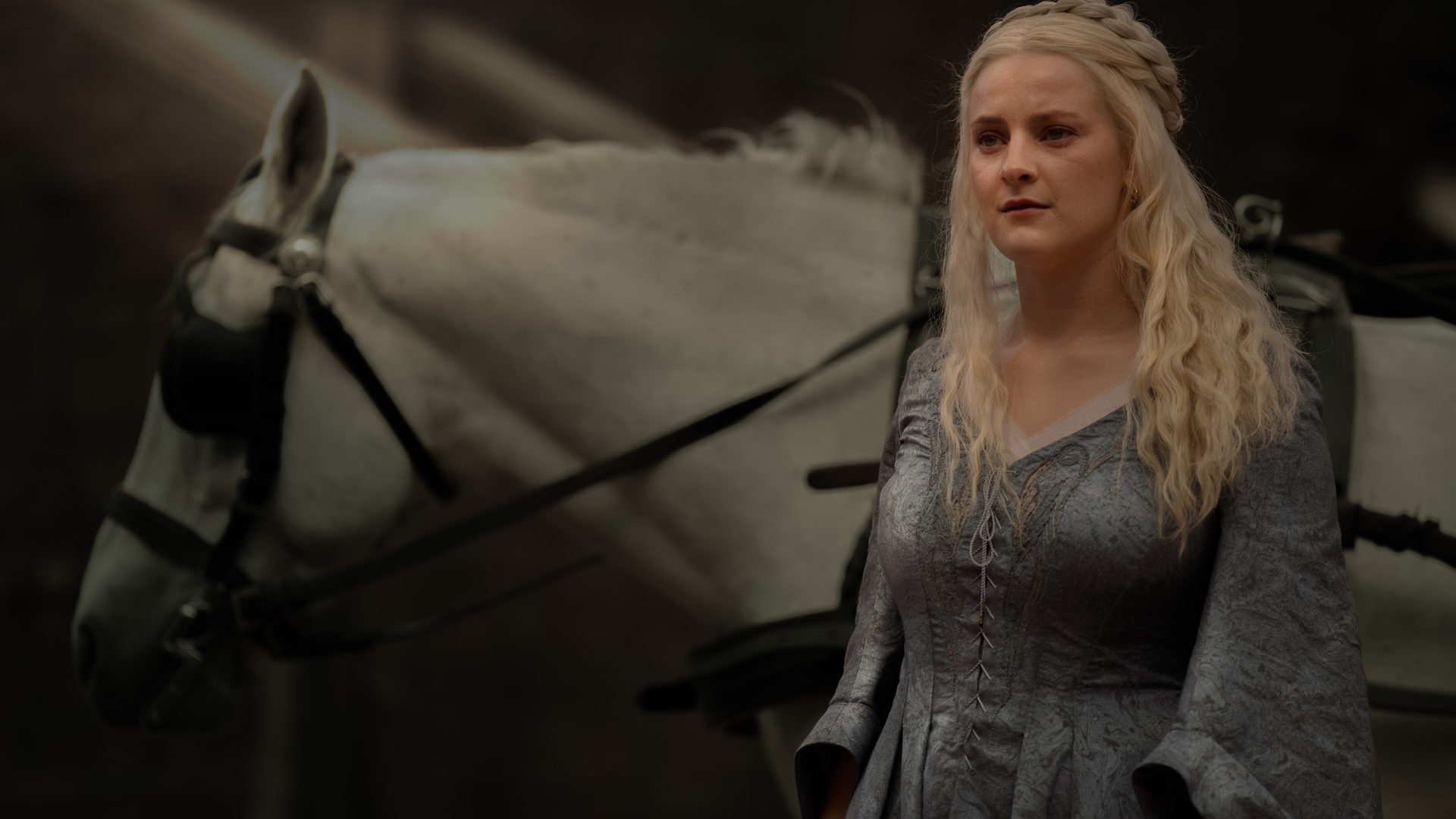
This article contains spoilers for House of the Dragon season 3 episode 8.
The problem with the House of the Dragon season 3 finale isn’t necessarily the finale itself, but everything that precedes it.
While that may seem like an unfair way to judge a singular episode of television, most season finales – particularly season finales of Game of Thrones shows – can’t reasonably be described as standalone experiences. House of the Dragon season 3 episode 8 (the name of which we won’t find out until well after press time… just one of the series’ many microaggressions against me specifically) doesn’t exist solely for its own sake. It exists to pay off the ambitious, yet at times frustrating, seven episodes leading into it.
And it does not do so… for the most part.
This is certainly not for lack of trying. Just as the season opened in bombastic fashion with the Battle of the Gullet, it closes with another major martial chapter in the Dance of Dragons civil war: the Battle of Tumbleton (ominously known as the First Battle of Tumbleton in George R.R. Martin’s Fire & Blood source material). And what a battle it is!
Ormund Hightower (James Norton), smell-averse Dennis Reynolds-eque goober that he may be, was undoubtedly correct in his theory of mind regarding his opponent Rhaenyra Targaryen (Emma D’Arcy). For the man with the hammer, every problem looks like a nail. And for the woman with many dragons, every fortified city teeming with innocent life looks like a Harrenhal ready to be torched. Ormund’s intentions with the occupation of the strategically insignificant market town were always clear. He was inviting a fiery spectacle that would turn the smallfolk against their queen. But even he couldn’t have anticipated just how much fire Rhaenyra was unwilling to unleash… or more accurately: how much fire she had the capacity to control.
There is much to love about the show’s depiction of Tumbleton’s fall. Ormund’s introduction of literal child soldiers is both grimly logical and strangely hilarious (*cue Always Sunny music* “Dennis Hires Child Soldiers”). It’s also to the script’s credit that it’s bold enough to allow these child soldiers to suffer real harm. There is no deus ex machina that saves these kids at the last minute. The poor lads literally piss their pants, then get cut down in droves and burned alive by turncoat Ulf (Tom Bennett) and his dragon Silverwing. Hell, even our old friend Roderick Dustin (Tommy Flanagan), he of the supposed heroes in the North, sinks his axe into a pre-teen’s skull! And then just goes about his day.
Prior to that moment, the man they call “Roddy the Ruin” was our most reliable source of comedic relief. When Daemon asks him pre-battle if he and his men are still prepared to die for their queen he responds with a terse and sincere “can’t fucking wait.” We then get to see how much he meant those words as Lord Cregan’s Winter Wolves respond to every victory in battle with disappointment that they’re not yet dead and remain one more aging mouth for Winterfell to feed. Thankfully, Roddy does get his wish in the end – down one arm but no less fearsome – he pukes blood in Ormund’s face, stabs him through the ass, and then welcomes Silverwing’s cleansing fire with raucous joy. R.I.P., you absolute weirdo.
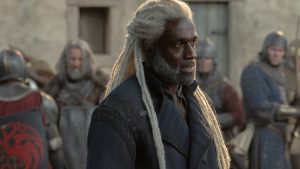
Epic and satisfying violence aside, the Battle of Tumbleton is also burdened with several contrivances like many fellow House of the Dragon skirmishes before it. Gwayne (Freddie Fox) and Daeron (Benjamin Evan Ainsworth) have little to do here other than attempt a Hail Mary peace plan involving Corlys Velaryon (Steve Toussaint) that goes nowhere fast. Daemon’s (Matt Smith) inclusion adds little to the proceedings other than to get a friendly face involved and for Ser Jon Roxton (Joplin Sibtain) to have someone notable to swing his Valyrian sword Orphan-Maker at, reminding us that he exists before his presumably expanded arc in the fourth and final season. The battle also just kind of… ends? Corlys convinces Daemon that the town is lost and they must leave following the turning of Ulf’s cloak. Yes, Daemon is clearly experiencing a post-traumatic stress response in the wake of Silverwing and Caraxes’ destruction but surely the opportunity to snap Ulf’s neck would be too juicy to pass up.
Even the circumstances that bring Daemon to Tumbleton’s doorstep in the first place are hard to fully square away. Ormund was indeed shrewd in knowing that Rhaenyra would cave and attack her ostensible allies in the Reach but he couldn’t have possibly anticipated that Aegon’s survival would have been the inciting event. This is where the House of the Dragon season 3 finale begins to buckle under the sins of previous episodes. It cannot be said that no one saw devolution of Rhaenyra’s psyche into paranoid fascism coming. The show has certainly put in the effort to prepare us for this moment. It just feels like it hasn’t prepared us enough.
A tired, broken, and desperate Rhaenyra, clad in Joan of Arc-style chainmail and darkened eyes, is visually striking stuff. And her speech to the smallfolk of King’s Landing, in which she reveals the nature of the prophecy her father shared with her is undeniably compelling. I’ve been known to quibble (re: scream myself hoarse and roll around on the ground pounding my fists) about the show’s changes from Martin’s text but every choice that showrunner Ryan Condal and company have made regarding the prophecy has been effective.
Rhaenyra speaking aloud the details of Aegon the Conqueror’s dream and going so far as to describe herself as “The Prince That Was Promised” discloses more about her true state of mind than any other line of dialogue or killing of clergy could. In a conference call with reporters before the finale aired, Condal even put forward an entirely logical reasoning as to why the particulars of the queen’s speech wouldn’t have made it into the historical record.
“Targaryens say crazy shit all the time,” Condal said. “So much of their existence is self-aggrandizement. It could just sound like somebody trying to make something of themselves. [The smallfolk] have no idea of the ‘real history.’”
See, that’s a thoughtful, measured way of approaching a story that presents itself as an historical text. Slightly less thoughtful and measured, however, is the show’s interpretation of what’s really going on in Harrenhal. Alys Rivers’ (Gayle Rankin) conversation with Aemond (Ewan Mitchell), in which she lays bare her true magical nature as the cursed wife of Black Harren, doomed to haunt the halls forever for seeking out unnatural cures to her child’s dragonfire injuries, is a creative explication of the character’s witchy nature. But as is the case with so many other reveals on this show, the opening of one narrative door also happens to close so many others.
Alys’ story is more fascinating as a possibility than it is a reality. Yes, Gayle Rankin gets the opportunity to deliver an emotional monologue (which she crushes, naturally) but going forward what else is there now for Alys to do now that the trick’s prestige has arrived? She even seems somewhat diminished in the first scene following the revelation when the risen Aegon arrives at Harrenhal to confront (but not to kill) his brother. Though that could just be that no performer or character could possibly find purchase on screen when a scarred Tom Glynn-Carney is joyfully tearing into lines like “I’m aliiiiveee, imbecile.”
Ultimately though, what really sinks this finale is its treatment of the show’s best (or at least most likable) character. Why did Helaena Targaryen (Phia Saban) have to die? That’s not rhetorical, I’m genuinely asking.
In his now-infamous (and since-deleted) blog post deriding House of the Dragon‘s adaptation choices, George R.R. Martin went ahead and brazenly spoiled the events of the then-yet-to-be-released third season of the show, writing: “In Ryan [Condal]’s outline for season 3, Helaena still kills herself… for no particular reason. There is no fresh horror, no triggering event to overwhelm the fragile young queen.”
At the time, many suspected that George, bless him, was being a bit of a drama queen. After all, the whole reason for that blog post in the first place was the show’s removal of a very minor character, Aegon and Helaena’s youngest child Maelor. But now that we’ve all seen the episode, does it not seem as though the “A Song of Ice and Fire” steward might have had a bit of a point?
While it’s not fair to say that Helaena self-defenestrates for no particular reason, her actual reasoning is murky at best. Leaning in to Helaena’s status as a prophetic Targaryen “dreamer” has paid off immensely throughout the show’s run and made her into one of the more eminently watchable characters onscreen but it also may have backfired here at the end.
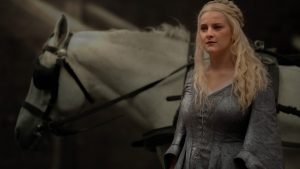
All good prophetic dreams are inherently unclear and up for interpretation. Helaena’s however, are simply too unclear to make any sense of her fateful decision. Was it the sight of a grey mare appearing in the courtyard that convinced Helaena her death was necessary? Was it the remote psychic damage endured from all the souls lost in Tumbleton? Or was it simply the awful taste of the porridge Rhaenyra had force fed to her?
I genuinely do not know. And I don’t feel as though the invisible hand of the story has handed me the tools to properly interpret it… or if it even wants me to try. There’s certainly something to be said about a precognitive character like Helaena understanding that her time as a thread in a richer tapestry has ended. On some level Helaena and the story itself are one and the same – or at least they understand each other better than most.
If anything, it seems as though Helaena dies not for the story, not for herself, not for her children, but for Rhaenyra. The Queen on the Iron Throne isn’t wanting for autocratic eurekas in this saga. The gods have not only killed two of her children and heirs but have now brought her rival back from the dead. And yet, Rhaenyra has never looked more resolute as she has when gazing down the parapet at her half-sister’s broken body. Could only Helaena’s death make that final fracture of humanity happen? Was she aware of that? Is that why she took the fall… so that Rhaenyra could one day take hers?
I, and say it with me now, don’t know.
Helaena Targaryen was not only the best of her family, she was also the only one left with a tangible connection to their Valyrian past, present, and future. Getting her out of the way now makes sense for the story as it sets up the final chapter for the dynasty’s downfall. I just wish I understood why it made sense for her.
All eight episodes of House of the Dragon season 3 are available to stream on HBO Max now.
The post House of the Dragon Season 3 Episode 8 Review: All the Things You Care About Are Ugly appeared first on Den of Geek.