By
By 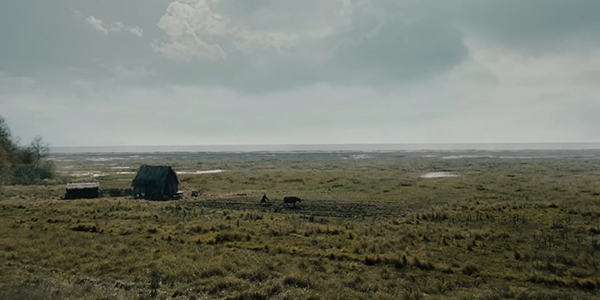
Do human rights exist?
The answer for most of history would be no. A regular person cannot expect the powerful to treat them with any measure of respect merely because they too are human.
And the answer would be a resounding no if you watch the trailer for The Uprising, a film directed by Paul Greengrass that is due out on September 11. Which may be surprisingly good news for anyone who cares about the idea of human rights, because the trailer is well-devised to inspire viewers to champion the dignity of even the most humble person in the face of top-down oppression.
In this case, the most humble person is a farmer, played by the eternally doe-eyed, eternally tortured Andrew Garfield. The opening sequence of three shots deftly establishes him as a working class hero, the first and third shots tightly framed to endear his boyish features, the second a long shot of him ploughing Mother Earth against an expansive countryside, the green fields tinged golden in the sun. He is Adam after the Fall, faithfully laboring to feed himself out of the sweat of his own brow.
source: Focus Features
But the nostalgic visuals differ starkly from what we hear. “I am no soldier. I am no priest. I’m just a farmer.” The foreboding voiceover makes it clear that the agrarian idyll will come to a violent end. We know immediately that he will not get to remain “just” a farmer, that he will have to come to blows with soldiers and priests, his societal superiors, on behalf of the truths that he believes and embodies.
The bucolic prelude is preparing us for the kind of brutal, graphic, hand-to-hand violence that medievalist storylines, from Robin Hood to Braveheart to The Game of Thrones, have always provided Hollywood with a pretext for delivering. The key is to establish a just cause, a good guy we can root for amid the mayhem that will take over the story. All of this the trailer delivers in the first 10 seconds.
What follows sticks to a tried and true formula, bringing our earnest, industrious Everyman through a series of rising confrontations to a climactic battle that promises to transform not just his life, but also the world in which that life must play out.
The historical backdrop for The Uprising is the 1381 Peasants’ Revolt in England, which happened during the reign of Richard II, who was just 14 years old at the time. Rural laborers, or serfs, their communities depleted by the Plague, struggled to pay heavy taxes, particularly the new poll tax, that were required to fund what would come to be known as the Hundred Years War.
The protests caught fire in southern and eastern England, with working class citizens gathering from several communities to march on London, where they killed a number of powerful officials. The young king met with them and agreed to their demands, including the abolition of the poll tax and of serfdom altogether.
The trailer invokes many elements of the historical record. Garfield’s character is Wat Tyler, the leader of the actual rebel forces that invaded London. According to legend, Tyler was incited when his daughter was sexually accosted by a soldier during the collection of poll taxes in his village, an encounter that is suggested early in the trailer. We later see Tyler in conversation with John Ball, a priest known for protesting corruption and a fellow leader in the rebellion. King Richard also shows up in several shots, youthful but icy and measured, a politician canny beyond his years.
source: Focus Features
But such historical allusions matter less than the trailer’s ability to move viewers to outrage on behalf of the exploited and the dismissed. Tyler is never named, but he is portentously identified as a “plowman.” The resonant reference is to William Langland’s contemporary allegorical poem, Piers Plowman, which celebrates laborers in general and the figure of the plowman specifically as a good Christian devoted to the simple life and the simple truth. The poem also critiques institutions of power and provides rationale for resisting corrupt officials.
The trick is to afford viewers enough glimpses of this historical record to lend the film moral gravitas while also promising that it will sate our unending appetite for graphic violence onscreen. Toward this end, the trailer moves fast, jamming some 107 shots into a little over two minutes of footage.
London itself (or at least CGI renderings of a 14th-century London) plays a starring role, as it has so often throughout Hollywood’s existence, a center of both civilization and savagery. In soaring overhead shots, we see rebel and royal forces converge on the steps of churches and palaces, on wooded hillsides and cobble-stoned streets. We see swordsmen and axe-men and archers and executioners. We hear bits of rousing speeches from the invaders as well as steely orders from the king’s officials to crush the rebels. And throughout, we hear medieval choral music lifting it all up to the heavens, sometimes punctuated with outbursts of thunderous percussion.
For the last segment, a drawbridge is dropped open with a resounding thud, and the invaders pour into the Tower of London, their righteous anger enhanced by the sounds of hundreds of running footsteps. This is the only time in the trailer that we hear a footfall, in this case en masse, a crescendo of urgency. Brutal violence has seldom felt so sacred.
Our hero even uses a hand-scythe, a farming tool, as his signature weapon. Just before the clipped official identifies him as a “plowman,” we see an insert shot of the hand-scythe being sharpened, a pronounced metallic ring added to the soundtrack to drive home the point. He is, in fact, a soldier – but a soldier of necessity, not fortune, a defender of the land, a feeder of the people, someone who has been forced to beat his private ploughshare into a sword of justice.
source: Focus Features
There are many other clever touches sprinkled through the trailer: bravura pep talks, home-made grave markers, the king’s mother looking dour and doubtful, a magnificent tomb in a vaulted cathedral where people pray in one shot and rush in to fight in another, a flotilla of boats on the Thames, a hail of arrows being released on the rebels, and more.
But all of it is contextualized by the opening images of the farmer, the humble man more sinned against than sinning. Everything in the trailer is made more dramatic by the idea of a small life being set in direct, violent opposition to the deadly hauteur of the great and the powerful. The last words, heard only in voiceover, are given to the plowman: “For all that you’ve taken from us, all that we’ve lost – time to pay.” No promise of victory to cap off this rousing trailer, only a declaration that some measure of grassroots vengeance will be exacted.
It will be instructive to see how the full film handles the outcome of the historical uprising. It did not end well for Tyler or for Ball, to put it mildly. The actual King Richard eventually rescinded his concessions and used the rebel leaders as graphic examples of what happens to those who challenge the crown. The justice they seemed to have secured did not prevail for long.
But such grim realities are not part of the trailer’s agenda. Its goal is to inspire viewers to come and see a movie that will stoke righteous wrath at tyrants at the same time that it lionizes those who fight for human rights. In that well done task, it proves a good and faithful servant.
THE UPRISING – Official Trailer [HD] – Only In Theaters September 11
Does content like this matter to you?
Become a Member and support film journalism. Unlock access to all of Film Inquiry`s great articles. Join a community of like-minded readers who are passionate about cinema – get access to our private members Network, give back to independent filmmakers, and more.