By
By 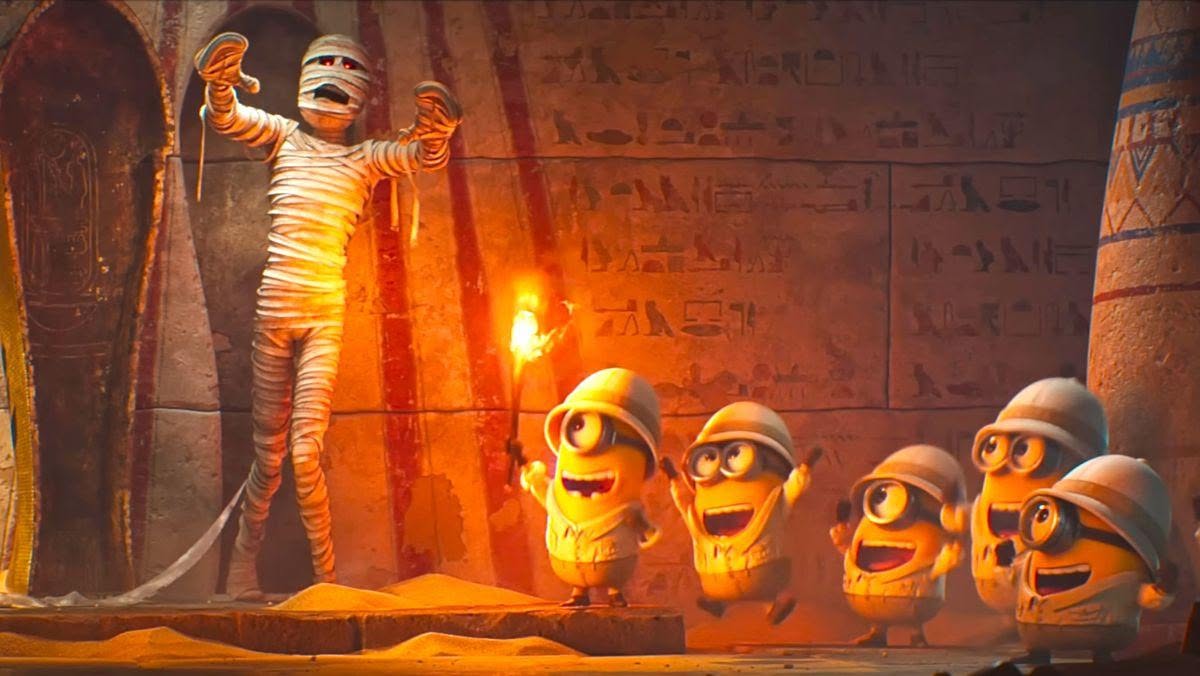
This article contains some Minions & Monsters spoilers.
Minions & Monsters is the third Illumination film to bear the title of the devious, banana-shaped critters who were first dreamed up by filmmaker Pierre Coffin and collaborators Chris Renaud and Eric Guillon. It is also the seventh film to showcase these animated hybrids between Oompa-Loompas and the Keystone Cops. Yet while devising a new film about the little guys, writer-director Coffin wasn’t so much thinking about their future as he was their past. Plus his own. It’s a fact that becomes obvious before the finished film even starts.
When families and fans enter the cinema for Minions & Monsters this holiday weekend, the first thing they’ll see is Eadweard Muybridge’s 1878 motion picture of a horse running (albeit Minions style). The second is a literal walk back through time via every Universal Pictures title card since the studio’s 1912 founding.
“I had the idea from the start,” Coffin confides to us with a wry smile over Zoom. “I even went on YouTube and got all the Universal logos.” With the exception of the earliest version from the salad days of studio founder Carl Laemmle, they were all online and easy to mash up and reverse. “I didn’t know if it was going to work, so I stole those off of YouTube, edited them, put it backwards, edited that little effect, and it’s in the movie.” It serves as a cute easter egg but also a statement of intent.
For Coffin, the whole appeal of Minions & Monsters has been this walk down memory lane, both as a cinephile who loves the building blocks of the moving image, as well as someone who was once a kid growing up on Universal’s catalog of monsters from nearly a century ago. Minions & Monsters represented a chance to explore the past, even while creating something new for the next generation.
“The goal of the movie is that it’s a Minions movie but it feels different,” Coffin admits. “[It needs to be] funny… but I didn’t want it to be more of the same. So the era, and everything that we put in there, was stuff that felt relevant and also that motivated me into wanting to do it.” Below are a handful of those biggest motivators and inspirations, for Minions, Monsters, and more…
Hollywood History, Gods and (Universal) Monsters
The new Illumination film’s framing device is designed to get moviegoers of every generation feeling nostalgic. Inside an apparent Hollywood History museum, a snappy tour guide voiced by Allison Janney walks families and school children by familiar—and often Universal copyrighted—sights. The hoverboard from Back to the Future Part II (1989); E.T. and the fateful bicycle from the Steven Spielberg movie of 1982; there’s even a deeper cut of Alfred Hitchcock’s The Birds (1963). Oh, also, no less than George Lucas himself.
But in the corner that sets the plot in motion is an area dedicated solely to the memory of Henry and James, the Minions from a different tribe who broke into Hollywood in a big way during the 1920s and ‘30s. And as a testament to their legacy are three specific movie posters: one for the Fritz Lang German silent film classic Metropolis (1927), and two that directly riff on iconic Universal Monsters The Mummy (1932) and Creature from the Black Lagoon (1954), albeit with a certain Minions styling. The latter two specifically represented monumental moments in Coffin’s childhood introduction to American culture.
“I didn’t know those movies existed before moving to the States in ’77,” Coffin reveals. “I moved to the States for three years, and there were so many horror movies that I didn’t know existed. So when I discovered them on TV—[movies like] The Fly and Frankenstein—at the time I was just in awe of these movies. They weren’t aired on French TV at the time, so I was just like, ‘Whoa, how come I can’t see them in my local theater?’ I had to chase them on those TV channels they were on at the time.”
Indeed, while The Mummy appears to be a personal favorite with a version of the Boris Karloff undead sorcerer showing up before quickly unraveling later in Minions & Monsters, one non-Universal beastie that had special significance on the film and young Coffin is Paramount’s original The Blob from 1958.
“I remember going to the movies in France to see The Blob… in the ‘70s,” says Coffin, “and I was terrified by it, really terrified. And just because of that I had the idea [on Minions & Monsters] for Irene.” The writer-director is referring to the ultimate monster that a Cthulu-like creature summons in the third act of the film (and which is on all the posters).
Says Coffin, “I was like, ‘Let’s make Irene this blobby thing with eyes.’ I then said we should all go look at that movie again.” The filmmaker pauses and a grin spreads across his face. “And horrible, just horrible. The Blob doesn’t even move in that movie! It’s just like standing there with everybody yelling and that was it! So the perception of it as a kid and knowing what it is as an adult, it’s a different thing.”
Charlie Chaplin, Harold Lloyd, Buster Keaton, and the Building Blocks of Comedy
Yet while the monsters of the title are one of the selling points of the movie, the real centerpiece of its muses comes during the grandest animated set piece. It’s the scene where the Minions Henry, Ed, and James quite literally break into Hollywood by way of a runaway locomotive that explodes into the film like a prop from The Great Train Robbery (1903). Meanwhile in hot pursuit is no less than the Keystone Cops, the titular slapstick law enforcement buffoons who appeared in a series of comedies produced by the Keystone Film Company between 1912 and 1917.
According to Coffin, all of the mayhem that ensued, including the Minions meeting their veritable ancestors in comedy stars like Charlie Chaplin, Buster Keaton, and Harold Lloyd, originally sprang from Coffin and his team trying to imagine a humorous way to introduce the Minions crossing over from ancient history to the relatively recent backstory of cinema.
“I go by visual cues,” Coffin admits. So when he and his team drew up what it would look like if there were so many Minions climbing atop a stagecoach in the Old West, Coffin knew they were on the right track by how humorously jarring it was when they started forming into giant balls of yellow. After that, it became about escalation.
“I knew that I needed to create a little bit of surprise,” Coffin explains, “so we added the train, and then we referenced The Great Train Robbery. And then the whole moment was for me to say, ‘How do I get from the audience thinking we’re in the Western era to the moment where we’re discovering that, no, that’s totally wrong, we’re in 1920s Hollywood. So we [decided] we need to trickle out the clues. And so from the train, we go to the Keystone Cops, which is ‘whoa, what are the cops doing here?’”
Eventually, though, it became specifically about recreating—and perhaps affectionately desecrating with Minions mayhem—three iconic moments in physical comedy: Harold Lloyd hanging from a clocktower in the vertigo-inducing silent rom-com classic, Safety Last! (1923), Buster Keaton surviving a literal house falling down around him in a shot that would make insurance men sweat bullets during Steamboat Bill Jr. (1928), and most especially the bit where Charlie Chaplin gets gummed up in the bowels of industrial America during Modern Times (1936).
“When I was thinking about a factory [setting], I said, ‘Maybe we should do that Modern Times quick reference and have our take at it?’” Coffin recalls. “And the conceit of those three little moments—Chaplin in Modern Times, Harold Lloyd in Safety Last!, and Buster Keaton in [Steamboat Bill Jr.]… is just not to give a reference. It was just to say maybe what we know of history is wrong? Maybe it’s the Minions that actually provoked those accidents?!”
Kidding aside, for Coffin it was about paying homage to his forebears.
“I think the Minions come down from every one of those geniuses that did slapstick at the time,” says Coffin. “Like before doing this movie, we were already referencing those guys just because in animation we go for slapstick, which is a form of physical comedy. So cartoons, in terms of an animated genre, is only referencing those guys who have invented slapstick: non-talking characters, physical violence, you name it. It’s Tom and Jerry, it’s all the Tex Avery movies.”
Babylon, Singin’ in the Rain, and All That Jazz
While Minions & Monsters isn’t (quite) another parable about the cataclysmic culture shock of sound being introduced to silent pictures in the 1920s, the movie nonetheless moves and bustles through quite a bit of Hollywood history, showing the Minions rising to the top of silent comedy cinema in the Jazz Age and getting completely decked out how we might expect.
Indeed, there’s a scene where James and Henry win an Oscar and a line of sequined flappers in pink dresses come bounding on the stage behind them. Coffin freely admits they’re modeled after Debbie Reynolds’ iconic cake-girl outfit and routine in the definitive Hollywood musical-comedy about Hollywood itself, Singin’ in the Rain (1952).
“Yeah, totally,” Coffin laughs. “She has the same hairstyle and stuff.” But then he admits he is playing in the same sandbox as every film, recent and old, that has revisited this monumental moment in Hollywood history. “I mean it’s the same subject matter, right?” Coffin considers. “Babylon, Singin’ in the Rain, and The Artist, they all speak about that era and the arrival of sound, obviously.” By his own admission, the party sequences in Minions & Monsters were more specifically modeled after the epic shindigs written down by F. Scott Fitzgerald in the seminal 1925 novel The Great Gatsby. Yet even by almost accident, he found himself echoing the immense bacchanal of Damien Chazelle’s Babylon, which imagined Hollywood debauchery culminating in an elephant running through Los Angeles house parties.
“The Babylon thing came after the fact, but my initial thing was Blake Edwards more than Babylon,” says Coffin. “It was just a general collectivist thing where let’s have crazy animals in there to show these guys are so rich they can get anything they want.” The filmmaker is specifically referring to the Blake Edwards and Peter Sellers comedy The Party (1968), wherein ‘60s go-go swingers and flower children throw down at a party that also includes an Asian elephant running wild. Still, when the connection to Babylon became apparent, Coffin and his team happily brought it into the merrymaking.
Casablanca, Citizen Kane, and the Brothers Warner
Of course no exploration of the Golden Age of Hollywood, especially when sound is introduced, can occur without a nod to two poles that frequently wind up at the top of all rankings of the greatest American movies: Michael Curtiz and Warner Brothers’ gold standard example of the Hollywood system of yore being able to produce masterpieces, Casablanca (1942), and the iconoclastic film that broke that mold and bucked industry trends and cinema vernacular, Orson Wells’ Citizen Kane (1941).
One of the latter’s several easter egg nods in the film has been partially released online, in which one of the Minion performers continuously flubs a pivotal moment for his director (Christoph Waltz) by being unable to say the fateful word “rosebud” on his deathbed. Once you see the finished film though… it ain’t “rosebud” that comes out of James’ mouth!
“Citizen Kane is obviously the ultimate thing,” Coffin admits, and it was one of the movies from the earliest concept art and meetings that was always going to be referenced in a montage of the Minions struggling with sound.
“That survived the test of time, but we tweaked it slightly, because we used to end it on just one word, a nonsense word. It used to be ‘bikini,’ which I think now is second. But in the end, it’s just, ‘Oh poop!’ And then ‘bikini.’ Then all of them.” It’s the culmination of a gag that was always supposed to show, like for the characters of Singin’ in the Rain, that the talking pictures were hard, man.
“We tried, I think, a dozen ideas,” Coffin explains. “I know that I wanted a moment where the Minions would screw up with sound. I didn’t know how yet. I didn’t know if it was going to be because they’re saying the English words wrong or if they just can’t speak. I didn’t know. So we did a lot of stuff.” At one point, the Minions were going to mess up on the set of a Western, at another they were going to fumble on the set of James Whale’s Frankenstein (1931), and also a Ten Commandments-esque biblical epic. What survived this process though was Citizen Kane being the ultimate punchline, a nondescript World War I epic that Coffin claims he picked just because he liked the aesthetics—albeit I see quite a bit of The Big Parade (1925) in it—and of course Casablanca, with maybe a little bit of The Maltese Falcon (1941) sprinkled in.
Both of those last two star Humphrey Bogart, which is the name that James’ miscast Minion goes by while chatting up a dame in an office that looks suspiciously like a film noir private eye’s humble abode.
Says Coffin, “Casablanca was really the thing that felt like it started slowly. Like ‘Okay, it established the principal and cue cards, and all that stuff.’ We needed something that slowly grew.”
Yet it wouldn’t be the only Casablanca nod in the film which also seems to be taking special aim at Jack Warner and Harry Warner, two of the Warner brothers who gave WB its name. Theirs was the studio that produced Casablanca with its iconic use of the song “As Time Goes By.” In Minions & Monsters, we meet the Bright Brothers of slightly diverging sensibilities on a studio lot that looks like a cross between WB and the iconic Paramount Pictures gate. Coffin freely admits he modeled both Bright Brothers on Jack and company.
“If I was a cartoonist at the time, that’s how I would draw them,” Coffin says of the Warners. “That image of the director stuck between those two big guys is actually a drawing for me where, when I started doing the beat boards and for this movie, that was one of the images I wanted to see in the movie. So it’s there. If I could have done like cigars and stuff, I would have done it, but I was not allowed.”
With that said, he wanted to at least nod to the legacy of what they could create as well.
“I wanted to have the cliché of those mean, scary guys, and then ultimately, we made them slightly different. One really ruthless, like mean, and the other one is just as ruthless but in a nice way. And adding that little Casablanca moment made them very human, which was very important to me. I didn’t want them to be all the way through caricature. I still wanted them to have this soul, this sensitivity, and them asking that Sam, the piano player, to play that music felt like a good way to humanize those guys.”
The Power of Movies
There is a line of thinking that might question why any of these sometimes hundred-year-old films are being homaged and revered in a Minions movie. The target audience will undoubtedly be children who likely never have heard of Citizen Kane, much less the infamous revelation that “rosebud” is the name of Charles Foster Kane’s sled.
“I get asked that question,” Coffin concedes. “‘But kids don’t know Citizen Kane’ and dah dah dah. I don’t think you need to know. You just need to know that it’s a guy, or Minion, that looks like he’s dying and his last words are, ‘Oh poop.’”
That’s the gag, but truthfully, Coffin hopes Minions & Monsters will be the start of some kids discovering more.
“So whether it’s Citizen Kane or all these moments of ‘who are those guys? Why is everybody laughing, hopefully, at the Modern Times moment, at the Harold Lloyd moment?,’” Coffins begins, “I don’t think kids know that, or maybe they do. But then it’s sort of a TikTok thing where it’s ‘poof,’ and ‘Harold Lloyd was a genius,’ and then moving on. So I’m hoping that if they don’t know, they’ll ask and then they’ll find an answer, and then they’ll realize that, yeah, Buster Keaton, when you see his stunts, they’re incredible. And then you fall on a video where you see a collection of all his stunts, and then all of a sudden you’re interested in his film career, and then you plunge into it, and you find The General, The Cameraman, and then you find all these movies that are still working to this day.”
By the Minions maestro’s accounting, these are the kind of classics that will always hold up.
“When you look at them, they’re just brilliant,” he says. “And when I showed it to my kids, they were reacting to the black and white, and saying, ‘Oh, what is this?’ But then 10 seconds in, they were totally forgetting that it was in black and white, and they were struck by the storytelling, which is still working these days, particularly Chaplin, by the way.”
It can be a new world of old gods and monsters.
Minions & Monsters is in theaters now.
The post Minions & Monsters Easter Eggs and Hollywood History Explained by the Director appeared first on Den of Geek.