By
By 
This article contains spoilers for Backrooms.
Early in the new A24 horror film Backrooms, furniture salesman Clark (Chiwetel Ejiofor) stops his exploration of the space attached to the basement of his store because he thinks he hears a monster coming toward him. Clark desperately crawls up an incline on one side of the room, to a tiny brown door adorned with three door knobs. To his dismay, Clark discovers that two of the knobs do nothing, and only one opens the door, finally allowing him to crawl through.
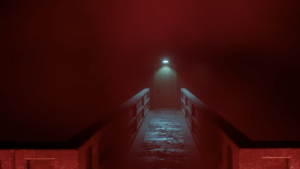
Clark needn’t have run from the noise, and not just because—as we eventually learn—the thing pursuing him isn’t what he expected. Rather, his running is unnecessary because Backrooms isn’t about a beastie come to kill and maim. Instead, director Kane Parsons builds a dread through uncanny images, visions of spaces filled with things that should be normal, but are a little bit off: fluorescent lights and cork board on an office wall instead of the ceiling, hallways that jut from the wrong part of the room, a face with three sets of eyes and three noses.
The terror comes, in part, from the way the banal becomes strange and unfamiliar. But it also comes from showing a world without the human, especially as Clark and his therapist Mary (Renate Reinsve) strive to retain their sense of selves. This tension between the strange and the human makes Backrooms one of the clearest looks at the fundamental horror of AI.
Inhuman Horror
Like most theatrical screenings in the U.S., my 5:45 p.m. showing of Backrooms actually began with commercials. Alongside odes to Mountain Dew and new cars, my theater played an ad for a local insulation company, in which a woman jumps up from her couch and begins yelling at the audience about energy efficiency. Where the other commercials one must sit through before the movie stars merely annoy, this one unnerves, and with good reason. It’s AI.
The woman’s eyes are a little too wide, her movements a bit too smooth, the sounds she makes crackle in the wrong places. As much as the woman extolls the importance of staying cool in the summer and warm in the winter, we viewers know that those comforts mean nothing to her because she can’t feel anything at all.
Up until that point, the insulation company commercial was the scariest depiction of artificial intelligence to hit the screen, but it was hardly the only one. Culture has long worried about melding humanity with machine, going back to Mary Shelley’s Frankenstein or Karel Čapek’s 1920 play R.U.R., which coined the term “robot.” Horror films from ranging from Demon Seed and Death Spa to The Terminator and M3GAN have warned that machines will destroy us if they gain sentience.
Yet, now that AI exists and is being pushed every time you do an internet search and every time you try to use your phone, we can see that none of these films got it right. The threat of AI isn’t that robots will come to life and kill us because we didn’t say thank you when our refrigerators dispensed ice. The threat comes from companies burning water and other resources to house data farms, from the local jurisdictions that give them tax breaks to do it. The threat comes from CEOs who lay off workers only to use machines to scrape the internet to steal their work.
AI is scary because it’s humans dehumanizing humans, and that’s what Backrooms captures.
Lost in the Uncanny Valley
Outside of Backrooms‘s cold open, the first sign that something’s amiss comes when Clark and a maintenance man check out the building’s electrical box. Opening the door, they find the usual set of switches than one expect, in two orderly columns at the center of the box. But then they notice three random switches, placed diagonally at the bottom. Switches, obviously, belong on an electrical box. But, not in that place, and not in that shape and color.
As Clark explores further into the backrooms, he finds more of the same. Each of the rooms have hallways, but the hallways lead to more hallways and the rooms serve no purpose. Couches appear would no one would place them, let alone sit in them. Windows let in no light and let no one look through.
To his credit, Parsons doesn’t offer an explanation for how or why the space works. Even the scientist (Mark Duplass) who rescues Mary at the end has no real insight into the space’s function. Instead, we just know that the space remembers things, and as it returns to each memory, it gets something wrong. It hyper-fixates on a specific detail while overlooking the generalities. So we see a room with chairs, but the chairs are scattered in front of the door or stacked up one another. We see a bathroom with a line of sinks in the middle and a tub sunk into the floor.
The horrors climax with four people: a small man fused to his wheelchair who can only turn on a light, a large man with cascading eyes and noses, a woman with a shuddering effect on her face, and lumbering, giant recreation of Clark in his pirate costume.
These images bring to mind the images that have littered the internet since techies started really pushing generative AI as a creative tool, bodies that blend together as they move past each other and arms jutting out of nowhere, topped by hands with too many fingers. Or, more befitting the “copy of a copy” language of Backrooms, they recall the game where users ask ChatGPT to replicate an image, each result growing more grotesque.
As that last example underscores, most people have been making ChatGPT replicas as a type of a game. But the terror invoked by the uncanny in Backrooms shows that there’s nothing funny about it at all. AI has no concept of the human, and thus its attempts to replicate life only make a mockery of humanity, twisting and reflecting in ways that feel all the more monstrous because of how normal it wants to be. When we look at an AI image, whether Owen Wilson staring dead-eyed in a simulacrum of Wes Anderson directing Star Wars or a fake pitch woman selling home improvement services, we feel ourselves slightly diminished, and it’s terrifying.
Moving Forward, Better
Of course, nothing in the text of Backrooms is about AI. Instead, the movie is explicitly about holding to memories and refusing to evolve. In perhaps the most heartbreaking moment of the film, Clark submits to the nightmare of conformity that he’s confused for safety, declaring to Mary, “I don’t want to change.”
Such declarations might sound like a rejoinder to those who doubt Generative AI. Not wanting change is bad, the movie seems to be saying, so I should stop being afraid of this new technology. But Clark only wants to stay the same because he thinks it’s safe, because maturing and moving on requires him to do things differently.
Maturing, growing, changing: these are all human attributes. If we don’t embrace those attributes, we might initially accept the false depictions offered by Generative AI. But once we look closer and see how distorted and grotesque it makes the world, then we have to run from it. Not because there’s a monster lurking, and certainly not because we’re afraid of technology, but because it takes away our humanity.
Backrooms is now playing in theaters worldwide.
The post Backrooms Is the First Horror Movie of the AI Era appeared first on Den of Geek.