By
By 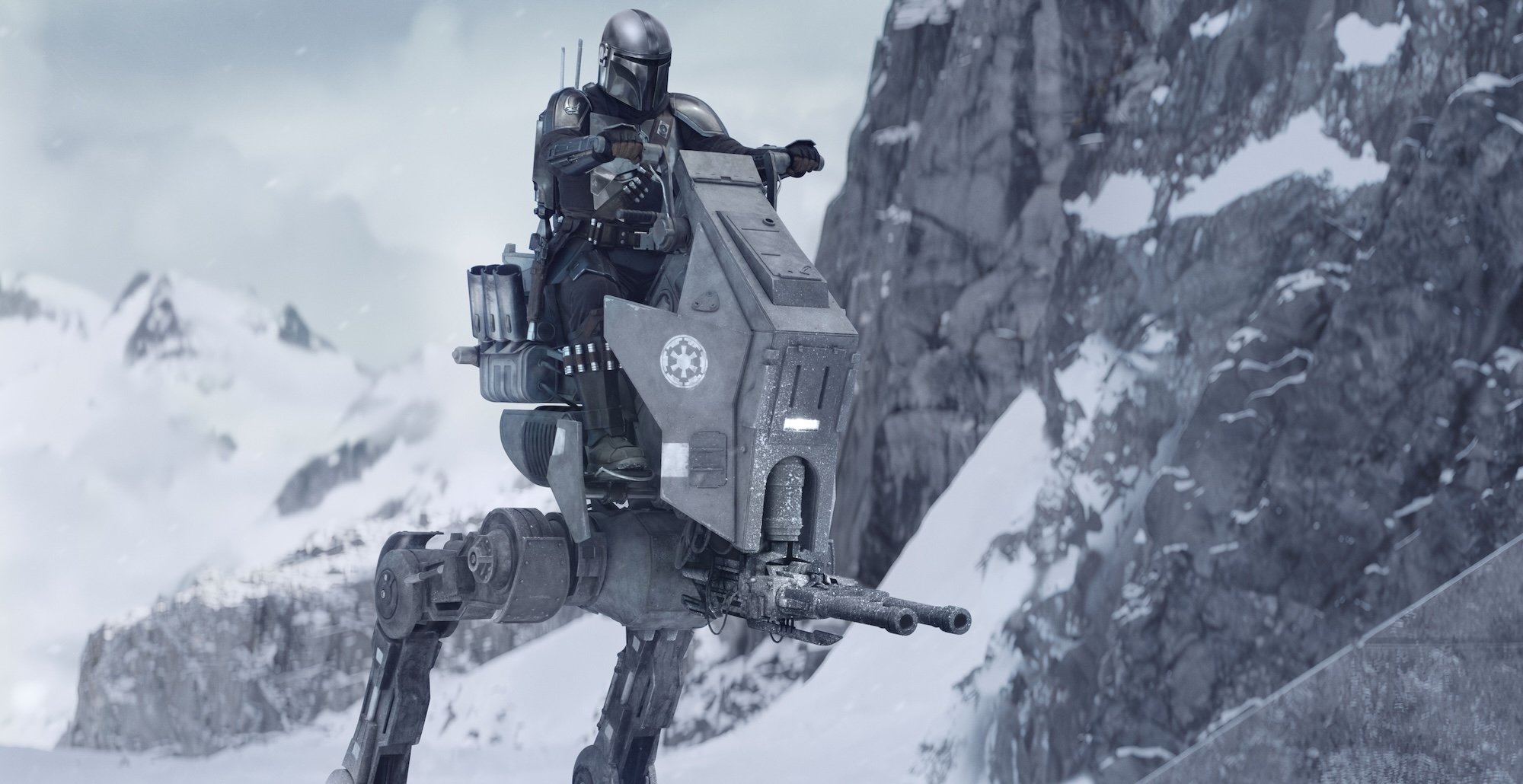
I don’t know how much screen time in Star Wars: The Mandalorian and Grogu is actually Pedro Pascal in the shiny chromatic suit, but I hope not much for a couple of reasons.
First of all, Brendan Wayne is credited as the “Mandalorian Suit Performer” right under Pascal in the final ending credits scroll, which means Wayne deserves his fair due. But secondly, and in spite of how spiffy that costume looks (and it’s real spiffy!), there’s little here of the enigmatic presence and physicality that Pascal brings to so many other roles, be it the lasciviously limber Red Viper of Game of Thrones or the aloof yet nevertheless scene-stealing third wheel in Materialists. Despite getting top billing in the poster, Pascal’s eponymous metal head is virtually a blank slate in this movie—a vessel as empty as a well-armored mannequin at San Diego in July.
To be fair, performances entombed by full masks and costumes are always tough. Robbed of eyes or a countenance, a pedant might argue the actor is denied a soul. Yet from Edward Norton’s haunting cameo as a philosophical leper in Kingdom of Heaven to Hugo Weaving’s demented formalities in V for Vendetta, there are exceptions that disprove the rule. A careful eye can even catch in V the early scenes shot with a different performer in the Guy Fawkes gear before Weaving took over.
Still, I get nothing from the beloved Mando in Jon Favreau’s new, expensive Memorial Day weekend relaunch of Star Wars on the big screen (or just The Mandalorian season 4 with a heckuva surcharge for a family of four). The costume is neat, catching the reflection of sunlight now on a shimmering, digital IMAX screen, but whether interacting with the title’s second more popular half, the mascot colloquially known as Baby Yoda, or opposite a flesh-and-blood human every once in a while like Sigourney Weaver, Mando and his companion suggest all the depth and personality of theme park meet and greet characters.
They will charm the youngest of attendees, and tickle the fancy of some Disney and Star Wars adults, but everyone else will just be waiting around for the next ride. Unfortunately on that count too, the rollercoaster thrill components come up lackluster; a first when compared to even the worst of the Star Wars movies that came before.
The Mandalorian and Grogu isn’t a bad film, per se, it’s just a disappointingly average one set in a universe that once inspired awe. There are still moments of fun or faint wonder betwixt the many beats undoubtedly approved in a boardroom. In fact, a particularly lovely passage of the film is entirely about the puppet. After being separated for spoilerish reasons from his papa, Grogu is forced to fend for himself in the wilderness of a swamp filmed wholly in the verticality of IMAX. Revisiting some of the quieter, simpler whimsy of early Star Wars movies, Mandalorian and Grogu briefly becomes a vibe-poem about a child’s view of the world and the goodwill that can engender.
It’s sequences like this where the special effects wizardry matches the warmth of Favreau’s early movies, and we get a sweeter, better adventure. Even David Klein’s previously blockbuster beige cinematography shakes off the blue screen and Volume soundstage doldrums of what came earlier for a saturated set of textured greens and invitingly earthy mud puddles. Alas, these grace notes are few and far between in a movie that feels still born from and constricted by its Disney+ origins.
Admittedly, I have never been a huge fan of The Mandalorian despite its early adoration on streaming, though I get the appeal. The lone warrior and his cub sidekick is a winning trope and lends itself to episodic adventures. But despite a clearly bigger budget for the occasional space battle and AT-AT sequence, Star Wars: The Mandalorian and Grogu never looks bigger than an episode of a TV show. Or maybe a couple of them.
The first and at least narratively sounder one involves Mando and his adopted child taking on the task of hunting down a leftover Imperial officer still making trouble for the New Republic on the Outer Rim of the galaxy. For those who have never watched the Disney+ show, this film is set in the aftermath of Return of the Jedi where the Empire has fallen, but the Rebel Alliance’s new galactic government is on shaky ground. Hence contracting bounty hunts from guys who look suspiciously like Boba Fett.
Mando is hired to find an Empire war criminal, but in truth his adventure is really about how he will parlay that information out of the Hutt Family. Aye, there are more Hutts than just Jabba, as indicated in The Phantom Menace 27 years ago, and his twin siblings (who are known simply as “The Twins”) will give Mando/the New Republic valuable information, provided that the bounty hunter rescues their nephew and Jabba’s son, Rotta the Hutt (played allegedly, and preposterously, by Jeremy Allen White). Yet when we find this wayward, CG space slug on a planet that looks suspiciously like Los Angeles circa Blade Runner 2049, he’s not a prisoner and barely a slug. Instead the digital creature is a buff, gladiatorial heartthrob in the local fighting pits of an urban moon.
That’s the first episode. Part two starts when the Mandalorian and Grogu essentially take on Rotta as the special guest. The kid turns out to be a big-hearted and big-boned third sidekick in the ship. This doesn’t sit well with Rotta’s aunt and uncle, however, who have no shortage of bounty hunters to chase our heroes. You can probably fill in the remaining blanks.
The Mandalorian and Grogu is not the worst Star Wars movie. It’s hard to get any drearier than The Rise of Skywalker, the moribund 2019 corporate bauble shrink-wrapped out of any risk, meaningful storytelling, or soul. However, Mandalorian and Grogu could be the dullest SW adventure, which is a problem when it’s the first movie in that galaxy far, far away to come about since Rise’s big screen thud seven years ago. Furthermore, it’s supposed to signal a new, next-gen era in this world.
In some ways, the film takes welcome risks with the material. As previously suggested, Favreau happily eschews George Lucas’ mid-20th century cinematic vernacular for a more modern look, and Ludwig Göransson’s score is nothing short of hypnotic. There are sprinkles of John Williams homages throughout, albeit more of the master’s Spielbergian twinkle when Grogu does something particularly adorable, as opposed to just reheating those 1977 trumpets again. Elsewhere, Göransson suggests a moody techno crime thriller while Mando does his thing.
The problem is that the movie does not match the evocative nature of that sound. The somewhat underrated Solo: A Star Wars Movie made a better gangster-twinged space adventure eight years ago, in fact. That movie had a bit of a helter skelter personality due to multiple chefs in the kitchen, but it still had something to wrap your Force gloves around at its core.
The Mandalorian and Grogu is just benign. It postures as both a crime thriller and an adventure flick about fathers and sons, but the father and sons have all the authenticity of a twentysomething sweating it out in a Mickey Mouse costume, and the crime sequences are often shot in the dull sterile digital flatness that bedevils so many blockbusters and streaming shows of the last decade.
Take the gladiatorial sequence where Mando meets Rotta. It’s not the first time Star Wars has tried to channel their inner-Ridley Scott—or Stanley Kubrick if you’re George Lucas. The Roman inspired bits in Attack of the Clones and especially Phantom Menace, which replaced chariots with podracers, had a kinetic excitement that was otherwise missing in those often staid prequels. But the arena of The Mandalorian and Grogu? A gray stage in a gray world where even the creepy King Kong-like monsters added to the arena are never allowed to do anything too nasty lest it turn off a segment of the four quadrants. It’s afraid to have the teeth of the far goofier Rancor sequence in another Hutt’s space palace.
But that is what continues to be a frustrating problem of every Star Wars movie of the Disney era not named The Last Jedi or Rogue One (throw in Andor if we’re talking TV). What we see are just lesser remixes and pale imitations of something that came before in this franchise. In this one, particularly, it’s mostly about more Clone Wars droids, more Empire Strikes Back snowbound AT-ATs, more Hutts and their palaces, more bounty hunters and their jet packs, and more Yoda. Only now he functions as both a baby and babysitter screen.
Maybe it’s an aging fallacy to dream of more for that galaxy far, far away, but it’s better than having no new dreams at all in a summer blockbuster that feels curiously like a rerun.
Star Wars: The Mandalorian and Grogu opens in theaters on Friday, May 22.
The post Star Wars: The Mandalorian and Grogu Review: This Is Not the Way appeared first on Den of Geek.