By
By 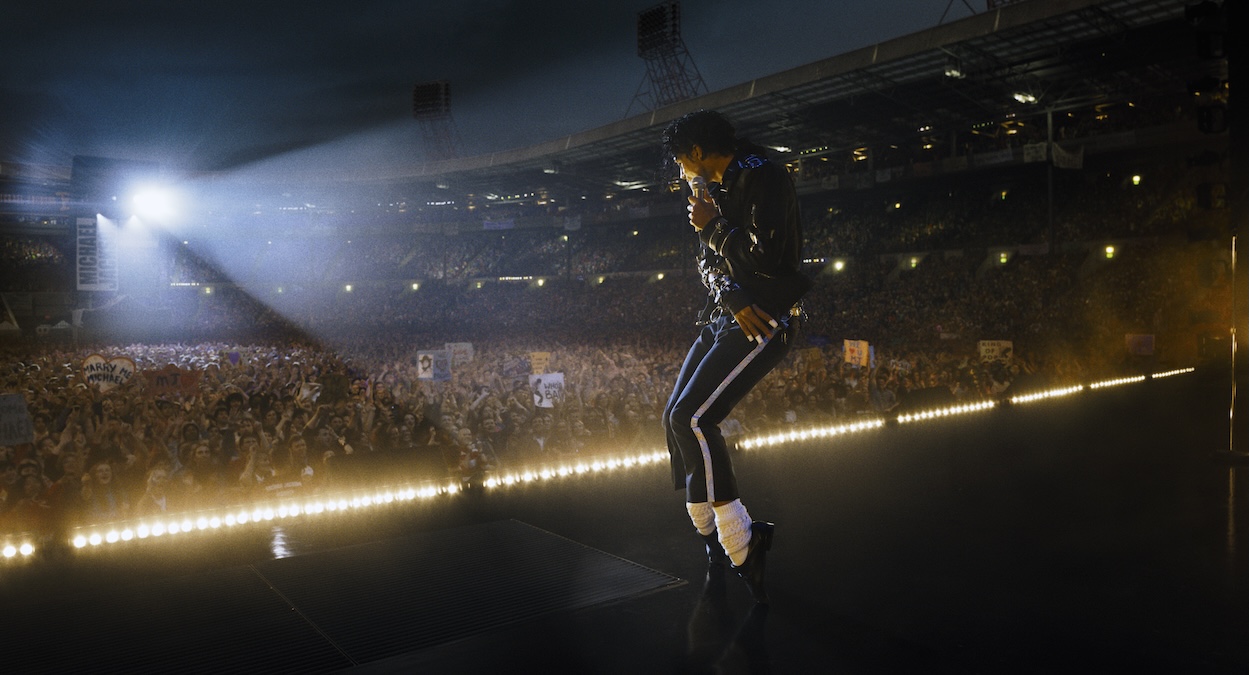
Even before it hit theaters, we knew Michael would be a divisive film. Not only is it about someone who was controversial by the end of his own life, but it makes a strong choice to avoid even the suggestion of allegations about its subject. Furthermore, like most musical biopics, it sacrifices basic cinematic standards in favor of delivering maximum enjoyment to fans, in the form of recognizable trivia and pop song bangers. One need look no further than the divide between the 38% critics rating and 97% fan rating on Rotten Tomatoes to see proof.
Yet, Michael has found a new way to divide movie fans. Reports have been coming in of fans singing along with the King of Pop’s hits, and even dancing in the aisles. Such loud behavior isn’t usually considered part of the cinematic experience, but with films such as Michael—to say nothing of actual concert films, such as Taylor Swift: The Eras Tour or the James Cameron co-directed Billie Eilish: Hit Me Hard and Soft: The Tour Live in 3D—suggests that maybe it should be.
Outside of an Alamo Drafthouse, proper moviegoing behavior isn’t as cut and dry as we’d like for it to be. Generally, we’re all agreed that attendees should be quiet when a feature is playing, and should avoid distracting fellow audience members. However, almost every screening has at least one person who checks their phone, talks to their seatmate, sits in a seat assigned to someone else, or commits some other violation of the cinematic social contract.
And that doesn’t even address edge cases. Is it acceptable to look at your phone during trailers? What about the soda and truck commercials that continue to play, even 15 minutes after the movie was supposed to begin? Can you turn on your flashlight for a minute to find your seat if you come late? Is it more distracting to climb over people to get to an exit and text your babysitter “Yes” when they ask if your kid can have ice cream, or would it be better to quickly type those three letters from your seat?
As much as we’d like to believe that there are hard and fast rules for these things, cinema has never been a pure sanctuary. It certainly didn’t begin that way, as crowd participation was expected during the first part of the silent era, when filmmakers such as Georges Méliès used movies like a magic trick and Mack Sennett’s Keystone Studios riled up viewers with slapstick chaos and shots of bathing beauties. When Buster Keaton’s projectionist jumped from the audience and onto the screen in 1924’s Sherlock, Jr., he only illustrated a blurred line between spectacle and spectator.
Even when the incredible success of D. W. Griffith’s The Birth of a Nation moved cinematic displays from nickelodeons and roadshows to movie palaces, stringent expectations weren’t in place. Films would play as part of hours-long programs, consisting of not just the “A” feature, but also a “B” feature, serials, cartoons, and newsreels. Audience members would regularly arrive and leave mid-showing, and committing various other disruptions.
That changed with the arrival of Psycho in 1960, when Alfred Hitchcock demanded that ushers not seat anyone after the film began, in order to preserve that movie’s mid-film shift. However, filmmakers have never completely left behind the desire to play to the crowd, whether in the form of William Castle’s carnival barker tricks, interactive films like Mr. Payback, or fourth-wall breaks in Funny Games, I, Tonya, and Deadpool.
If this trip through the history of cinematic presentations makes you squirm, you’re not alone. This writer also prefers theaters to be silent and audiences to be respectful, no matter what. Moreover, most people at least accept that quiet observance should be the norm, even if they violate that norm from time to time.
However, the explosive response to Michael proves that some people want to be part of the movie. And they’re not alone either. Fan participation screenings aren’t new, ranging from showings of The Rocky Horror Picture Show and The Room to sing-along releases of The Greatest Showman and K-Pop Demon Hunters to those weird rowdy screening of Cats. Furthermore, 4DX and 3D upgrades promise more immersion into the film, even if they don’t provide space for the viewers to talk back at the picture.
For cinematic purists (see: this writer, again), these special screenings transform the movies into something other than movies. These showings are more like concerts and amusement park rides than they are proper films. Lest that sound condescending, one need only look at the comments from people singing and dancing at showings of Michael.
While it is easy to find commenters decrying dancers as suffering from “main character syndrome,” it’s just as easy to find those who disagree. A video posted to r/MichaelJackson is filled with comments expressing support, claiming that “critics will hate this” and asserting that dancing captures the spirit of the performer. Likewise, a New York Times article on the response to the film includes a teen reproaching her mother by saying, “Mom, this is not a concert.”
Judging by these comments (and, you know, the quality of the movie), Michael isn’t trying to be a proper film. The same could be said of Rocky Horror, The Room, The Greatest Showman, and so on. As such, these types of not-quite movies deserve their own space, special screenings where people can sing and dance and shout and leave others to watch the movie their way, in peace.
Michael is a divisive movie. It’s time to let it divide.
Michael is now playing in theaters worldwide.
The post Michael Can Inspire a Different Type of Theatrical Experience appeared first on Den of Geek.