By
By 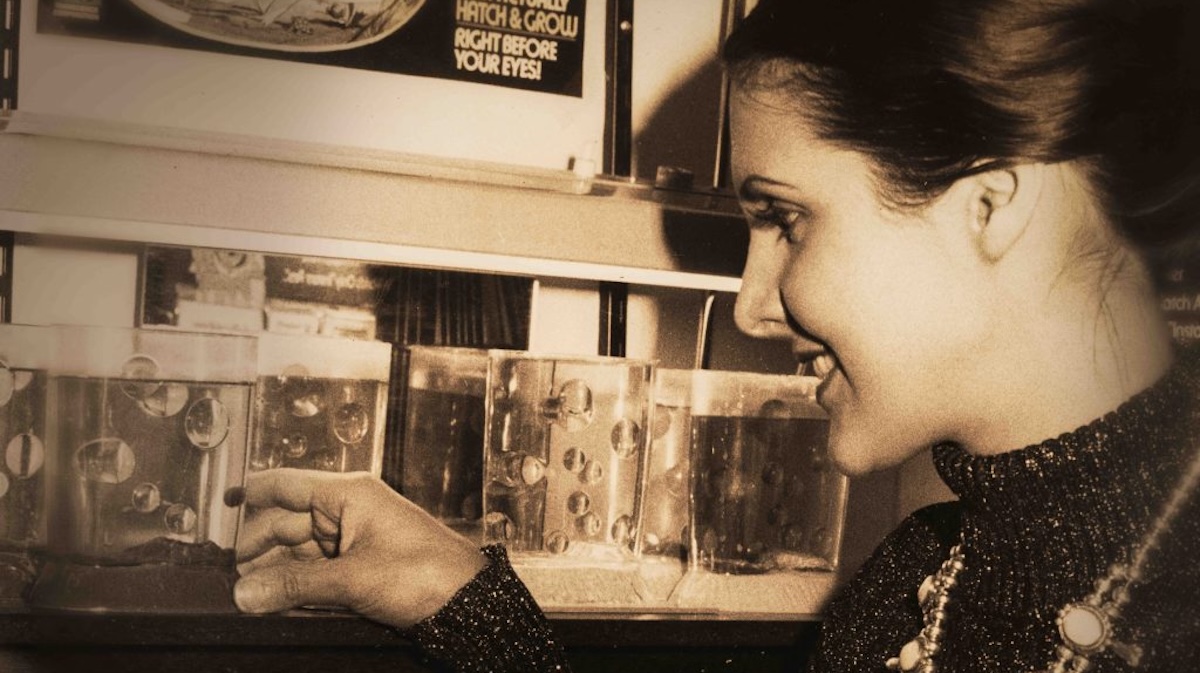
In the 1960s and ’70s, kids couldn’t open a comic book or go to a toy store without seeing sea-monkeys. Sort of. While advertisements and displays promised an underwater kingdom of smiling pink creatures living lives of ease, the actual creatures were microscopic specks that were barely visible to the naked eye. Most would just forget about sea-monkeys as an odd update of the old flea circus phenomenon.
But to documentarians Mark Becker and Aaron Schock, the legal battle over the creatures is the stuff of epic drama, precisely because of the woman at the center, Yolanda Signorelli, wife of sea-monkey marketeer Harold von Braunhut. “Yolanda, she’s a complicated person,” Schock tells Den of Geek after the SXSW premiere of Amazing Live Sea Monkeys. “As we understood the parameters of Yolanda’s life, we gained insight into who she was.”
Since Von Braunhut’s death in 2003, Signorelli has been caught in a legal battle over ownership over the sea-monkeys and the secret formula that allows the creatures (actually, brine shrimp) to come to life when removed from packaging and placed into the water. Between the ongoing legal battle, the complexities of her relationship with her much-older husband, and Von Braunhut’s hateful political views, Signorelli made for a reluctant subject.
“It was a process of talking to her for a few months at a time until we built up a certain level of trust with her, and we eventually got that invitation to come visit her,” explains Becker. “We showed up at her home at the Sea-Monkey Estate, with those gates in the shape of sea-monkeys. They opened and we entered into this entire world.
“When we met Yolanda in that first weekend, we had this feeling that she was a great subject. As a person, she’s very ethical. She’s fighting this battle she believes in, and we knew that we had the heart and core of our story, whatever the ugliness surrounding it.”
“Sometimes, when you do a documentary, you start with this almost schematic understanding of what the story is,” adds Schock. “Yolanda seemed like somebody who’d lived through a whole world. We were very interested in this Mad Men-era, with her working behind the scenes at [Sea-Monkeys distributor] Transcience and working with novelty toys. But then we were struck by her struggle.”
That realization came the moment they visited Signorelli at the estate and found her living in ruins, with no running water or electricity.
“It was like a portal,” Schock says. “It was compelling, and we were a little bit ecstatic about it, to be honest, in that dorky documentary way that we had the privilege to be there. But then the human side came through, because we left the schematic notion we had and met Yolanda herself. She was so relatable, and we became comfortable talking to each other fast that we wondered when we would actually start filming. We were spending so much time just chatting and hanging out.”
During that period of conversation, the filmmakers witnessed Yolanda interacting with animals. Her care for real small creatures, not just sea-monkeys, struck the documentarians. But they were even more impressed that she stuck to her principles when it came to the dispute instead of cashing out.
“We figured pretty quickly that Yolanda had other options for her condition,” Schock points out. “She could have sold the sea monkeys for a few million dollars and retired, and that would be totally understandable. When we met her, she was in the process of putting hundreds of acres of valuable land into a trust so it could be a preserve forever. She could have sold it and retired to Florida. As we began to understand the parameters of her life and the choices she was making, it gave us insight into her ethical backbone.”
With such an ethical figure in the center, the filmmakers had a way into their story, which often went to dark and upsetting areas. The filmmakers may be quick to credit Von Braunhut for his audacity with the Sea-Monkeys (“He’s a mad genius,” acknowledges Becker), but they also have to wrestle with his political beliefs. Von Braunhut was an overt White Supremacist who supported the Ku Klux Klan.
Because of her late husband’s legacy, Signorelli has been reluctant to draw attention to her situation. “When we would broach situations that came up in the press, Yolanda was wary of always being lumped into the worst of what Harold had done in his life. She felt rather separate from that in her own way.
“Our conversations with her were a slow walk towards full transparency,” admits Schock. “We’d be talking to her about B-movies and dealing with oppressive men in the ’60s, but also broaching darker subjects that have to do with the secrets that Harold held.”
Through those difficult conversations, Becker and Schock have been able to make something rich and human with Amazing Live Sea Monkeys, proving once again that, when it comes to these odd creatures, there’s so much more than meets the eye.
The post Amazing Live Sea Monkeys Documentarians Discuss a Big Battle Over Tiny Creatures appeared first on Den of Geek.