By
By 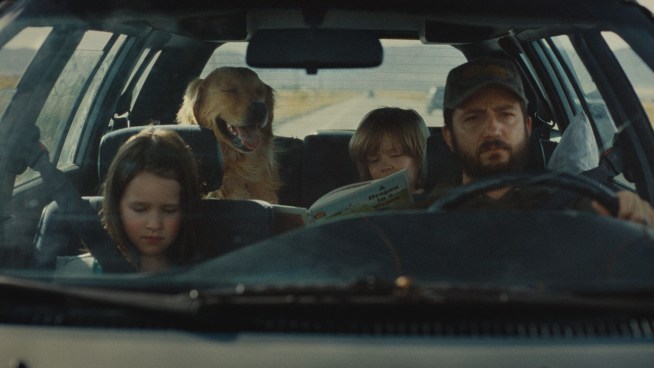
When I told John Magaro I’d watched Omaha twice and was still recovering, he laughed and apologized. It’s a tough movie, but one that’s nevertheless rewarding and Magaro’s powerful, largely wordless turn powers the film confidently. Cole Webley’s debut feature, written by Robert Machoian, is a road trip movie with a dark destination, a slow-burn gut punch that withholds its darkest revelation until the bitter end. Magaro plays Martin, a father navigating an unspoken interior collapse – leaving behind the house they’ve been evicted from, packing into a car that will barely start, and driving his two young kids to Nebraska. The film churns almost entirely on what Magaro doesn’t say. Fortunately that wasn’t the case when I spoke with the 43-year old Ohio native.
Magaro has become – if not a household name – someone that audiences are acutely aware of over the past decade. He’s been involved in the industry since 2005 but it wasn’t until his breakout leading turn in First Cow that people really began to take notice. Since then, Magaro has featuring in Past Lives, The Many Saints of Newark, September 5, The Mastermind, Materialists, the Showtime spy series The Agency, and – most recently – The Bride! But it’s his quietly devastating starring performance in Omaha that really spotlights exactly what he’s so good at.
The script for Omaha arrived when Magaro’s daughter was around two and a half. He didn’t hesitate to move forward. “It’s not often that you get a script where you can just read it and say, yeah, I’m on board,” he told me. “And that was how it was with this.” The film is rooted in the reality of Nebraska’s 2008 safe haven law, a legislative mishap that briefly and inadvertently allowed parents to relinquish children of any age without legal consequence. Magaro said he hadn’t known about it before reading. “It illuminated something I didn’t even know about,” he shared.
What the film is really about, though, is a particular kind of masculine collapse: the stubbornness of a man who won’t reach out even as everything unravels. “He’s clearly dealing with deep issues, depressions, anxieties, things like that, and he doesn’t understand it, and he’s refusing to ask for any help,” Magaro said. “And because of that, he’s spiraling kind of down this drain.” He made it broader than just Martin. “Especially young men — you can’t ask for help, or don’t. It’s not worth trying to hide it and cover it up and think you can solve every problem yourself, because that’s not always the case.”
As a father of a young daughter myself, I was curious how occupying that headspace weighs on you differently when you have a kid at home. “You can’t live in that,” he said, “but it certainly affected me more as a father than if I wasn’t a father. You can’t help but look at these kids and see your own daughter or your own children in it.” He was quick to note that the film’s reach extends beyond parents. “I’ve talked to people who don’t have children, and a lot of them have said, ‘that reminded me of my parents, when I discovered that everything wasn’t perfect with my mother or father.’ We’ve all been children.”
Much of Omaha rests on Magaro’s scenes with Molly Belle Wright, who plays his daughter Ella, and Wyatt Solis as her younger brother Charlie. Working with them was less like traditional scene work and more like structured improvisation. “Cole said we were kind of co-directing the kids,” Magaro explained. “We had to sketch out a framework of the scene and then found ourselves just having a conversation and playing around, asking questions to prompt them to say certain things.” The result is something you can’t manufacture with adult actors. “Unlike a veteran actor, you find a lot of exciting things, because the kids are just being honest and saying whatever they want to say.”
He was protective of them throughout. The entire crew, directors, producers, DP, were fathers themselves. “There was a lot of patience, and a real want to keep these kids safe and protect them and keep this as fun of an experience as possible.”
On the performance itself, Magaro described an approach built on inversion. Rather than leaning into the weight of Martin’s situation, the goal was to lighten it wherever possible. “What we discovered was that was him focusing mostly on the kids, and trying to keep them as happy as possible, trying to make this a good memory for them,” he said. “Trying to play against the heaviness of the situation, and letting those moments shine when he was alone.” It’s a choice that makes the film more devastating, not less.
Magaro has made a habit of returning to directors he trusts, Kelly Reichardt (First Cow, Showing Up) and Céline Song (Past Lives, Materialists) among them, even in smaller capacities. He frames it less as professional strategy and more as a philosophical position. “I like my Cassavetes and Altman, these people who build ensembles, or Tarantino, or Scorsese, people who build these kinds of groups they work with over and over again. I always wanted to be a part of that.” With Reichardt, it’s unconditional. “She could call me and I’d be there to do anything for her.”
When it comes to regrets, he’s surprisingly sanguine. “I think I’ve actually dodged more bullets than regretted it,” he said. “There’s been things where it didn’t shake my way, and then you see it and you’re like, oh, good thing it didn’t.” He did cop to one miss: passing on an early read for The Bear. “I didn’t read for it. I didn’t realize — it was a mistake, I guess.” He couldn’t quite remember the specifics of why. Some regrets are fuzzy like that.
Asked which character he’s played is closest to himself, he picked Arthur from Past Lives, a pretty normal, upstanding guy. “I’m a normal guy,” he said, without a trace of irony. “I’m glad I’m a normal guy.”
If he had a blank check and a story to tell, he’d go to history, specifically the world of early 18th century piracy, the military-adjacent privateers who operated during the Spanish War of Succession, well before the romanticized Blackbeard era. “These are like military guys, and they’re fighting for a country, but it’s piracy.” Pirates, I offered, with less silly hats. “Way less silly,” he agreed.
Though John has been careful to dodge bullets in his career, the franchise machine eventually comes for everyone. When asked if he were forced to do something within an ongoing franchise, he didn’t hesitate. “Probably Batman,” he said. “Batman’s great. Batman’s always been pretty respectable, and they always tend to do a good job with it. Even in the worst form, even the Joel Schumacher form, it’s still decent.” Alright James Gunn, the ball is officially in your court. Get this guy in the next Batman movie. There’s no question he would kill it.
Omaha arrives in theaters April 24, 2026.
For more reviews, interviews, and featured articles, be sure to:
Follow Silver Screen Riot on Letterboxd
Follow Silver Screen Riot on Facebook
Follow Silver Screen Riot on Twitter
Follow Silver Screen Riot on BlueSky
Follow Silver Screen Riot on Substack
The post John Magaro on the Weight of ‘Omaha’, Being a Thoughtful Performer, and Accidentally Missing Out on ‘The Bear’ appeared first on Silver Screen Riot.