By
By 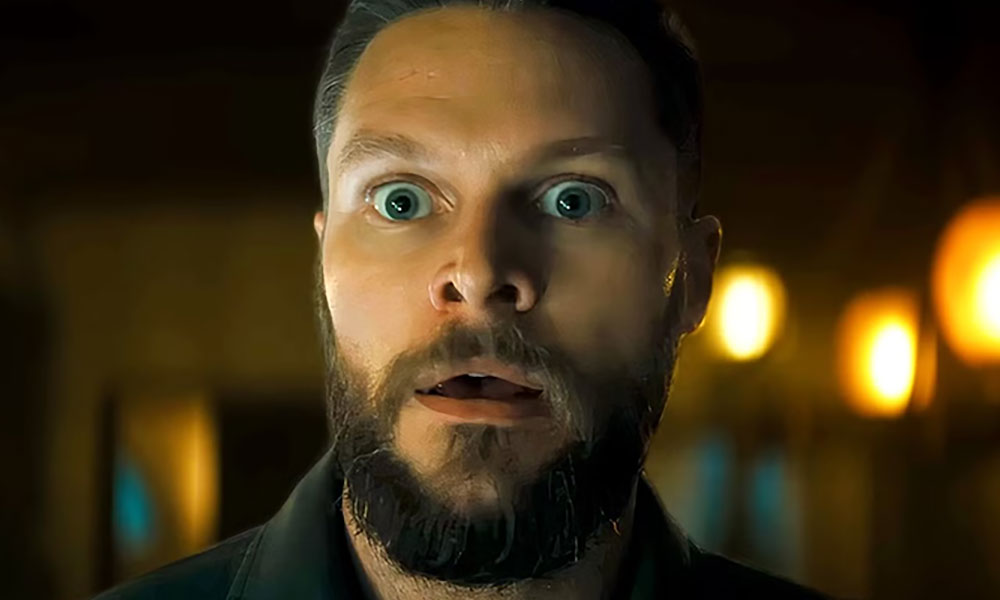
Lee Cronin’s The Mummy puts me in a problematic position. Self-doubt blooms. Fear of losing credibility threatens. Yet, I crunched the numbers backwards and forwards, right to left and upside down, and they add up the same way: Lee Cronin’s The Mummy is somehow, in some unexpected way, a decent effort…
Let’s take a spoiler-free look at it.
Lee Cronin’s The Mummy
First of all, who is Lee Cronin, and why is it his mummy?
Cronin is an Irish dude who did Evil Dead Rise. That makes total sense. Lee Cronin’s The Mummy has some Evil Dead aspects. The mummy is more deadite than mummy.
Lee Cronin’s The Mummy also shows the same approach to gore as Evil Dead. Much, much less blood shows up here, but it displays a similar sense of humor. Cronin wants the audience to go “ewwww…”
A sound design link between Evil Dead and Lee Cronin’s The Mummy exists, as well. A whole lot of crunch happens. Maybe it is only the speaker setup in my local theater, but certain audio stings nearly bounced me out of my chair.
Cronin’s work on Evil Dead Rise is suspect, but he refined his writing and directing skills for this version of The Mummy. Like Blumhouse’s take on The Invisible Man and The Wolf Man, the story takes a different direction than the old Universal films. Cronin crafted a tale that builds nicely. It starts quietly and steadily ramps up.
The Invisible Man and The Wolf Man both had neat ideas, but they struggled in execution. Lee Cronin’s The Mummy best represents Blumhouse’s vision for these properties.
Tommy Lee Cronin’s The Mummy
What makes Lee Cronin’s The Mummy work is that it is built on an entirely normal foundation. Grownups worked on this film, and the theater kids got exiled to a playroom with crayons and valium.
The film revolves around a nuclear family. The dad acts like a dad. The mom acts like a mom. The siblings act like siblings. No gender tries to be stronger than the other. The dynamic is like the one depicted in Poltergeist.
In fact, Lee Cronin’s The Mummy is scoured of almost all identity politics. The chance existed to present them, but they all said, “Nope. Let’s tell a story instead.”
The opening scene fools a person, however. The movie starts out overly cute. The jaded viewer immediately says, uh-oh, but it rapidly becomes clear that Cronin is taking the piss on viewers as the true nature of things is revealed.
If one is inclined to analyze film to the point of themes, the theme of Lee Cronin’s The Mummy is easy to identify. It is a pro-life film about the sacrifice a family makes to care for a loved one who is disabled. It is a surprisingly wholesome message. Yet, it is not sanitized. The film acknowledges the realities of these situations.
Lee Cronin’s The Mummy Main Players
Jack Reynor (Midsommar) is the father. He is in manly protector mode. He even sports a beard in case any confusion exists about this.
Spanish actress Laia Costa is the mother. She gives a nice performance that wavers between vulnerable and strong. Yet, the neat thing about her strength is that it is not based on being a boss girl. It is based on a mother’s devotion to her children.
May Calamawy (Moon Knight) brings an Egyptian flair to the cast as a law enforcement agent investigating the mystery.
Katie Cannon plays the titular mummy. Cannon does not have a big list of credits. She is effective in the film. Most of her performance is physical. She either sits and projects an aura of creepiness or contorts. Oddly, she kind of disappears into the background. She is more of a canvas for the other performers to project upon.
A few other characters are thrown in: a grandmother (Veronica Falcon) and two additional siblings (Shylo Molina and Billie Roy), but that is about it. It is a contained cast, which works well. At its heart, the story is simply a nuclear family challenged by horror.
Add It Up
In this age of reboots and remakes, another Mummy film doesn’t bother me that much. The monster is not overused and has a history of multiple iterations. Even Charlton Heston did a mummy movie (The Awakening).
Regardless, Lee Cronin’s The Mummy can be dinged for a few things. It runs a smidge long at 134 minutes, but it mostly plays at a good pace. It is appropriate that Jack Reynor is in this movie since he was in Midsommar. “Ari Aster pace” is a good way to describe how the film works from a time-in-chair perspective.
Another issue is Lee Cronin’s The Mummy could be just as well be shot in black and white. I cannot remember a single instance of popping color to give images onscreen some soul. Cronin also insisted on using wide-angle lenses for pretty much everything. Distortion around the borders of the frame continually appear and can distract the eye.
Nevertheless, it all came together into a workable movie. Normally, I don’t pay attention to review scores, but I had to look at them in this instance for piece of mind. I needed to know that I’m not insane for liking it.
First off, it sits at 46 per cent on Rotten Tomatoes. This is not surprising. RT is compromised. Plus, I’ve seen zero X glazing for Lee Cronin’s The Mummy. I don’t think Blumhouse pays a shill bill.
IMDb rating sits at 6.5/10, and Fandango is at 75 per cent. That is right in line with my impressions. I can breathe easier now.
Of the 2026 horror movies I’ve seen so far (Primate, 28 Years Later: The Bone Temple, Send Help, Undertone and Scream 7) Lee Cronin’s The Mummy is easily the best of the bunch.
The post Review: LEE CRONIN’S THE MUMMY appeared first on Last Movie Outpost.