By
By 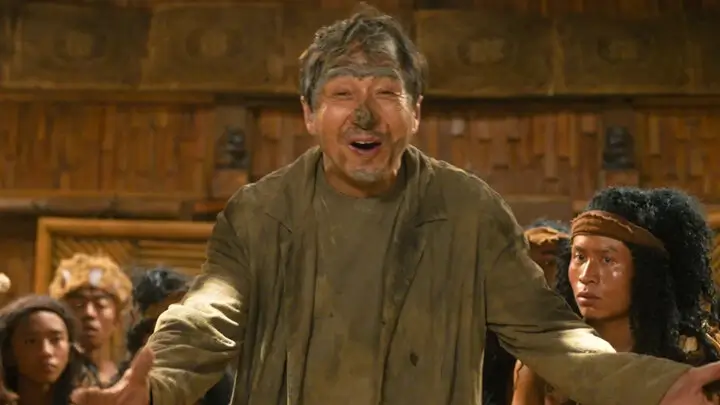
Panda Plan 2: The Magical Tribe opens with an offbeat fantasy hook – a legendary action star is mysteriously transported into a strange parallel world where a sacred prophecy, a mystical mountain, and a talking panda place him at the center of an unexpected quest, blending absurd comedy with a light adventure narrative that unfolds without relying on major spoilers.
Leading the film is Jackie Chan, effectively playing a fictionalized version of himself, though the film never explicitly confirms it, allowing his persona to operate somewhere between reality and caricature.
Rather than presenting him as an unstoppable martial arts force, the story leans into his age and legacy, portraying him as a confused yet resilient outsider navigating an unfamiliar world with reluctant determination.
However, this approach exposes a deeper issue: Chan appears out of place in a role that feels designed for a much younger version of himself, as if the production is attempting to recapture a charisma and physical presence that defined his earlier career but no longer aligns with where he is today.
Opposing him is less a traditional villain and more a rotating set of obstacles, though the closest the film comes to a central antagonist is the jealous son of the tribe’s leader, played by Yu Yang, whose motivations are rooted in insecurity and a desire for recognition.
Adding an unexpected comedic highlight is Qiao Shan as a bumbling assassin whose shifting loyalties and memory-loss gag inject a recurring absurdity that often steals focus from the central conflict.
Director Derek Hui approaches the film with a noticeably different sensibility compared to its predecessor. Having also worked as an editor on action titles such as Kung Fu Jungle and Skiptrace, Hui demonstrates an understanding of pacing, yet here he intentionally leans into whimsical chaos rather than structured storytelling.
The result is a film that feels less like a natural continuation and more like an unnecessary extension, reinforcing the idea that some films are better left without sequels, with this standing as a clear example of a concept stretched beyond its limits.
Where the first entry functioned as a passable action-comedy, this follow-up leans into exaggerated fantasy and tonal inconsistency, ultimately feeling like a cheaper and less focused iteration.
The stunts and camera work reflect this shift in priorities. While action sequences are present, they are not designed to showcase Jackie Chan in the dynamic style that defined his legacy. Instead, the camera emphasizes broad comedy and exaggerated movement, often relying on CGI-driven spectacle that lacks the tactile authenticity of his earlier films.
The choreography exists, but it rarely carries weight, and the visual approach prioritizes silliness over precision. This reinforces the sense that the film is attempting to use Chan as a nostalgic anchor rather than adapting to his current strengths as a performer.
That is perhaps the most frustrating aspect: Chan has already proven in films like The Karate Kid, The Foreigner, and Ride On that he excels in roles reflecting maturity, experience, and emotional depth. His performances as Mr. Han, Quan Ngoc Min, and Lao Luo show a natural evolution into mentor figures, seasoned veterans, or world-weary fighters—directions that feel authentic and compelling.
In contrast, casting him as a bewildered, comedic figure stumbling through a surreal jungle adventure feels like a regression, not an evolution. There is a strong argument to be made that audiences would respond far more positively to seeing Chan as a mentor, an old guard, or an experienced mercenary rather than in roles that attempt to recreate a version of him from decades past.
The final verdict is clear: Panda Plan: The Magical Tribe will only appeal to viewers willing to embrace its chaotic humor and surreal tone without expecting coherence or meaningful progression.
Fans seeking classic Jackie Chan action or a continuation worthy of the original will likely be disappointed, while those open to its absurdity may find occasional amusement.
Ultimately, the film serves as a reminder that not every story needs a sequel, and that even the most iconic stars are best served when their roles evolve alongside them rather than remain stuck in the past.
The post Panda Plan 2 movie review appeared first on Budomate Magazine.