By
By What is your martial arts background, and who were your main influences?
My first martial arts class was Kempo Karate when I was eleven. There was one in every strip mall back in the 80s. It was basically fight choreography class: guy grabs you, grab nuts, stomp foot, elbow up to chin, backfist to nose, back kick to stomach. Great for memorizing choreo, but as “self-defense” even a kid could tell it was fishy.
Som I dropped out to do what I loved: weightlifting and gymnastics. I didn’t get very flexible, but I got strong, then got into springboard but fell off the board and hit the edge, and my body couldn’t figure out how to dive again. So, when I started The Stunt People at age 18, I had a hodgepodge of skills that allowed me to hit the concrete but not much fight experience.
It wasn’t until I turned 20 and went to San Francisco for film school that I opened the yellow pages and started calling, and I landed at Hwa Rang Kwan Taekwondo on 5th St. in SOMA. My teacher Andy Leung was a Donnie Yen fan, so I taught him fight choreography and he taught me Taekwondo and kept my Cantonese fresh. I also got overcharged for a class by accident, so the owner let me use the school for stunt practice every Sunday, and we expanded The Stunt People there and soon had about 30 people at every stunt practice.
Some of the new members like Dennis Ruel and Ray and Troy Carbonel were teachers from Hapkido USA who had done their own movies, so I started learning Hapkido from them. Theirs is a Myung Jae Nam branch taught by Grandmaster Kong, which had a ton of kicks, so it looked a lot more like Hwang In-shik’s Hapkido than Ji Han-jae’s. We started sparring regularly at Sunday practices. When they moved over to The Hapkido Institute we started doing open sparring there on Wednesday nights too, and we’d fight almost anyone who came in off the streets.
After those days I mostly trained on a per-project basis. I learned boxing for Heart of a Champion, Iaido for Blindsided: The Game, and whatever I had to learn to get through Tekken In Real Life. For the past five years I’ve just maintained the 8 basic kicks and do a lot of kettlebell, and this has worked wonders.
What led you to become a fight and stunt choreographer?
Pure passion. Just as I was a late-bloomer in martial arts, I came to Hong Kong cinema late in life too. When I saw Drunken Master II in 1998, I had a scary intuition that Hong Kong action – in the purely physical sense – would never get better than this, and I ended up being right. I was obsessed over these films and reviewed hundreds of them for my website in the late 90s, until I felt like I had a grasp on how they were shot.
Then one night Chelsea (the first Stunt People member with me) and I were watching the newer Hong Kong films, which just weren’t hitting the mark, and we got this hairbrained idea that we could do it better.
So, we grabbed my high school buddy Ben, the only guy we knew who owned a VHS camcorder, and we shot our first short called The Civic. It was garbage, but we were addicted. I choreographed and directed almost everything we did after that, always comparing our stuff to the Hong Kong stuff and trying to find ways to improve performance, choreography, camera, and editing.
I really enjoyed your Rope-A-Dope short films. How did you come up with the idea and the character?
After I shot my third feature, Death Grip, I ended up talking to a stunt veteran named Clayton Barber who had worked on Blade and all kinds of classics. He had an old script that was inspired by Groundhog Day where lightning struck every night and reset the day, but it was a dead-serious thriller. I was tired of doing serious stuff after Death Grip and pushed for more comedy.
We came up with the idea that when a guy gets knocked out the day restarts, and Rope-A-Dope was naturally born from that. I was also tired of talking from Death Grip, especially since it made sound mixing such a nightmare, so when I wrote the script, I just didn’t write any dialog, and it worked. The character comes across like he’s just had enough, and that’s definitely where I was after Death Grip. “Just lemme have my burger.” Nothing complicated. We were shooting within a month. It really happened fast.
What changed in your approach for short film Blindsided?
I directed Rope-A-Dope 1 and 2, which were co-directed by Pete Lee, and Clayton produced those. He wanted to direct the next project, and we had been talking about doing a character study of a blind man for a while.
He was inspired by Zatoichi, but also by Blind Fury where the hero is more of an everyday guy. I can’t remember how we happened upon the apple pie theme; it might have just been the simplest shorthand to making an American Zatoichi. Blindsided was only a 12-page script back then, and we shot it in 4 days in Long Beach for a shoestring budget.
Blindsided: The Game is an expansion on Walter’s story. How does it differ from the previous short?
After showing Blindsided around, we learned that everyone wanted to know more about Walter, and we had interest from Adam Eccleshall who came on to executive produce an extension. So, we scrubbed the old ending and added 30 minutes to the story, delving into Walter’s backstory as well as Gordon’s situation. We also had more budget this time, and we spent a week shooting it. But it was actually a much harder shoot because we were so ambitious this time. It really paid off though.
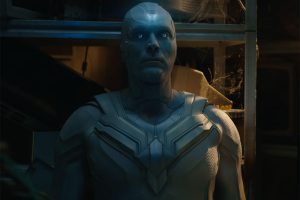
You directed three shorts featuring Darth Vader. Can you tell us about those projects?
The first FPS Vader (or Vader Strikes) came out of an interaction I had at stunt practice in 2012. Again, I had just finished Death Grip, and I was eager to try something fun and fast-paced. Our stunt practices had gotten pretty small, with most of the older members getting hitched, having kids, working on their careers.
However, there were some new folks coming in, and one of them, Alain Bloch, was a Star Wars lightsaber pro who had costumes and light-up sabers, and he brought a tall fellow who regularly cosplayed as Vader.
At that time, the GoPro 3 camera had ironed out the kinks of the old models and it was super easy to shoot first-person videos with it. I asked the guys to get the costumes and sabers together for a first-person lightsaber fight, and I went and bought a GoPro.
We shot it in the dark hallway of the stunt gym in about an hour, put it on my YouTube channel, and that thing went viral. My subscribers shot up from 1,000 to 10,000 in one week. I made the mistake then of releasing misc. practice fights on the channel, which none of these new subscribers wanted. They just wanted Star Wars stuff.
So, Alain and I ponied up $500, rented a night club, and shot Vader Strikes 2 and 3 as a three-way battle. They were far better than the original, but after releasing them the algorithm didn’t seem to approve and they got barely a fraction of the attention of the first one.
On the one hand I missed a tiny window of opportunity and probably could have made a career doing Star Wars fan films, but on the other hand I had no interest in doing that, and I think the algorithm picked up on that. That was my first lesson in social media: be careful when playing to the algorithm.
You worked on Mortal Kombat 1 as a fight choreographer. How is that process different from working on films?
I had worked with Marty Stoltz, the cinematics director, on Mortal Kombat 11 and developed a good rapport with him. He had worked with George Romero back in the day and was all about super-violent action and wanted to get away from the shape-y action of the earlier titles. So, I think he trusted me enough to let me motion capture and choreograph chapters 5–12 at my SuperAlloy studio in Vegas.
Choreographing for Mortal Kombat 1 was actually very similar to working on films. I was able to cast the other stunt performers and had a lot of control over the action design, and we even had a live camera operator as though we were shooting a movie.
We would stream both the motion capture skeletons and the live video over a conference call, and Marty would direct from Chicago. The main constraints we had were environmental and costuming, but even then I could request to move a column around.
I’d always start by asking, “What’s the story of this scene and how long is it?” and Marty would give a beat-by-beat breakdown with a time length. Next, I’d figure out the canvas: “Where is it located? What geography can we interact with? What can’t we interact with? What are the characters wearing? Can we grab the clothing? Can I use this prop that he’s wearing? Can I use that prop in the environment? Can we cut a limb off? Can we kill this guy?” I’d figure out all these limitations.
Then, we’d discuss a general camera flow for the scene, how Marty imagined it, how I could execute it, where we’d have to cut, how we’d move the camera around, etc. Finally, we’d block out the story with the cast, fill in the beats with phrases of movement, shoot a test, review, rework, and then shoot the final. We could burn through a lot of action in a single day this way.
For example, I recall Dennis Ruel and I finished the Scorp vs. Sub-Zero fight in about two hours, from conception to finish. I loved every minute of working on this game. It was a dream come true.
Which video game project has been the most challenging for you?
God of War was by far the hardest because the character, Kratos, had very specific posing requirements. Bruno Velazquez directed me a lot in that one, and he has an eye for shapes. If my arms were off by 5 degrees, we had to retake. It was crazy. I’ve seen great stunt performers crack under that kind of pressure, but I took every day as an eight-hour physical and mental workout.
I came away learning a style of movement that is extremely technical, but it’s been the most useful way of movement I’ve ever learned. It might as well be its own martial art. When I lean on this style, I can deliver 150%, and the only thing I have to do is tone it down.
I actually had to do that quite often on God of War Ragnarok. We did most of that gameplay at SuperAlloy, and there were days when I was doing 6–10 different characters, and the director would often have to remind me not to move like Kratos. It takes me a few minutes to downscale from Kratos, but it took me two years to upscale to him.
What are your three favorite martial arts films of all time?
Drunken Master 2, both because of the film itself and the lore. You just can’t go wrong with two titans, Jackie Chan and Lau Ka-leung (“Pops”), collaborating on one film. And yet it did go wrong. There was a huge controversy over the drunken style. Pops wanted to make it a bait-n-switch style, but Jackie wanted Fei Hung to actually get drunk. Mark Houghton talks all about this in my Action Talks podcast #12. Every fight is bliss in this film, and I have a feeling it’s because the on-set tension was so high.
Prodigal Son, not only because it’s the best Wing Chun film ever made, but it’s one of the greatest underdog stories. For me, it solidified Yuen Biao as the greatest action star ever.
The Matrix, which changed the entire action industry. This film was proof that the international audience loves the Hong Kong style, and I’ve been an ardent proponent ever since.
What are your two favorite fight scenes in film history?
Wheels on Meals, Jackie vs. Benny “The Jet” Urquidez, because it’s technically perfect, and the story is so good. I feel like Jackie had a big say in how this fight developed, since his character learns to relax and have some fun. It feels like the perfect transition from the 70s to the 80s.
I say Yuen Biao is my favorite action star, but I had to admit Jackie Chan proved here that he was the best. He could move like Bruce, and he could make us drop our guard and laugh. It’s just perfect. What’s strange is there’s no such character arc in their rematch in Dragons Forever, which plays much more like a straight 80s film.
Pedicab Driver, Sammo vs. Billy Chow, because it’s a cinematic marvel. The location is actually amazing, but Sammo never wastes time showing a wide just to establish geography. He just knew his stuff. There is also some blistering rapid-fire editing in this fight that makes Bourne seem tame, but Sammo could compose a shot perfectly, and he could edit in his head, so he’s the ultimate montage filmmaker.
There are also some amazing character moments, like Chow with the toothpick. I get the feeling that, whenever Sammo choreographed himself, he just wanted to beat the enemy with his own medicine. This time he wins right at the end when he bicycle kicks Chow in the face while he’s flicking that toothpick in his mouth. And it’s a real contact hit that would blacklist you from getting any GL insurance in the future in today’s world.
Which three recent action movies would you recommend watching?
Hardcore Henry. If you can stand the first-person shaky camera, this is an amazing and fun look at how Russians see violence. I never get tired of this movie.
Day Shift. I love how JJ Perry just wanted to make a fun action film, and he just went for it. I just love him for that. Plus it’s so awesome seeing practical contortion used in a fun way.
Dragged Across Concrete. This one hit me hard because it’s a smart action film that’s violent and dangerous at the same time. The market is filled with lots of “creative murder” action films – we’ve started branding them as Chan-X – but not many of them are dangerous or smart. They’re a kind of Deadly Theater where every violent gag is recycled or one-upped from the previous violent film or gag. Dragged left me invigorated because it didn’t revel in this. It put story before violence.
Disclaimer: The images and videos used in this interview are sourced from other sources and are used for informational and editorial purposes only. All images remain the property of their respective copyright holders.
The post Eric Jacobus Interview appeared first on Budomate Magazine.