By
By 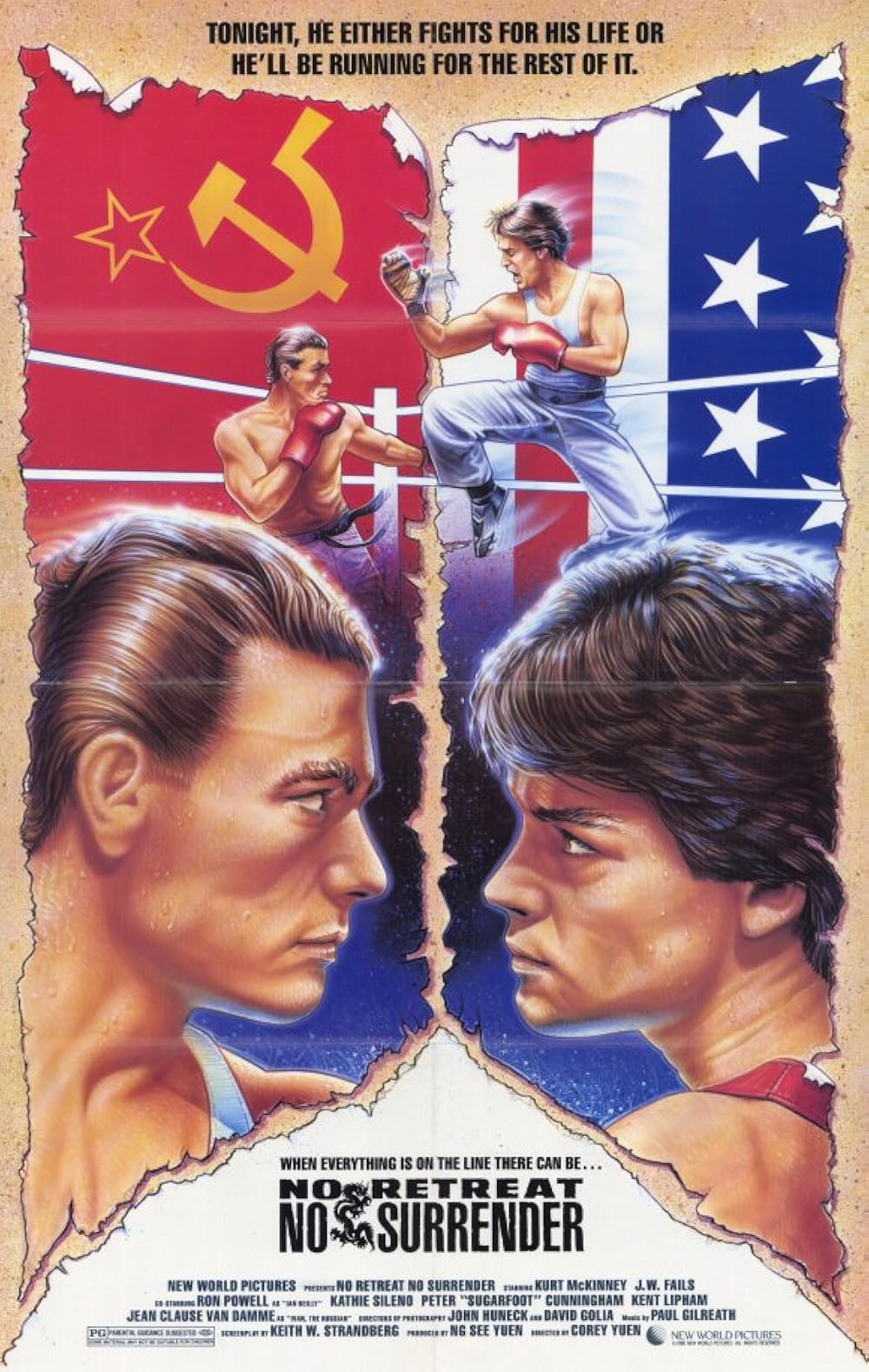
The 80s rabbit hole I have completely disappeared down, revisiting some of the most notable VHS hires of my youth, has turned up some real gems. It has also turned up some real stinkers. There are also films like No Retreat, No Surrender. They defy explanation. They feel less like something deliberately made and more like something that simply happened.
This movie feels as if a group of writers collided in a room full of karate mats and punchbags, VHS copies of The Karate Kid, a dash of Rocky IV, and a Ouija board. Then, two months later, this thing emerged, blinking into the light, asking for a theatrical release.
You don’t so much watch No Retreat, No Surrender as you gradually come to terms with it.
No Retreat, No Surrender
As is usual with this type of movie, the origin story behind the film is as entertaining than the film itself. In the wake of The Karate Kid becoming a cultural juggernaut, the industry did what it always does when lightning strikes: it tried to bottle the thunder, the clouds, and the general concept of weather.
An international co-production between Hong Kong’s Seasonal Film Corporation and the American company Balcor Films, the story involves Keith W. Sandberg, an American living in Taiwan. He became interested in working in martial arts films as an actor. He moved back to the United States and became a tour director in China, from where he continued to visit Hong Kong to make contact with producers and screenwriters.
After being turned down by several studios, including Shaw Brothers, Strandberg read about Seasonal Film Corporation and got in contact with the studio head, Ng See-yuen. Ng expressed an interest in making an American film and asked if Strandberg knew anything about screenplays; Strandberg lied that he did.
Then, The Karate Kid became a massive hit, and everybody wanted something. Ng contacted Strandberg in America and demanded a script. So, No Retreat, No Surrender was born.
So along comes this film, which clearly studied The Karate Kid very carefully, then misunderstood it at a molecular level. Where that film had restraint, this one has panic. Where it had character, this has a collection of moving parts that occasionally shout at each other.
Somewhere along the line, in a moment of truly baffling creative confidence, someone decided:
“We can improve this formula by introducing the ghost of Bruce Lee.”
Not metaphorically. Not as inspiration. As an actual, literal ghost. While that decision alone tells you everything you need to know about the mental state of this production, it was also the birth of VHS rental legend.
Bruce Lee, But Not Bruce Lee
The spectral mentor in question is portrayed by Kim Tai-chung, who is tasked with embodying one of the most recognizable human beings to have ever existed, despite bearing approximately zero resemblance to him. Which is weird, because Kim Tai-chung was a South Korean taekwondo expert who made his career in “Bruceploitation” films ostensibly due to his resemblance to the late actor. Most notably, he doubled Lee in the 1978 version of Game of Death and playing his character’s brother in Game of Death II. One can only imagine this is some kind of complex South Korean joke.
As Kim didn’t speak any English, he recited all his lines phonetically, later having his voice dubbed by another actor, which fits the whole vibe of No Retreat, No Surrender kinda perfectly and actually adds to the illusion.
However, it’s not just that he doesn’t look like Bruce Lee. It’s that the film behaves as though this is a minor technicality no one will notice. The camera lingers. The lighting glows. The music swells. The movie commits so hard to the illusion that you start to wonder if you’re the one who’s wrong. Maybe Bruce Lee always looked like this? Maybe history has been lying to us?
All of this is woven together through a plot that, at times, feels like several movies arguing with each other. Trying to summarize the story is a bit like trying to explain a dream you had after eating cheese.
Jason Stillwell, played by Kurt McKinney, is a teenager obsessed with Bruce Lee and martial arts. He helps run a dojo with his father. So far, so grounded.
Then the mafia arrives. Not metaphorically. Not as a vague threat. Actual, organized crime figures who have decided that the future of their empire lies in aggressively acquiring suburban karate schools. Their business model appears to be: show up, intimidate people, and, if necessary, unleash a European martial arts assassin. Because when you think “organized crime expansion,” you naturally think “regional dojo consolidation strategy.”
It’s never explained why this is profitable, sustainable, or even vaguely sensible. It just is.
The film treats it with the same seriousness one might apply to a hostile corporate takeover, except the assets in question are children in white uniforms practicing sidekicks. When Jason’s father refuses to join this karate cartel, things escalate, leading to relocation, bullying, and eventually a tournament – because of course there’s a tournament. Not because it makes sense, but because the genre demands it like a ritual sacrifice.
During all this, Jean-Claude Van Damme arrives from another dimension as “The Russian”. He doesn’t so much enter the movie, as intrude upon it twice. Van Damme’s performance is fascinating because the acting of all involved is truly terrible.
Whereas Van Damme barely says a word, as the character demands almost no dialogue. So he is focused on movement, presence, and controlled menace. As a result, every time he’s on screen, the film briefly snaps into focus. His kicks are sharp, deliberate, and convincing. You believe this man could dismantle everyone else in the movie without breaking a sweat, which raises an uncomfortable question:
Why is he in this movie?
It’s like finding a professional concert pianist accidentally booked to perform at a children’s birthday party. Impressive, yes, but also deeply confusing. Imagine, for a moment, a movie where JCVD is the single best thing in it? Now I feel quite queasy.
The performances of others have a peculiar quality, as though the cast collectively agreed that emotional authenticity was more of a guideline than a requirement.
Kurt McKinney delivers his lines with unwavering sincerity, which might have worked if those lines didn’t sound like they were assembled from spare parts. His emotional range tends to hover between “mild concern” and “slightly louder concern.”
Scenes that should carry weight instead drift by with a kind of polite indifference. Arguments lack tension. Triumphs lack impact. Even moments of supposed heartbreak feel like everyone involved is aware that lunch is coming up soon. It’s not that anyone is trying to be bad. Quite the opposite. There’s an earnestness here that almost makes it worse. You can see the effort. You can feel the intention. It just never quite connects.
The Coherent Language Of Kicking
The antagonists at Jason’s new school are less characters and more configurations. There’s the large, perpetually sneering fat bully, whose entire existence revolves around making Jason’s life difficult in ways that feel both excessive and oddly specific. He doesn’t just bully, he commits to it with the focus of someone pursuing a long-term career goal.
His associates are similarly committed, forming a loose coalition of haircuts, attitudes, and inexplicable wardrobe choices. They behave less like teenagers and more like a committee tasked with embodying “hostility” in its most generalized form. Their dialogue sounds like it was generated by feeding 80s slang into a machine and shaking it until words fell out. And yet, there’s a strange consistency to them. They exist in their own fully realized ecosystem of bad behavior, untouched by nuance or self-awareness.
For all its narrative confusion, the film understands one thing: how to stage a fight.
When people start hitting each other, everything else fades away. The awkward dialogue, the strange pacing, the existential question of why the mafia is involved. For a few moments, No Retreat, No Surrender communicates clearly. A lot of this is down to the production manager, producer, and director Corey Yuen. Yes, that Corey Yuen.
Jason gets “trained” via a series of ghostly beatdowns and philosophical nudges that sound like fortune cookies translated through three different languages and then dropped down a staircase. It’s less “wise mentor guiding a student” and more “ethereal figure aggressively workshopping a concept” but it works because the movie completely commits.
The choreography isn’t groundbreaking, but it’s clean and purposeful. Movements have intent. Impacts have rhythm. There’s a sense that, at the very least, the physical side of the production was handled by people who knew what they were doing. Van Damme, naturally, elevates every scene he’s in. But even outside of his presence, the fights are competent enough to keep you engaged.
It’s as if the movie only becomes fluent when it stops talking.
By the time the film reaches its climactic tournament, it has abandoned any pretense of logic. The event itself feels less like a sporting competition and more like a loosely organized gathering of people who have agreed to settle their differences through choreography. The stakes are vaguely defined. The rules are… aspirational.
Jason, now armed with spectral training and a renewed sense of purpose, enters the fray. What follows is a sequence of fights that oscillate between engaging and completely unhinged.
The final confrontation with Van Damme is the highlight, not because of the story, but because it’s the one moment where the film’s physical and narrative elements briefly align. You have a believable threat and a protagonist who, through sheer narrative necessity, must overcome it. How he does so is less important than the fact that the film insists he can.
There’s no separating No Retreat, No Surrender from the decade that produced it.
Everything from the music cues to the wardrobe to the general vibe, feels locked into the mid-80s with absolute certainty. Not in a nostalgic way, but in a “this could not exist outside this narrow temporal window” way.
The soundtrack leans heavily into synthetic enthusiasm. The fashion choices suggest a world where subtlety was briefly outlawed. Even the pacing reflects an era where lingering shots and abrupt transitions were considered perfectly acceptable storytelling tools. It doesn’t just belong to the 80s, it’s fully saturated by them.
The final result may be something that feels like the cinematic equivalent of building a house around a perfectly functional staircase, but you cannot deny that the staircase is truly functional.
The result is a movie that is a misfire, but that cannot be ignored. No Retreat, No Surrender isn’t a hidden gem. It isn’t misunderstood. It isn’t secretly brilliant. It is, however, memorable in a way that more competent films often aren’t.
There’s something undeniably compelling about a movie that commits this fully to such a strange combination of ideas. Mafia-driven dojo politics. Supernatural martial arts mentorship. A future action star silently dismantling everyone in sight. It shouldn’t work. It doesn’t work. And yet it lingers.
You don’t walk away impressed. You walk away slightly bewildered, mildly entertained, and very aware that you’ve just watched something that could only have been made under very specific circumstances by very determined people.
And when No Retreat, No Surrender is over, you’re left with a single, unavoidable conclusion – Someone, somewhere, thought this was a completely reasonable idea.
The post Retro Review: NO RETREAT, NO SURRENDER (1985) appeared first on Last Movie Outpost.