By
By 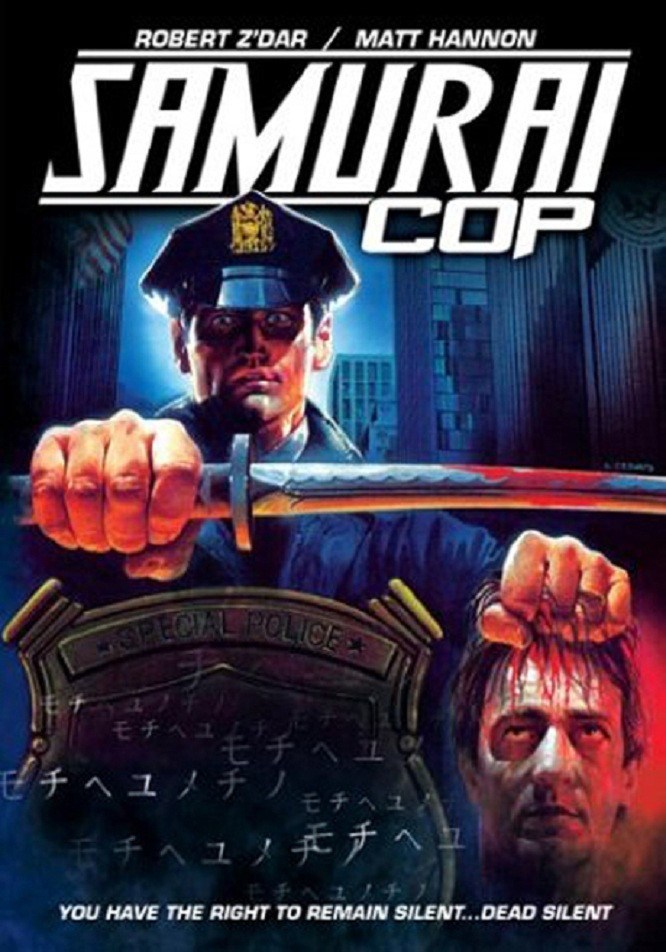
There are bad movies. There are so bad they’re good movies. And then some movies pass straight through so bad they’re good that they end up right back at bad again. Truly awful movies.
However, even then, there is something to be taken from them. Not on an entertainment axis, but on an axis of pure comedy. Samurai Cop is one of those movies.
It is a film that sprints past all other attempts at categorization, trips over its own untied shoelaces, smashes face-first into the brick wall of ineptitude, and somehow tries to convince you it was intentional.
Samurai Cop not merely a bad film. This is a monument to failure. A cathedral of cinematic wrongness. A fever dream assembled by people who appear to have only heard movies described in hushed tones by others and then decided to make one, without ever watching one.
It does not earn your affection like a cult classic, instead it demands your attention in the same way a horrific car wreck at the roadside does. You absolutely cannot look away, even as you are repulsed.
Samurai Cop
Trying to summarize the plot of Samurai Cop is, frankly, a waste of time, but as this is a movie review, I guess it is compulsory.
Joe Marshall is a cop. He’s also a samurai. Why? Don’t worry about it. He’s paired with a partner who looks like he had been told they were making a Police Academy sequel, and they could no longer afford Michael Winslow.
Together they’re tasked with taking down a gang of Japanese criminals led by a man named Yamashita. This would be fine, except Yamashita is played by a man who looks about as Japanese as a Chicago steakhouse menu.
Things escalate, people get shot, clothes come off for no reason, and dialogue happens that should be illegal. Seriously, there are moments in this movie that are a war crime in script form.
Every other line feels like it could have been translated from English into another language and then back again by one of those online translators. Examples:
“What does katana mean?”
“It means Japanese sword.”
This is not a joke. This is a real exchange. Two grown adults. In a film. Written by another adult.
“I’m going to kill you.”
“You’re going to die.”
Then the all-time classic:
“I feel like someone’s stuck a big club up my ass. And it hurts. I gotta figure out a way to get it outta there.”
The script operates on the principle that if you say something obvious enough, it becomes profound. It does not. There are entire conversations where characters just repeat information at each other like malfunctioning robots. At one point, it genuinely feels like the actors are hearing the lines for the first time as they say them. Because they probably are.
Face Acting
Matt Hannon, playing lead Joe Marshall, is less an actor and more a collection of facial expressions loosely strung together by big hair and blind confidence. And what expressions! He smirks. He squints. He stares into the middle distance like he’s trying to remember where he parked his car. Sometimes he appears to forget he’s in a scene entirely.
It’s like watching someone try to act by remembering what acting was from the drama class they took 15 years ago.
Mark Frazer is his partner, Frank Washington. There are moments where Frazer just… pulls faces. No dialogue. No motivation. Just faces.
And then we have Robert Z’Dar. This man’s famous jawline could be used as a defensive structure. Whatever you could say about this, you would struggle to say he looks Japanese, but his character is called Yamashita.
Yes. Really.
There is no attempt to explain this. No effort to justify it. He’s just… there. Delivering lines with all the subtlety of a cinder block falling down a staircase. And yet, he is somehow the most committed person in the film.
With that jaw, Z’Dar was always going to chew the scenery and asks for seconds. He does it while seemingly operating on a different frequency to everyone else, and nobody thought to point this out to anyone. It is baffling. It is utterly, gloriously wrong.
Occasionally, these actors are required to exist in action sequences and it is here that Samurai Cop is… aspirational. Fights consist of people nudging each other and then reacting as if they’ve been hit by a truck. Gunfights involve a lot of standing around, pointing weapons vaguely in the right direction, and hoping for the best.
At one point, a character is clearly waiting for their cue to fall over. You can see it happening. The anticipation. The hesitation. The eventual, deeply unconvincing collapse.
It’s less “action choreography” and more “group improv with fake firearms.” This culminates in the infamous hospital shootout, a scene so incompetently staged it feels like a parody of bad filmmaking. The positioning. The timing. The complete lack of spatial awareness. It’s like everyone involved was given different instructions and decided not to compare notes.
If the action is bad, the romantic scenes are… catastrophic. There are multiple seduction sequences in this film, and every single one plays like a hostage situation.
Joe Marshall has the sexual charisma of a damp sponge, yet women throw themselves at him with alarming frequency. Conversations escalate to intimacy with the speed and logic of a glitching video game.
One minute, they’re talking. The next minute, they’re in bed. No transition. No chemistry. Just a hard cut to awkwardness. The dialogue during these scenes is particularly painful, filled with lines that sound like they were generated by an AI trained exclusively on bad 80s pickup lines.
All of the dialogue is excruciating.
Just when things couldn’t seem to get any funnier, for some reason, Matt Hannon apparently cut his hair. This would normally be a minor inconvenience. Instead of reshooting scenes or adjusting the script, the filmmakers decided to slap a wig on him and hope no one would notice.
Everyone noticed. The wig is… something. It doesn’t sit properly. It changes between shots. Sometimes it looks like it’s trying to escape. There are scenes where the lighting makes it painfully obvious that this is not his real hair. It’s like watching a low-budget stage play where the props are actively rebelling. The wig is not just bad. It’s distracting. It becomes the focal point of entire scenes.
You stop listening to the dialogue. You stop following the plot. You just stare at the wig, wondering how it came to be.
A Perfect Storm of Bad Decisions
The making of Samurai Cop is as expected. Directed by Amir Shervan, the movie was produced under conditions that can only be described as “optimistically chaotic.” There were language barriers, budget constraints, and what appears to be a fundamental misunderstanding of how movies work.
Scenes were shot without proper planning. Dialogue was often dubbed later, leading to mismatched audio that makes it sound like characters are speaking from another dimension. The production design ranges from “barely adequate” to “did they forget to finish this set?”
Continuity is nonexistent. Characters change clothes between shots. Props appear and disappear. Time and space cease to have meaning.
It’s less a film and more an accidental experiment in how many things can go wrong at once.
Over the years, Samurai Cop has gained a reputation as one of the worst films ever made. And not in a vague, throwaway sense. In a competitive sense.
It regularly appears on lists of cinematic disasters, often mentioned alongside other notorious trainwrecks. Critics have described it as “astonishingly incompetent,” “unintentionally hilarious,” and “a masterclass in how not to make a movie.”
Audiences, however, have embraced it — not because it’s good, but because it’s so spectacularly bad.
It’s the kind of film you watch with friends, pausing every few minutes to ask, “Did that just happen?” Because it did. It absolutely did. What makes Samurai Cop so fascinating is how it transcends normal badness. Most bad films are simply boring. They fail quietly. This one fails loudly. Enthusiastically. With added jazz hands.
Every scene contains something worth laughing at – a line delivery, a weird edit, a baffling choice – so it’s a constant stream of unintentional comedy. This is why it doesn’t settle at so bad it’s good. It overshoots.
There are moments where the incompetence becomes exhausting. Where the joke wears thin. Where you start to feel the weight of its failures. And then something new happens. Something even worse. Something even funnier. And you’re pulled right back in.
So I guess you could call it a Cringe Classic?
You can study this film. Watch the body language. The timing. The complete lack of convincing human interactions. You could argue that it’s actually made by aliens attempting to recreate a real human conversation they once read about, light-years away.
So Samurai Cop becomes something rare. A perfect storm of incompetence. A cinematic anomaly. A film that manages to be terrible in ways you didn’t know were possible.
It is frustrating. It is baffling. It is often painful to watch. And yet it is unforgettable.
Get your mates over and get the beers in, because suffering loves company, and let it play. You will laugh. You will cringe. You will question reality. When it’s over, you will sit there in silence, trying to process what you’ve just experienced.
Good luck. You’re going to need it.
The post Retro Review: SAMURAI COP (1991) appeared first on Last Movie Outpost.