By
By 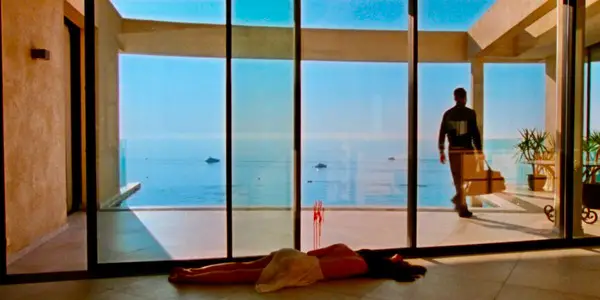
The films of Hélène Cattet and Bruno Forzani are edited like they are trying to fight against the rhythm of the narrative. They take the Godardian jump-cut to its absolute limit and exploit the hell out of Dede Allen’s cross-cutting object-subject associations. When you watch their movies you are quite literally as a viewer forced to take cinema as a form-driven experience, where the crashing sounds and hyper-kinetic juxtaposition of imagery is often the substitute of spoken language.
For this reason, their films tend to work really well as genre pastiches. Much like Pulp Fiction which created a film out of imitating loose parts and scenes of other films, Cattet and Forzani’s movies use pop reference and image-sound associations to hint at the genre(s) they are aping. Their latest is a romp on the pulpy and amusing Euro-Spy cinema of the 1970s. But there are tendencies to draw back to their fascinations with giallo horror and spaghetti westerns as well.
source: Shudder
Can’t Escape Who You Are
An old retired spy named John Diman (Fabio Testi) sips cocktails in Cote d’Azur (also known as the French Riviera) in South France. He thinks his days of espionage and gunfights and chases are over but while in his hotel room he begins to hear familiar voices that take him back in time to when he was a debonair James Bond type. His past comes back to haunt him slowly and he sees his present blend with women and villains from his old days. This seems like the premise of a fantastic plot, but Cattet and Forzani have no intentions of following linear structure or creating some kind of spell-it-all-out thriller. Their cinema is one of impulse, so what we get is an assault of images of poker games, knives, car chases, fire, the turquoise sea, white suits, comic books, and blinding-white diamonds all overlapping and fighting with each other for attention.
A Chaos of Ingredients
The voice Diman hears is of a woman next door, who disappears. Cattet and Forzani aren’t interested in creating some kind of plot that makes sense, instead we get threads of Diman’s acquaintances of the past, one an assassin who comes back for revenge. They fill the frames with kaleidoscopic action sequences that prioritize the symbolic ingredients of an action sequence rather than the cohesive whole. This can seem grating to some viewers, but those preordained (like myself) to the duo’s zany and elliptical style, this is a daring and fun approach. After a poker game, Diman has a shootout and chase with another player at the table. We get visuals of cards flying, poker chips dancing, a bullet firing off, and various hypnotic patterns of casino carpets, lights, numbers, and balls. So much of the deconstruction of convention allows for the movie to have its own unique pace and language and accentuates the impact of the stuff we love from spy/thrillers.
source: Shudder
Conclusion
Reflection in a Dead Diamond is a wild sensory ride that ramps up the cool and stylish elements of the action genre over the actual action. Much like the duo’s previous two films, it is a style of its own and takes self-reflexive pastiche to the ultimate lengths.
Reflection in a Dead Diamond released on Shudder on December 7th, 2025
Does content like this matter to you?
Become a Member and support film journalism. Unlock access to all of Film Inquiry`s great articles. Join a community of like-minded readers who are passionate about cinema – get access to our private members Network, give back to independent filmmakers, and more.