By
By 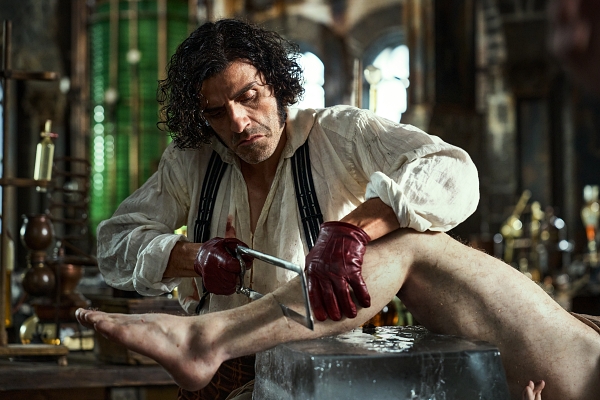
Guillermo del Toro seemed destined to tackle Frankenstein eventually. The fact that he finally got around to it feels less like a surprise than a gothic inevitability, summoned with clear adoration for the source material and a meticulous eye for detail. His entire career has circled the idea of misunderstood monsters and the nobility buried within those abandoned to the fringes. But after decades spent riffing on creation myths and weaving stories of the macabre and supernatural, his version of Frankenstein, for all its sumptuous production and undeniable cinematic majesty, feels a bit, well, Frankensteined together.
Adapting broadly from Mary Shelley’s 1818 gothic novel, James Whale’s 1931 classic horror film, and even cribbing some aesthetic inspiration from the 1950s Peter Cushing Hammer films, del Toro’s take on Frankenstein continues his knack for melodrama amidst the macabre. Oscar Isaac is Victor Frankenstein, a mainstay in literary and cinematic fiction, treated this time around to a full-throated origin story. We meet Victor as the child of a stern physician and watchful lord, played with the hard-nosed severity we’ve come to so closely associate with Charles Dance. Young Victor would rather spend his days gallivanting with his doting mother than closely studying the biology that his father forces upon him, punishing him with beatings when he gets questions about anatomy incorrectly, but his days of gayety are limited. When his beloved mother dies during childbirth, delivering his younger brother William, Victor is left with a singular obsession: to cure death. Or: to best God.
We move forward in time, where an adult Victor entreats the scientific community with his discoveries, mainly re-animating the cobbled-together corpses of the previously dead with some choice volts of electricity. His colleagues are shocked and appalled, convinced he’s up to no more than parlor tricks or pure devilry, and cast him out of their esteemed organizations. But a mysterious benefactor, Henrich Harlander (Christoph Waltz), who has ties to Victor’s now-grown younger brother (Felix Kammerer), offers to fund his experiments with bottomless pockets and a lab tower primed for scientific theatrics and electrification. You probably know the rest of the story.
Drunk with hubris, Victor creates life in the form of a thatched together undead creature, played with gentle sensitivity by Jacob Elordi. Elordi breathes humanity into Frankenstein’s creation, itself an intriguing spin on the iconic monster with a stitched up neck and protruding bolts. The creature’s puppy dog devotion to his master is met almost immediately with cruelty, punished for not understanding quickly enough and despised for his obsessive affection for Victor. And from that blooms the central idea of Del Toro’s Frankenstein, his thesis on how abuse is the most deformative power a parent can wield. Victor’s monstrosity — his lack of empathy, his impatience, his constant frustration, and his acts of captivity and physical violence — is what begets the monster. All fathers play God, some more benevolently than others. Victor chooses the opposite. He gives life to his creation in a biological sense but denies him the very foundation required to truly live.
That sweet, life-sustaining nectar is instead provided by another: Victor’s brother’s fiancée Elizabeth (Mia Goth). She is one of the few characters in the film who sees the creature and doesn’t respond with revulsion or violence. She’s tender, caring, and gentle. And he responds in kind. Goth imbues Elizabeth with an otherworldly sense of calm and grace. She’s devout and deeply human and this is what draws not just the creature but Frankenstein himself to her. And yet she remains somehow just as out of place in this world as the creature she grows to care for. Their relationship, though full of promise, ultimately feels underdeveloped and largely underdelivers.
The story is told in a fragmented structure, splitting time between Victor’s telling of events and the creature’s, and bookending the film with an Antarctic expedition sequence that feels ripped from Shackleton’s journals. As a framing device, this mutual recounting doesn’t quite land, especially for a film that stretches well into two and a half hours. The pacing proves uneven throughout. Certain parts of the story linger on with near-operatic patience, while others, such as the creature learning to speak, read, or understand his evolving relationship to Victor, feel hurried, unearned even. The creature’s bouts of rage are justified, and we’re shown in gnarly, visceral detail why he comes to hate his creator and mankind itself. But the emotional evolution of that hatred feels jagged, and the place the film ultimately leaves the two of them lacks cohesion.
Del Toro can be overwrought and sentimental, and while that blend of melancholy and the macabre has worked wonders in films like Crimson Peak and The Shape of Water, it doesn’t always serve him here. There are moments that feel genuinely earned, but overall the film’s emotional impact lands a bit muted. Elordi does everything he can, internalizing the creature’s awakening, his reckoning with violence, and the slow, aching realization that life inevitably leads to death. But not for him. Still, even with Elordi’s remarkable performance, the film doesn’t always reach the emotional heights it seems to be striving for.
Visually, though, Frankenstein is breathtaking. From the elegant costumes to the immaculate set design and on-location grandeur, from vast manor interiors to windswept, barren tundras, every frame is composed with painterly care. Few directors can match Del Toro’s attention to detail. This is a production design showcase from start to finish.
The performances across the board strong; Oscar Isaac makes for a compelling Frankenstein, a volatile mix of megalomania, obsession, and intellect unmoored; Mia Goth brings a haunted tenderness to Elizabeth; Christoph Waltz, while not especially memorable here, remains a welcome presence. But it’s Elordi who steals the film. He channels a raw, haunted sadness that feels miles removed from the confident charm or blunt anger of his earlier work. It’s a performance of restraint and physicality, much of it wordless, carried in his eyes and posture. He also taps into the creature’s physical power and explosiveness. As a victim of abuse, the creature moves through the world unsure of how to react, having learned that it punishes confusion with violence and shame. Elordi plays him as someone who wavers between tenderness and rage, monstrous one moment and achingly human the next.
[READ MORE: Our review of ‘Crimson Peak‘ directed by Guillermo del Toro and starring Mia Wasikowska]
And yet, for all its craft and care, Frankenstein feels curiously lifeless in spots. Perhaps Del Toro is so reverent of the source material that he holds back, hesitant to inject too much of himself and his own authorship into it. The result is a film that is obviously inspired, and at times awe-inspiring, but not often inspiring. Del Toro’s vision is too sumptuous and too well-realized to dismiss, but it lacks that elusive spark that transforms a retold classic into something urgent, personal, and alive. In missing that, it also misses the very thing it’s trying so hard to revive: life undying.
CONCLUSION: A gorgeous retelling of a classic tale about the monsters that dwell within us, Del Toro’s take on Frankenstein features a standout turn from Jacob Elordi but remains a middle of the pack effort from the beloved Gothic storyteller. Much like the creature in this story, desperately wanting to understand why it is here, the film lacks its own sense of purpose.
B
For other reviews, interviews, and featured articles, be sure to:
Follow Silver Screen Riot on Letterboxd
Follow Silver Screen Riot on Facebook
Follow Silver Screen Riot on Twitter
Follow Silver Screen Riot on BlueSky
Follow Silver Screen Riot on Substack
The post Del Toro’s ‘FRANKENSTEIN’ a Sumptuous Parable of Abusive Fathers appeared first on Silver Screen Riot.