By
By 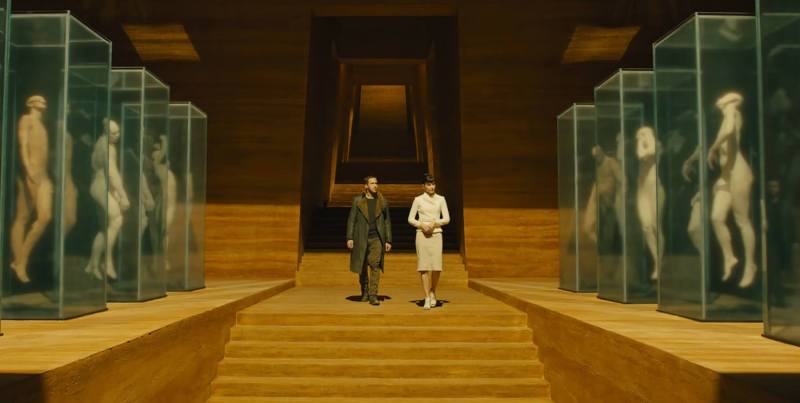
Roughly 8 years after writing my review of Blade Runner 2049, I chose to revisit the film. Upon my second viewing, I was repeatedly struck by how a seemingly straightforward narrative — K, a replicant blade runner, tasked with hunting his own kind — expands into a rigorous meditation on personhood, recognition, and meaning.
Beneath the genre scaffolding of control, obedience, and survival, the film stages a philosophical inquiry: what counts as a self in a world prepared to deny your reality? On subsequent viewings — made easier by the accessibility of streaming services — I found myself reading K’s arc as the drama of a consciousness negotiating imposed scripts and self-authored possibility.
He is told he is property, engineered for compliance; yet he longs for autonomy, memory, and belonging. The question is not simply whether he “has” these things, but whether the social order will recognize them — and whether he himself can sustain them in the absence of recognition.
What Does It Mean to Truly Exist?
Stepping away from the narrative from a moment, we (me as writer and you as reader) are now connected through the internet, thanks to your internet service provider, and the boundaries between human and machine feel a little bit thinner, though we can still mark the distinction between the two. In K’s universe, however, the familiar Cartesian starting point — cogito, ergo sum — appears deceptively simple.
K thinks, doubts, deliberates, and feels; by Descartes’s measure, those acts establish his existence as a thinking thing. Yet the film complicates the inference from thinking to worth. The social world withholds moral status, treating K’s subjectivity as instrumental. Here, the problem shifts from metaphysical assurance (“Am I real?”) to ethical acknowledgment (“Will my reality be honored?”). I am reminded that existence, in lived terms, is as much a relational status as an introspective fact.
The film also tests Locke’s “memory criterion” of personal identity. For Locke, continuity of consciousness — especially memory — binds the self across time. K’s implanted memories scramble that criterion: if a memory can be manufactured yet still structure my dispositions, attachments, and moral commitments, does its origin invalidate the identity it sustains?
Blade Runner 2049 suggests not. What matters, the film intimates, is not provenance but integration — how remembered (or implanted) episodes are taken up into a coherent narrative that guides action. The authenticity of experience is measured by its normative force in a life, not merely by its causal history.
Can the Artificial Hold a Soul?
Blade Runner 2049 (2017)
The film’s most unsettling achievement is to displace a binary — human versus machine — with a spectrum of mindedness and moral considerability. In an era when artificial systems can simulate conversation, pattern recognition, and creative recombination, the old Turing-style criterion (“Can it convincingly talk?”) feels insufficient.
The film invites a richer test: Can it enter relationships of mutual address, vulnerability, and accountability? K’s bond with Joi, a holographic companion, dramatizes the paradox. Joi may be code, yet the care she expresses — and elicits — has real phenomenological effects: consolation, motivation, grief.
Skeptics will invoke Searle’s “Chinese Room”: syntax does not guarantee semantics; simulation is not understanding. The film neither resolves nor dodges this objection; instead, it relocates significance to the relational plane. If meaning is enacted between agents — through responsiveness, shared projects, and sacrifice — then the line between “as if” and “is” blurs ethically even if it remains crisp ontologically. K’s experience of attachment is not falsified by the ontology of its object; it is constituted by his practical orientation — how he lets those feelings reorganize what he values and what he risks.
A Kantian lens sharpens the stakes. Treating beings as ends in themselves requires that we see in them a capacity for lawgiving — for acting on reasons they can avow. The film shows K moving from programmed compliance to reason-responsive agency: he interrogates directives, revises priorities, and accepts costs for the sake of another. That transition signals more than clever design; it embodies the emergence of accountability. The form of a soul — if we keep the term — appears in the structure of commitment.
What We Choose to Feel Makes Us Real
If you have access to this film on streaming platforms and other traditional TV services like DISH TV, I beg you to watch it, if for no other reason than to see a potential glimpse into the future of artificial intelligence. Identity in Blade Runner 2049 is neither a mere given nor a mere fabrication; it is a normative achievement. Harry Frankfurt’s idea of second-order desires — wanting to want certain things — helps here.
K does not only experience urges; he evaluates them, endorses some, repudiates others, and builds a hierarchy of cares. That reflective endorsement is the architecture of agency. When he acts on commitments that cost him — risking safety to protect a stranger’s future — he demonstrates the asymmetry between preference and principle. The choice to let one’s feelings be answerable to reasons is where personhood thickens.
The film also insists on the politics of recognition. Axel Honneth’s thesis — that individuals require social esteem, love, and rights-recognition to flourish — maps neatly onto K’s world, which withholds each of these. Denied love, he accepts approximation; denied esteem, he internalizes stigma; denied rights, he improvises dignity.
His final gestures, quiet and unspectacular, reveal a different grammar of heroism: not triumphal self-disclosure but faithful self-disposal for the sake of others. The scene reframes “being human” away from species membership toward relational fidelity — keeping a promise, guarding a life, preserving a hope.
Finally, the film foregrounds embodiment without reducing identity to biology. Merleau-Ponty reminds us that we are body-subjects: we inhabit the world through sensorimotor schemas and affective attunement. K’s body is engineered, yet his comportment — hesitations, tenderness, pain — registers an inhabited perspective. The camera lingers on breath, weather, texture; the world resists him, and he answers back. That reciprocity — the world mattering to him and he mattering in return — marks a threshold that pure simulation struggles to cross. He does not merely process inputs; he undergoes and understands.
In the end, Blade Runner 2049 persuades me that humanity is less a biological predicate than a practice: the sustained work of binding memories (implanted or earned) into a narrative that can answer to reasons; of forming attachments that obligate; of choosing, again and again, the costly good over the convenient script. K may be built, Joi may be projected, but meaning thickens in what they do — in what they love, what they forgo, and whom they protect. Perhaps being human is not the fact of being born but the discipline of living as though another’s future is part of one’s own.
If you’d like to read more film essays like this one, check out the Philosophy in Film Homepage!
The post Blade Runner 2049 on What Makes Us Human appeared first on Philosophy in Film.