By
By 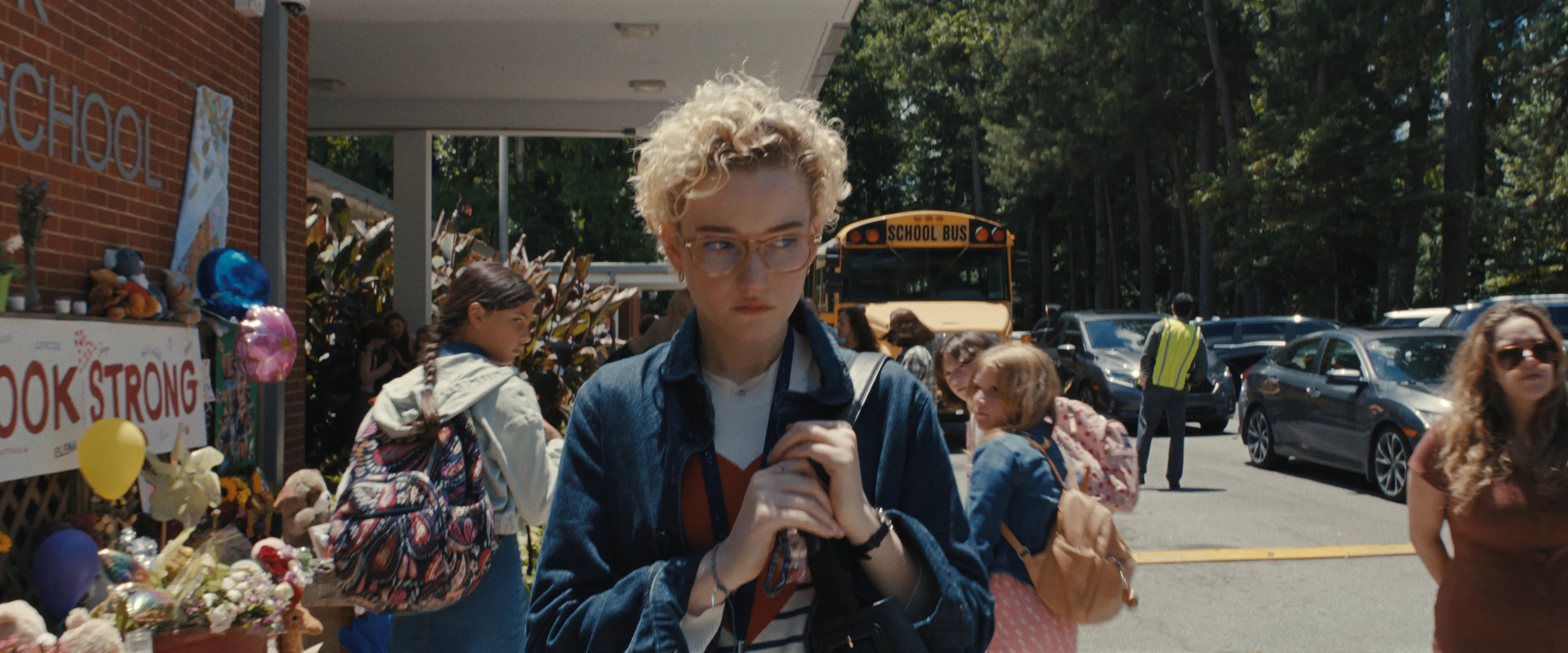
Weapons (2025)
And they never came back.
Spoiler Warning: The following review contains major plot revelations from Weapons — proceed only if you’ve seen the film or don’t mind knowing its secrets.
At exactly 2:17 a.m., seventeen elementary school children in the quiet American suburb of Maybrook rise from their beds and vanish into the night. All but one, Alex Lilly (Cary Christopher), disappear without a trace. What follows is a spiraling nightmare for everyone connected to the case — a twisting, multi-perspective horror that blends supernatural dread, small-town paranoia, and deeply human grief.
From the outset, suspicion falls squarely on the children’s third-grade teacher, Justine Gandy (Julia Garner), whose life quickly unravels under the weight of media frenzy and public hatred. Into this pressure cooker walks Archer Graff (Josh Brolin), the grizzled, grief-stricken father of one of the missing children. Archer and Justine are unlikely allies — he’s desperate for answers, she’s desperate to clear her name — yet both are drawn into the same horrifying truth.
Step one: keep your head down. Step two: realize everyone’s still staring.
Told in fractured, chapter-like sections, Weapons adopts a structure that feels more literary than cinematic, with its shifting vantage points and overlapping timelines. Director Zach Cregger, Barbarian (2022), isn’t afraid to let the film breathe in strange ways, opening with quiet domestic moments before dropping the audience into scenes of surreal terror. One chapter might follow Justine navigating the suffocating scrutiny of her neighbours; another might pull back to Archer, hunched over hours of grainy security footage, watching ghostlike figures of children vanish into the night; and yet another might linger on the eerie, dreamlike perspective of Alex — silent, withdrawn, and holding a secret he can’t put into words.
These fragmented viewpoints eventually converge on a single figure: Gladys (Amy Madigan), Alex’s apparent great-aunt. Her first full appearance comes in the office of Principal Marcus Mitter (Benedict Wong), where she arrives upon his request — claiming Alex’s parents are unwell, offering calm reassurances, and projecting the perfect image of a caring guardian. Yet something about her looks disturbingly off. Her bright orange-red wig stands in stark contrast to her pale complexion; her mouth, caked in red, looks like it was painted on. It’s a nearly clownish visage — jarring and uncanny. Coupled with the meticulous measurement of her words, the slightly too-long pauses, and the lingering gaze, the shimmer of kindness evaporates entirely.
From that moment, she is the film’s true nightmare: polite, composed, and matter-of-fact in her malice. Beneath the veneer lies a predator, using ritual magic and an ancient, gnarled tree in her home to drain the life from children, leaving them hollow-eyed and vacant. It’s a role that could have easily tipped into camp, but Madigan plays it with unnerving restraint, making every smile and every pause feel like a threat. There’s a reason the internet will be talking about Gladys long after the year’s horror releases have come and gone.
When the class clown takes it way too far.
While Weapons never leans on jump scares, it’s packed with images that lodge themselves in your mind. Children sprinting down an empty street, arms outstretched, disappearing into the night like sleepwalkers. And perhaps most unsettling: a scene where a pair of scissors quietly snip locks of hair from the back seat of a car. Nothing overtly violent happens in that moment, yet it’s almost unbearable to watch — intimate, invasive, and utterly skin-crawling.
The film’s chapter-based structure allows each segment to carry its own tone. Some sections play like straight procedural drama, following police interviews and forensic work. Others dip into surreal horror, where time feels unreliable and reality frays at the edges. Cregger uses this variation to keep the audience off-balance; you never quite know whether the next scene will be grounded in kitchen-sink realism or plunge into a waking nightmare.
That said, the film’s fractured structure comes with trade-offs. Some threads trail off without resolution, and the supernatural rules behind Gladys’s magic remain deliberately — perhaps frustratingly — opaque. The mystery is compelling, but it’s also pocked with small plot holes, often hinging on borderline incompetent detective work from the authorities. For some, these gaps will add to the film’s lingering, dreamlike power. For others, they’ll feel less like intentional ambiguity and more like frayed stitching in the narrative fabric.
A press conference meant for answers, but steeped in suspicion.
Cregger’s direction is confident and deliberate, never rushing the pace. He understands that the scariest moments are often the quietest ones, and he’s willing to let the camera linger just long enough to make you squirm. Working with cinematographer Larkin Seiple, Everything Everywhere All at Once (2022), he transforms everyday suburban spaces into places of menace. Daylight, in particular, is used to unsettling effect — scenes that should feel safe are instead imbued with a flat, washed-out quality, as though the world itself is sick. Interiors are claustrophobic, cluttered with personal detail, yet there’s always a sense of something lurking just outside the frame.
The ensemble cast is uniformly strong. Garner carries Justine’s arc with a brittle, determined energy, making her both sympathetic and quietly formidable. Brolin gives Archer a weary gravitas, grounding even the film’s most surreal turns. Cary Christopher is heartbreakingly effective as Alex, his performance hinging on silence and small gestures rather than big dramatic moments. Alden Ehrenreich, Austin Abrams, and Benedict Wong all make strong impressions in supporting roles, each inhabiting one of the film’s shifting perspectives. But it’s Amy Madigan who walks away with the movie — her Gladys is a creation destined for horror-canon status.
The music is crucial, too: an uneasy, droning tapestry credited to Ryan & Hays Holladay (with Cregger) that leans on mournful textures and nursery-rhyme dissonance. It doesn’t just underline the scares; it deepens the film’s emotional undercurrent, reminding you that at its heart, this is a story about grief, loss, and the monstrous lengths people will go to avoid facing them.
The road out of Maybrook has no return.
By the time Weapons reaches its finale — a surreal, grotesque confrontation in the glow of the gnarled tree — it’s clear that Cregger isn’t interested in providing neat answers. The ending is cathartic, violent, and deeply strange, leaving you with the sense that the horror might not be entirely gone. It’s the kind of conclusion that invites discussion, dissection, and probably more than a few late-night arguments.
Among this year’s most formidable genre offerings, Weapons rises to the front of the pack. It’s ambitious, unnerving, and surprisingly emotional, a horror film unafraid to experiment with structure while still delivering memorable scares. Yes, it’s imperfect — the plot holes are there if you go looking for them — but its combination of distinctive narrative voice, haunting imagery, and an antagonist for the ages more than earns it a place among the year’s best.
A flawed masterpiece — chilling, inventive, and utterly unforgettable.
4.5 / 5 – Highly Recommended
Reviewed by Dan Cachia (Mr. Movie)
Weapons is released through Warner Bros. Australia