By
By 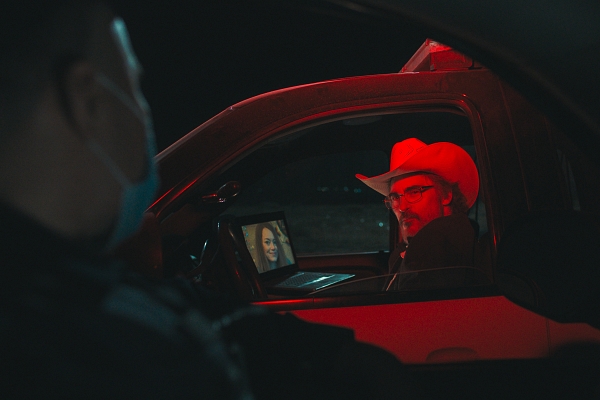
Covid denialism. Mask mandates. BLM protests. Ari Aster’s fourth feature revisits all the trials and tribulations of the 2020 pandemic, dragging us back to that fever dream while adopting a decidedly odd “both sides” stance to interrogate the existential mania of the era. The result is a film that tries to tackle a lot—most notably how partisan mainstream media, social platforms, and fringe sites funnel viewers into conspiratorial rabbit holes that deepen division and further otherize an already fraying left/right American divide—but ends up feeling more like the frazzled screed of someone who, frankly, had a really bad pandemic.
We meet Joe Cross (Joaquin Phoenix) the newly appointed sheriff in the small New Mexican town of Eddington. He opens the film in a standoff with local police from neighboring Pueblo, defiantly refusing to wear a mask despite being the one tasked with enforcing those very mandates. This segues to a bar where an “unhoused man” is mid-rant while the mayor, Ted Garcia, played by Pedro Pascal, attempts to hold a city council meeting. Aster uses this chaos to establish the ideological divides between the sheriff and the mayor and what the two city officials stand for, including what counts as essential work, who gets to enforce rules, and how far civic authority stretches in a fractured America. They both believe they are right, that they are the good guy here, though the oversights of both of their perspectives peak through early and often. This tension should define the film, but Aster eventually gets bored with his own premise and tosses it aside for something ostensibly bigger but undeniably less legible.
Spurred on by a small but vocal contingent of fellow anti-maskers (as in exactly one), Cross launches his own mayoral campaign to challenge Garcia. His wife does not approve. Each man is a barely-disguised caricature—Cross of the right, Garcia of the left—neither possessing much in the way of subtlety or depth. Cross is the kind of candidate who plasters his work truck with misspelled slogans and barely veiled dog whistles about shadowy globalist cabals. Garcia has slick, buzzword-laden campaign ads and hosts catered fundraisers soundtracked by tacky Katy Perry ballads. We expect Eddington to build on the ideological showdown between these two men but Aster ratchets up their discourse in admittedly unexpected ways instead.
[READ MORE: Our review of ‘Hereditary‘ written and directed by Ari Aster and starring Toni Collette]
In lieu of a true contest of ideologies, we get a whirlwind of subplots: rape accusations involving Cross’s mentally unraveling wife Louise (Emma Stone); conspiratorial outsiders stoking tension for their own murky agendas; an anti-trafficking cult leader played by Austin Butler; teenagers performatively protesting for romantic clout; and a parade of frame jobs, double-crosses, red herrings, and dead ends. The central message is clear: we allowed Big Tech to sew division on a level that may have fundamentally broken the decency of society. All for some likes and reposts. But this message is cluttered by plot diversions, extraneous characters, and far too many time-wasting subplots. It’s a lot. And rarely in a good way.
The pacing and editing leave a lot to be desired. It takes a full 90 minutes of its 2.5-hour runtime to try to establish what Eddington seemingly wants to even be. At first, its a Western-inspired conspiracy showdown: a red-pilled sheriff clashes with a tech-backed progressive, with the added wrinkle of a shared romantic history. Interesting on paper, but not so much in execution. This anchors the narrative, until it doesn’t, because like most threads in Eddington, it’s introduced, half-developed, then dropped without ceremony.
Hereditary and Midsommar both earned their reputations as high-water marks for the modern horror genre and are amongst the best of the century. They deserved the fact that they stretched past the two hour runtime mark. Beau is Afraid, less successful both critically and financially, was decidedly its own thing, allegedly Aster’s take on a comedy, but its lackadaisical plotting revealed a filmmaker maybe better suited to a more exacting editor and a more confined genre. With Eddington, the slop has metastasized to become the whole. It’s not just indulgent; it’s truly mystifying. A list of 2020 grievances masquerading as a plot.
[READ MORE: Our Top Ten of 2019 which includes ‘Midsommar‘ written and directed by Ari Aster]
Soon the film morphs into something more closely resembling a character study of a bad man’s unraveling, then a paranoid psychodrama, then back into conspiracy territory, this time with automatic weapon shootouts. It reeks of a filmmaker lobbing all kinds of plot ideas at the wall, with COVID-19 being the only throughline, and seeing what sticks. Phoenix’s Cross encapsulates this chaos: one moment he’s campaigning on a message of love and tolerance for the unmasked (“Covid’s not in our town,” he claims), and the next he’s indiscriminately opening fire, spraying bullets with zero regard for collateral damage or casualties.
That’s Eddington in a nutshell: a muddled, trigger-happy satire that punches in every direction and hits absolutely nothing. There’s moments where the deadpan humor lands but Aster can’t manage to create any kind of interesting story around these meager threads of COVID complaints. He seems equally eager to parody the overwrought language of progressive protest as he is to skewer right-wing extremism, but instead of a sharp critique, we get a limp shrug and a juvenile “both sides suck.” It’s not just immature, it’s also deeply meaningless. One is genuinely left questioning why he made this movie, except maybe to stoke pandemic-era angst all over again. If the goal was to explore the existential dread of an unprecedented time, Eddington fails. Instead, we’re left with something so jaded, so smugly cynical, it inspires not reflection, but irritation.
Eddington falls apart for many reasons, but the most glaring is that there isn’t a single sympathetic character in the whole bloated ensemble. The cast is generally strong and deliver good enough performances but the story just directs them off a cliff. With names like Phoenix, Stone, Butler, and Pascal, you’d expect a bit more impact, but none of them are done any favors by Aster’s shambling script.
Stone and Butler are saddled with characters so thin they barely register. Phoenix, reliably intense, does his usual tortured soul routine with conviction, but fails to make this particular wreck of a man remotely likable. Pascal’s oversaturation might finally be working against him, especially in roles as underwritten as this one. You can feel him trying, but there’s just nothing to hold onto. What’s worse is the sense that Aster actively dislikes these characters—or maybe can’t even be bothered to understand them. They all play like exaggerated avatars of things that annoy him: less people, more punchlines in a protracted social media rant.
Eddington remains a curio, a mostly ineffective and flawed film, one that is deeply political but with almost nothing meaningful to say, unless you count “both sides are annoying” and “social media is real bad” as a significant artist stance. The movie’s message feel less like critique and more like the whiny rants of someone who got too into pandemic Twitter and never came back.
CONCLUSION: Ari Aster gets carried away skewering the pandemic and people’s response to it in this “modern Western” that tackles too much without much in the way of point or conviction. It’s far too all over the place and underwritten to leave much of an impact, other than a deep frustration for what this could have been.
C-
For other reviews, interviews, and featured articles, be sure to:
Follow Silver Screen Riot on Facebook
Follow Silver Screen Riot on Twitter
The post Ari Aster’s ‘EDDINGTON’ Sloppily Relitigates Pandemic Woes appeared first on Silver Screen Riot.