By
By 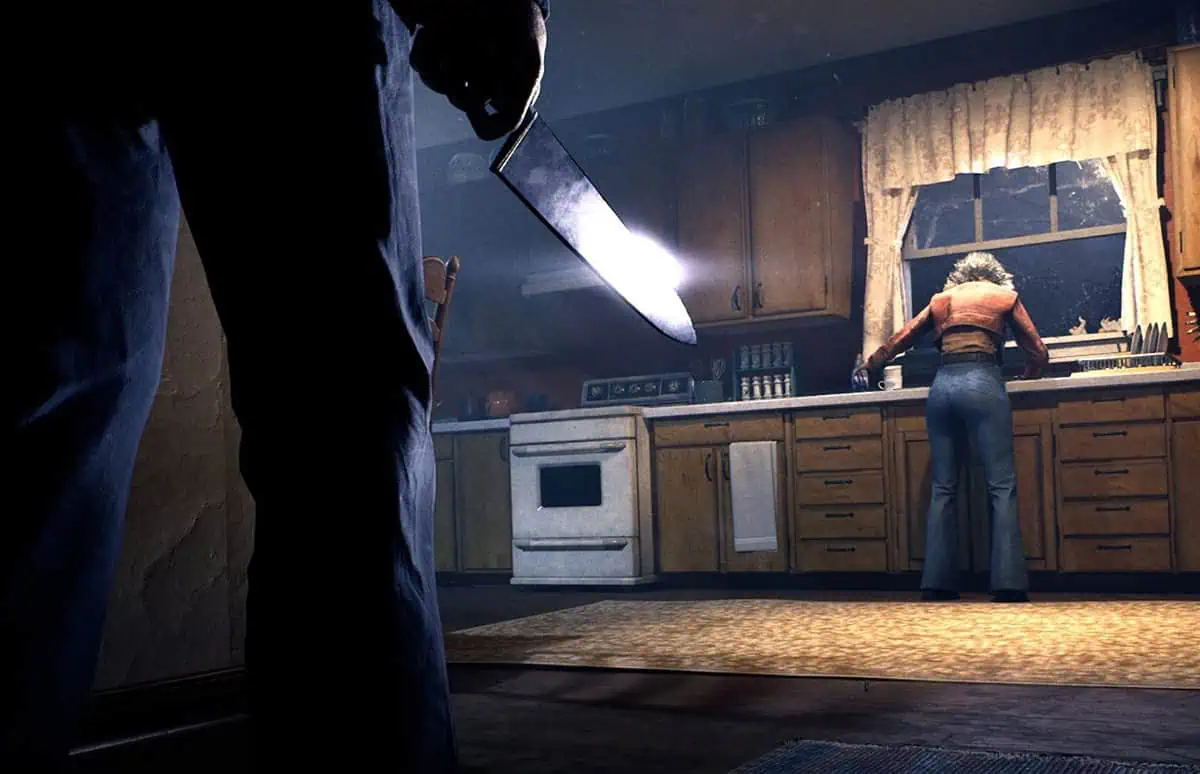
PLOT: On Halloween night, 1978, no one is safe from Michael Myers. Become the Boogeyman or fight back against the face of evil itself in Halloween.
REVIEW: Despite growing up on horror movies and playing games from across a wide spectrum since I was in Underoos, I’ve spent little time engaging with asymmetrical multiplayer titles, like Dead by Daylight, Evil Dead: The Game, and Predator: Hunting Grounds, to name a few. I’ve dabbled with several, but nowhere near long enough to get the hang of the rules and mechanics of their intense gameplay. When IllFonic announced Halloween: The Game, I saw it as a unique opportunity to dive headfirst into unfamiliar territory couched in a horror franchise I’ve loved for decades. While the vibes of the game are immaculate, aspects of the gameplay and online experience felt as if someone put old pennies, black licorice, and Circus Peanuts in my pillowcase of Halloween treats.
Halloween: The Game immediately establishes itself as a project determined to honor its source material in every way. Much of the game’s content is ripped from the time-honored horror film franchise, with IllFonic positively nailing the sights and sounds of Halloween‘s most iconic elements. To its credit, IllFonic doesn’t miss a beat while making players feel as if they’re participating in a Halloween movie, which is the most important ingredient to this interactive stew of survival and scares. If you turn off the lights, crank the volume, and zero in, there are moments when it feels as if you’ve been transported into Haddonfield.
In my experience during the game’s pre-release period, Halloween: The Game is divided into two parts: A single-player story campaign and a 1v4 Multiplayer Mode, where one player assumes the role of Michael Myers (The Boogeyman), while four players control Heroes of Haddonfield (civilians).
The Story Mode, while fun, is more of a glorified tutorial, with each chapter introducing Michael’s moveset, special abilities, and stalking techniques. There’s more depth to playing as Michael than you would assume, but in the build I played, the game did a poor job of letting me try the new abilities on for size before outside forces would interrupt my best-laid plans. To Illfonic’s credit, the studio pushed a few updates that improved the experience, such as making Michael faster (chasing down civilians early on was a huge pain in the ass), adding much-needed sound effects, and fine-tuning Myers’ otherworldly traversal. Still, aside from recreating iconic moments from John Carpenter’s original film, the Story Mode feels more instructional than anything else.
Multiplayer Mode serves as the heart of the game, letting you step into the boots of Michael Myers or play as one of four civilians desperate to survive the night. As Michael, your goal is to stalk through Haddonfield, systematically slaying teens, executing local police, and earning experience points for maximum rampage. Playing as Michael is a blast, cathartic, engaging, and deeply fun as you tap into his supernatural abilities to maneuver around traps, terrified locals, and escalating threats.
Illfonic offers Michael a wide variety of ways to take his victims off the board. You can kill them with your equipped weapon or bare hands, but the best way to take people off the board is to use one of the game’s many context kills, marked by red icons around the environment. Dragging a victim to these locations lets you perform a particularly gruesome execution, such as smashing someone’s head in with a refrigerator door, throwing them face-first into a blazing fireplace, or hanging them like a Halloween decoration on a nearby wall. These killings are violent, extreme, and rarely get old. When you’re playing as Michael, you feel like the masked killer that’s haunted so many for generations. In that way, Halloween: The Game succeeds and lives up to its namesake.
However, I found playing as the civilians not to be nearly as much fun. Unlike Michael, there’s no tutorial for playing as a civilian. As one of four teens trying to survive Michael’s onslaught, you make your way around the map, warning residents, calling the police, and searching for weapons and items to aid your escape. On paper, that sounds great, but in practice, I quickly grew tired of this portion of the game.
A quick caveat: pre-release matchmaking was tough, and my time playing with full lobbies was limited despite joining setup groups. While veteran asymmetrical players in my lobbies seemed to dig the underlying systems more than I did, my own time in civilian shoes left a lot to be desired. With that in mind, take my analysis of this portion of the game with a grain of salt. I could see others in the chat having a far better time than I was, and I trust their enthusiasm was warranted and genuine.
Still, dying as a civilian in Halloween: The Game is like getting served candy corn when what you really want is a mouthful of gummy bears. If you die early in a match, your only means of participating in the game is through a series of repetitive mini-games that age like a rotted Jack-O’-Lantern. When you finally complete enough of these tedious exercises, you earn the chance to select a card that boosts gameplay mechanics for your team. At least, I think they do. The game does such a poor job of explaining the civilian mechanics that I was never entirely sure what the cards were doing. I did come back as Dr. Samuel Loomis in one match, but aside from admiring his character model (he looks fantastic), he played just like any other civilian.
I could see a scenario where a lack of instruction on the civilians’ side paves the way for players to discover options and rule sets through community chatter, à la early Souls games. That said, organic discovery through trial and error just isn’t my preference. IllFonic may want an element of player-led discovery, but as someone relatively new to the asymmetrical genre with zero desire to open my voice chat to randoms, this approach misses the mark for me.
Overall, Halloween: The Game is a mixed bag of tricks and treats. I enjoyed playing as Michael a lot, and at $40, I could recommend the game to hardcore fans of the franchise, if only to feel like The Shape for a spell. With some polish and more instruction, I could see Halloween winning over the asymmetrical audience. As I’d said, people in my chat with more experience in this game genre were more positive than I, with many praising the game’s experience system and improvements to titles like The Texas Chainsaw Massacre and Friday the 13th: The Game. Take that for what you will. I’m excited to check the game out again after its official launch, when I can hopefully find more people to explore the portions of the game where I felt it was lacking.
The post Halloween: The Game (Video Game) Review: A Killer Vibe Trapped in a Mixed Bag of Tricks and Treats appeared first on JoBlo.